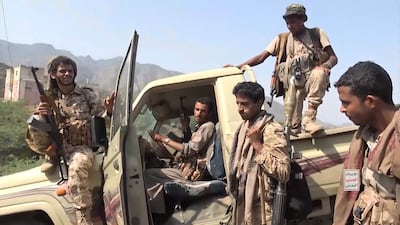
Yemen's Iran-backed Houthi fighters suffered heavy losses of personnel and equipment in clashes with government forces on several fronts in the southern province of Taiz on Sunday, state television reported.
Fighting was concentrated around the Air Defence site west of Taiz city and in several areas of Jabal Habashi district. The clashes ended with Houthi forces retreating, according to reports citing military sources.
The rebels are trying to make further gains after seizing the entire western coastline and key islands this week, which tightens their control over maritime traffic through the Bab Al Mandeb strait and the Red Sea.

State TV said Yemeni government fighter jets carried out strikes targeting Houthi reinforcements, military vehicles and armoured units along Al Sitteen Road north of Taiz, as well as the rebels' positions, barracks and vehicles in Al Rabiei, Hayfan, Al Kadha, Mokha and Al Ahkoum.
Meanwhile, Houthi forces shelled the Al Qasr crossing and residential areas east of Taiz city with heavy and medium weapons, the report said.
The fighting has added to Yemen's humanitarian crisis after 12 years of war, with nearly 86,000 more people displaced so far, including more than 82,000 this month alone, according to the International Organisation for Migration (IOM).
More than 2,000 people have fled to Djibouti, landing at various points along the coast near Obock, including many women and young children. "People are crossing the sea with nothing because they have no other choice left," IOM director general Amy Pope said.
The Houthis also continue to target Saudi ships and oil facilities with drones and missiles, adding to the disruption in global energy supplies caused by the Iran war, as well as military bases. Houthi military spokesman Yahya Saree said the rebels hit weapons depots and command-and-control centres at a base in Sharurah near the border. Saudi authorities did not immediately comment on the claim.
Saudi Arabia, which supports Yemen's internationally recognised government, on Friday announced the closure of its East-West oil pipeline after an attack blamed on Iran-aligned groups in Iraq. The pipeline became its main conduit for exports after Iran blockaded the Strait of Hormuz following the start of the Iran war.
Vessel traffic through the Strait of Hormuz and Bab Al Mandeb thinned further last week amid the escalation in tensions.
An average of 14 vessels a day crossed Hormuz in the week to September 12, down from 16 the previous week and 95 a day in February, the last full month before the war, according to ship-tracking data from Kpler.
Crossings at Bab Al Mandeb averaged 26 a day, down from 28, and fell to 23 in the three days after Houthi fighters seized the Red Sea port of Mokha and nearby islands on Thursday. Laden tankers carried about 5.2 million barrels a day through Bab Al Mandeb last week, down from 8.8 million in June.
Oil prices surged last week, rising above $100 a barrel for the first time since July. Brent, the benchmark for two-thirds of the world's oil, settled 2.81 per cent lower at $104.6 a barrel on Friday, while West Texas Intermediate, the gauge that tracks US crude, was down 2.37 per cent to close at $100 per barrel.
Saudi Arabia might only have enough oil stored at its Yanbu port to maintain exports for five to seven days if the pipeline remains shut, Reuters reported, citing traders and buyers. If that happens, as much as 4 per cent of global oil supply could be affected, it added.
Saudi Arabia has not revealed details about the extent of damage.
Iran plans to formally unveil an agreement with Oman on a temporary shipping lane through the Strait of Hormuz on Monday, after a flurry of diplomatic activity.
The announcement will be made in the southern Omani city of Salalah at which representatives of Gulf states and Iraq will also be present, a source told Iran's Tasnim news agency. However, the strait will not reopen unless the US meets seven conditions set by Iran, it said.
Oman has not officially announced the meeting, and other Gulf countries have remained silent about their participation. Bahrain said on Saturday it would not attend meetings with Iran.
The Houthi advance is creating a new strategic challenge for the US, as Washington weighs how to protect freedom of navigation without becoming directly involved in another major campaign in Yemen. The US has been providing Saudi Arabia with intelligence support but has so far resisted direct military intervention against the Houthis, Reuters reported.
US President Donald Trump said on Saturday that Iran was probably behind an attack on the kingdom's East-West oil pipeline, while saying the Houthis did not want a confrontation with the US.
He added that he was confident the situation would be resolved, pointing to his relationship with Saudi Crown Prince Mohammed bin Salman. Asked about the Houthis, he said the rebels "don't want to fight with us".
Iraq’s government said an investigation had determined that attacks targeting Saudi Arabia had been launched from a site in Maysan province. Prime Minister Ali Al Zaidi ordered an investigation into the military command responsible for the area and dismissed its commander. Saudi Arabia said it would give Baghdad an opportunity to take action rather than immediately respond.

