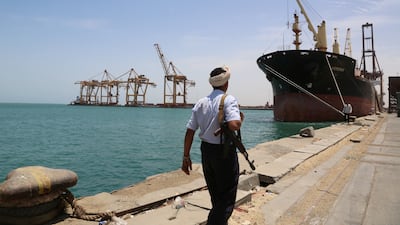

The Houthi seizure of Mokha is more than just another setback for Yemen’s internationally recognised government.
The historic Red Sea port gives the Iran-backed militia a strategically important position about 75km from the Bab Al Mandeb strait.
The Houthis first captured Mokha in November 2014 during a southern offensive months after they overran the capital, Sanaa. They used the port to move weapons towards their northern strongholds until a Saudi-led military coalition drove them out in January 2017.

Prized hub
For centuries, Mokha was one of the world's best-known coffee trading centres, exporting Yemeni beans to markets from the Middle East to Europe. Its name became synonymous with coffee.
Today, however, Mokha is a prized coastal logistics hub, the location of which is more important than the capacity of its port. It handles general cargo but is far less than Yemen's main Red Sea port, Hodeidah.
Crucial route
Bab Al Mandeb – the "Gate of Tears", named for its perilous navigation conditions – is the southern outlet of the Red Sea, separating Yemen from Djibouti and Eritrea. It is a crucial route for crude oil and fuel from the Gulf heading towards the Mediterranean through the Suez Canal or the Sumed pipeline.

The strait remains outside direct Houthi control, but holding Mokha gives the rebels a stronger position and removes a major logistics and operating base for their foes in the south. About 12 per cent of global trade has historically passed through the narrow waterway.
War context
The immediate concern is Dhubab, an area further south and much closer to Bab Al Mandeb. The Houthis are reported to be advancing towards it today.
That makes Mokha more significant in the context of the Iran war. With the Strait of Hormuz already severely constrained, Bab Al Mandeb has become even more important for trade and energy moving between the Gulf, Indian Ocean, Red Sea and Suez Canal.
Territorial gain
Mokha does not give the Houthis control of international shipping, and its port is not large enough to transform their maritime capabilities on its own. Its importance is mainly in its geography.
If the capture holds, it would arguably be the most significant tangible territorial gain for Iran's proxies since the war began on February 28, and one of the Houthis' biggest strategic gains since a 2022 truce.
The main question now is whether Mokha is an isolated victory or the beginning of a Houthi push towards Dhubab and Bab Al Mandeb. If it is the latter, the capture could have implications well beyond the fighting in Yemen, adding another threat to an already disrupted global shipping route.

