Hundreds of Palestinian detainees released on Monday after being held for nearly two years in Israeli prisons have not returned to the Gaza they remember, but to a land of ash, rubble and ghosts.
The joy and relief at being freed under the ceasefire deal between Hamas and Israel were tempered by the shock of seeing the devastation caused by Israel's war on the enclave. For many, there was also grief as they learnt that loved ones they had dreamt of seeing again had been killed in the conflict.
Abdullah Farhan, who is from the southern city of Khan Younis where the former detainees were taken by bus, said he was shocked by the scale of destruction after crossing the border from Israel. “Gaza has turned into rubble, in every sense of the word,” he told The National. “This is not the Gaza I left. This is a ghost city.”

He said he had been isolated from the outside world for most of his 20 months in Israeli custody. “We didn’t know anything about what was happening in Gaza – no news, no voices, nothing,” he added.
After being released, he discovered that many of his friends, relatives and neighbours were dead, including his uncle and closest friend, Mohammed. “He was like my brother,” he said. “We did everything together.”
Mr Farhan said there was no reason for Israeli forces to arrest him as he accompanied a relative to Nasser Hospital in Khan Younis. “I have never been part of any faction, nor carried out any resistance activity."
He said he was beaten, verbally abused and humiliated in prison. He was also taken before the relatives of Gaza hostages, who were allowed to shout and curse at the detainees.

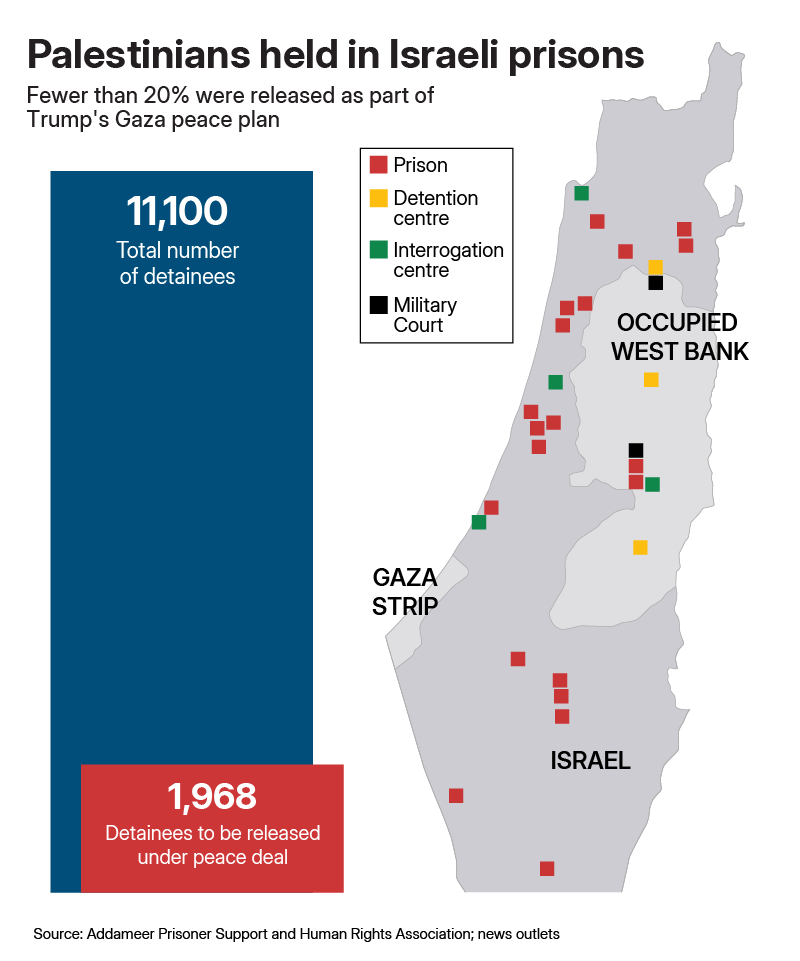
Many of the 1,718 Palestinians released in Gaza were in poor health. They underwent check-ups at the hospital, before reuniting with their families.
Dr Ahmed Mohanna, who was director of Al Awda Hospital in northern Gaza when Israeli forces arrested him nearly two years ago, said he was overjoyed to be reunited with his mother.
"She is my entire life and the source of my happiness,” Dr Mohanna said as his mother stood beside him, tears streaming down her face. “Every day in prison, I thought of her. I waited for the moment I could embrace her again. Every minute without my family was torture.”
There was no joyful reunion for Haitham Salem, who was detained in northern Gaza in October last year. Just a month before his release, his wife Ikhlas and his three children – Iman, Lian and Bara – were killed when an Israeli air strike hit their tent in Al Mawasi, the so-called humanitarian zone in Khan Younis. “It’s something the mind cannot comprehend,” he said.
He said he had been counting the days until Lian's birthday on October 18. “I had made her a bracelet in prison. I dreamt of giving it to her myself," he added.
Freedom now felt like a punishment, he said. “When I heard the news, my freedom lost all meaning. I wish I had never left prison, so I wouldn’t have known," he said.
“They were just children. Why were they killed? Because Israel loves blood and death. They want to destroy us completely. I will never forgive them – not for this crime, not for this war.”