

Al Jazeera reporter Anas Al Sharif, father of two, brought the world to tears last month when he broke down on air while reporting on starvation in Gaza caused by Israel's blockade.
“Keep going Anas, you are our voice,” one bystander could be heard telling the journalist. Now the 'voice of Gaza' has been silenced forever.
The prominent correspondent was killed on Sunday night in an Israeli air strike attacking a tent housing the Al Jazeera crew near Al Shifa Hospital in Gaza city. The network's correspondent Mohammed Qreiqeh and camera operators Ibrahim Zaher, Mohammed Noufal and Moamen Aliwa were also killed in the attack, as well as a sixth journalist and another person.
In a statement, Al Jazeera condemned the killings as “yet another blatant and premeditated attack on press freedom”, calling Al Sharif, 28, “one of Gaza's bravest journalists”. The network said the attack was a “desperate attempt to silence voices in anticipation of the occupation of Gaza”.
Al Sharif’s fearless frontline coverage for Al Jazeera Arabic made him one of the most recognised and followed reporters in Gaza. He was described as the ‘voice of Gaza’ by the media network.
The journalist and videographer was born and raised in Jabalia refugee camp in northern Gaza, which had come under intense Israeli attacks since October 2023.
Al Sharif graduated from the media faculty at Al Aqsa University in Gaza city with a degree in mass communication, specialising in radio and television.
Throughout his career, he received the Best Young Journalist Award in Palestine in 2018 for his reporting on Gaza. Last year, he was awarded Amnesty International Australia’s Human Rights Defender Award to “honour his extraordinary resilience, bravery, and commitment to press freedom while working in the most dangerous conditions”.
-
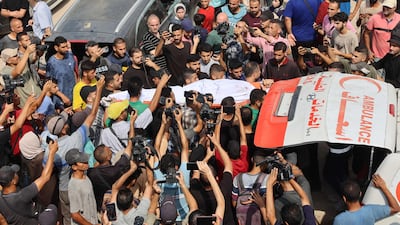
Mourners carry the body of Palestinian reporter Anas Al Sharif, who was killed alongside other journalists in an overnight Israeli strike on their tent, during his funeral in Gaza city. AFP -
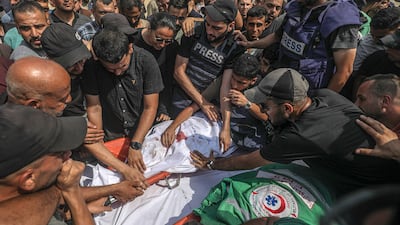
Mourners attend the funeral of journalists Anas Al Sharif, Mohammed Qreiqeh, Ibrahim Zaher, Moamen Aliwa and Mohammed Noufal. EPA -
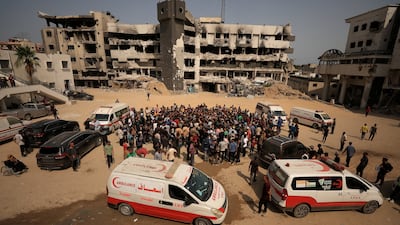
Mourners attend the funeral of Al Jazeera journalists outside Al Shifa Hospital. Reuters -
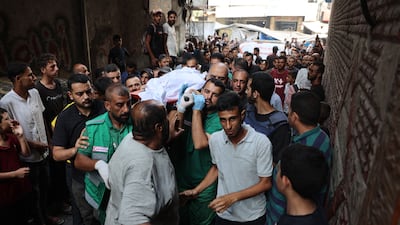
The Israeli army claimed that Mr Al Sharif was a 'Hamas leader' posing as an Al Jazeera journalist. The network and journalists' groups have denied the accusations. AFP -
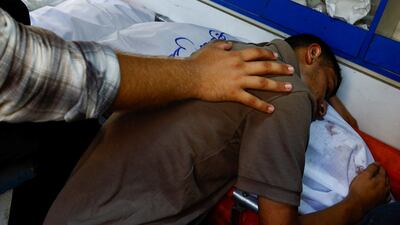
A Palestinian man reacts over the body of Mr Al Sharif. Reuters -
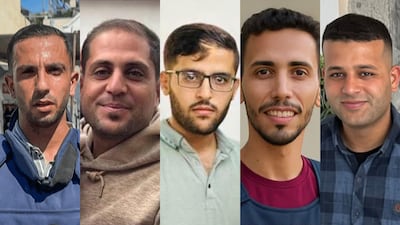
From left, Anas Al Sharif, Mohammed Qreiqeh, Ibrahim Zaher, Moamen Aliwa and Mohammed Noufal. Photo: Al Jazeera -

A Palestinian man speaks to members of the media at the site of an Israeli strike on a tent near Shifa Hospital where the Al Jazeera journalists were killed, in Gaza city. Reuters -
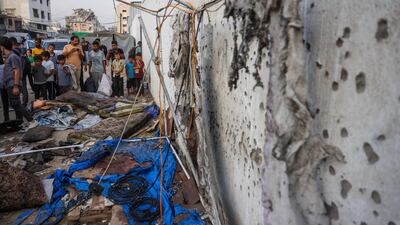
Palestinians check the destroyed Al Jazeera tent at Al Shifa Hospital in Gaza city after an overnight strike by the Israeli army. AFP -
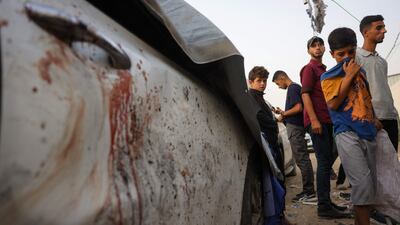
Palestinians check the destroyed Al Jazeera tent and a car at Al Shifa Hospital. AFP


Al Sharif leaves behind a wife and two children, whom he barely saw throughout his coverage during the war. His father was killed by an Israeli strike on their family home in Jabalia in December 2023.
Last month, the Committee to Protect Journalists (CPJ) raised concerns about Al Sharif’s safety.
“We are deeply alarmed by the repeated threats made by Israeli army spokesperson Avichay Adraee against Al Jazeera’s Gaza correspondent Anas Al-Sharif and call on the international community to protect him,” said CPJ regional director Sara Qudah. “This is not the first time Al Sharif has been targeted by the Israeli military, but the danger to his life is now acute.”
In a statement admitting to the deliberate killing of the journalists, Israel’s military accused Al Sharif of being affiliated with Hamas. Israel had increased accusations and threats against him since the journalist cried on air while reporting on starvation in Gaza, said CPJ.
Al Jazeera, CPJ and rights groups have all dismissed Israel’s claims as unfounded.
Al Sharif's colleague, Mohammed Qreiqa, was also killed in Israel's Sunday strike. The pair had been working together since August last year, when Al Sharif welcomed Qreiqa to the Al Jazeera team in Gaza city in a post on X.
Qreiqa, 32, was from the Al Shujaia neighbourhood in eastern Gaza city. The news correspondent was the only son to his mother, who was killed in an Israeli attack in March last year. Israel also killed his brother, Karim, in March in an air attack on Gaza city.
He leaves behind a wife and two children. In early 2025, Al Sharif had filmed the reunion of Qraiqea with his kids after 15 months of separation due to Israel's war.
Al Jazeera cameraman Ibrahim Zaher, 25, was from Jabalia refugee camp in northern Gaza.
Mohammed Noufal, 29, was also from Jabalia. He lost his mother and one brother in earlier Israeli attacks. His other brother, Ibrahim, also works as a cameraman for Al Jazeera.
The sixth journalist, Mohammad Al Khaldi, was described as a Youtube news content creator by Reporters Without Borders.
Media workers in Gaza have been working relentlessly under dire conditions. A statement by Amnesty International said journalists in Gaza “endure relentless bombardment, displacement, and the use of starvation as a weapon of war” to report from the war-torn strip, where international journalists are banned from entry.
Despite threats to his life, Al Sharif said he would continue to report from the north, which has been under Israeli siege for months.
Moments before his death, Al Sharif shared a video to X, where loud Israeli bombing can be heard in the background. “Non stop bombing … For the past two hours, Israeli aggression on Gaza city has intensified,” he wrote on the social media platform.
His death was confirmed in a statement posted to his social media platforms as his “will and final message” to the world.
“If you're reading these words, know that Israel has succeeded in killing me and silencing my voice,” read Al Sharif's statement.
“I have lived through pain in all its details, tasted suffering and loss many times, yet I never once hesitated to convey the truth as it is, without distortion or falsification, so Allah may bear witness against those who stayed silent, those who accepted our killing, those who choked our breath, and whose hearts were unmoved by the scattered remains of our children and women, doing nothing to stop the massacre that our people have faced for more than a year and a half,” he continued.
“I entrust you with Palestine … its people … its oppressed children … the apple of my eye, my daughter … my dear son … my beloved mother … my lifelong partner, my wife … I urge you to be their support … and don't forget about Gaza,” he wrote in the haunting message.
Al Jazeera said Al Sharif and his colleagues were among the “last remaining voices in Gaza conveying the tragic reality to the world”. On Monday, hundreds of mourners gathered to bid farewell to the reporters. Their bodies were taken from Al Shifa Hospital to their houses and then to Sheikh Radwan cemetery in Gaza city for their burial.
At least 186 journalists have been killed by Israel in Gaza, according to CPJ.

