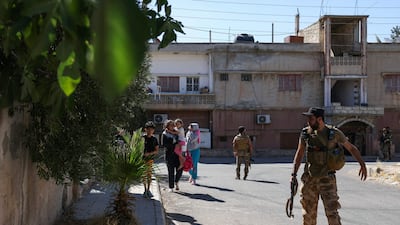
Ramzi has witnessed horrors throughout his career as a doctor during Syria’s 13-year civil war. But few compare, he said, to the scenes he witnessed this week at the main hospital in Sweida, a Druze-majority town where bloody sectarian violence raged for days.
“I saw at least 200 bodies at the hospital, many of them civilians,” he recalled.
Videos purportedly filmed inside the hospital show bloodstained corridors and rooms strewn with bodies, many soaked in blood and piled on top of each other.
The National spoke with six Druze civilians from Sweida who described four days of intense fear as fighting spread through their city, confining them to their homes amid heavy shelling without water and electricity. Their names have been changed to protect their identities.
Some recounted seeing neighbours killed after stepping outside; others said they recognised the bodies of loved ones in videos circulating online.
“I’ve only seen similar scenes the day ISIS attacked Sweida province,” Ramzi said, referring to a surprise attack by members of ISIS in 2018 that killed more than 200 people. A minority sect that follows a religion derived from Islam, the Druze are considered heretics by some extremist Sunni militant groups.
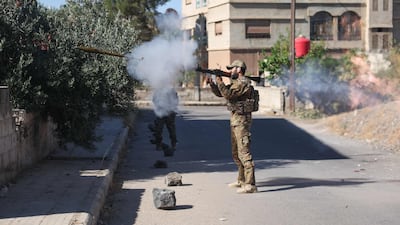
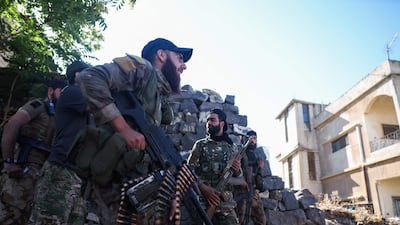
Clashes erupted on Sunday in Sweida, in southern Syria, before a retaliatory exchange between armed Bedouin and Druze factions, two long-standing rivals, quickly escalated into widespread violence as Syrian troops were sent to the area to quell the unrest.
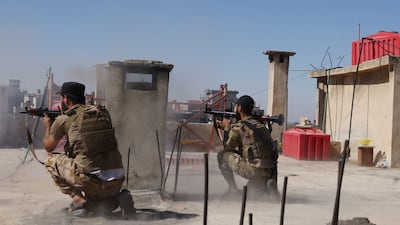
Druze factions, which deeply distrust the government, mobilised to repel its troops.
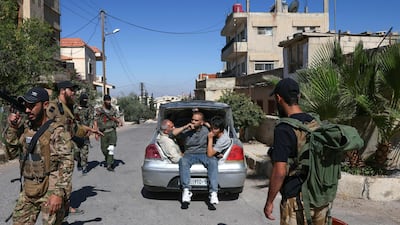
In hours, the fighting turned into bloodshed, with many breaches reported against civilians. As videos were posted on social media, reports emerged of government-affiliated troops abusing and humiliating Druze people, as well as looting and burning their homes.
The UN Commission of Inquiry on Syria has said it is “deeply alarmed” by the violence in Sweida, quoting reports from local residents of “killings, abductions, burning of properties and looting, as well as an increase in incitement and hate speech online and in person”.
The Syrian Network for Human Rights (SNHR), a war monitor, says at least than 254 people have been killed, including civilians and fighters from both sides, as well as members of the security forces, amid “extrajudicial killings, mutual shelling, as well as air strikes carried out by Israeli forces”. Israel joined the fighting by launching dozens of strikes across Syria, claiming to be defending the Druze minority.
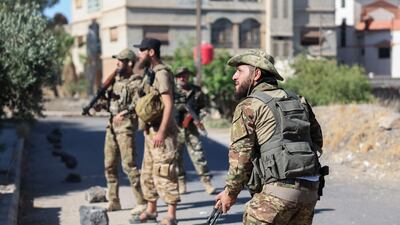
The reported breaches against civilians come as Syria’s new government, led by an Islamist faction once affiliated with Al Qaeda, struggles to assert authority over myriad armed groups, despite calls to bring all factions under the command of the Ministry of Defence.
For Rahaf al Doughli, a professor of Middle East and North African Studies at Lancaster University, the violence reflected a lack of control by Syria’s President Ahmad Al Shara over the patchwork of factions operating in Syria, despite promises of unification.
“It was a major mistake to launch an attack on Sweida using the same military groups that have yet to undergo proper training or discipline,” she said.
The fighting lasted for four days until Syrian authorities announced on Wednesday an “immediate and complete halt” to their offensive, following a deal with some, but not all, representatives of the Druze community.
Mr Al Shara said on Thursday that the government was “keen on holding accountable those who transgressed and abused our Druze people”.
Residents said they believed Syria's General Security was involved in the violence against them, but were unable to identify the killers amid the chaos.
The National was not able to independently verify which factions or groups were responsible for the reported violations against locals.
Interviews were frequently interrupted by the sound of explosions, even hours after the ceasefire was agreed.
Hospital under siege
Ramzi said he left Sweida Hospital on Tuesday to rest and was unable to return, as all roads were closed amid indiscriminate shelling.
“Authorities should have secured a safe corridor to the hospital so that at least the wounded could be treated,” he said.
He added that the hospital remained under siege for days, without medical supplies, electricity, or water. “Roads to the hospital were cut, water and electricity were shut off, the wounded had no chance of being saved,” he said.
According to Ramzi, at least two doctors were killed by snipers, one while attempting to reach the centre, the other in a car alongside her son. He said he later saw the boy’s body among the dead inside the hospital.
SNHR documented the killing of children, women and medical workers in the violence.
'What did they do?'
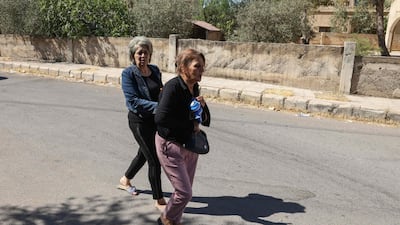
Many Sweida residents were trapped in their homes for days without water or electricity, surrounded by shelling and gunfire. Venturing outside came at the risk of death.
Timour, a resident from Abou Hayan Nabwan in the centre of Sweida, said his neighbour, a retired engineer, was shot dead by a sniper as he stepped outside. “He was trying to get to his village, hoping to escape,” he said.
“I wanted to run out and help him, but it was too dangerous. I saw his body from the window. From what I could see, there was no way he could have survived,” he added.
Baha, another Sweida resident, said he had no news from his family for hours - as he was sheltering in a calmer part of the city with poor internet connections - until he saw a video online in which he recognised a cousin with his son, their lifeless bodies lying on the ground in front of their home in the Sawat Blat neighbourhood. “What did they do?” he lamented.
In the video, seen by The National, a man is heard saying: “This is inside the city of Sweida. Praise be to God. These are your dogs, Hijri.
"This is what happens to anyone who turns against the state,” he added, as he drove past two bodies in civilian clothes, which Baha said were his relatives.
The man was referring to Sheikh Hikmat Al Hijri, one of the main Druze spiritual leaders, who has openly opposed Syria’s new leadership in Damascus.
“Liberation has been achieved through the determination and will of Syria’s honourable sons,” the voice continued.
Baha said both his cousin and his cousin’s son were civilians. The father was in his fifties, the son just 20. The family owned a small poultry business, he said, and had no connection to Sheikh Al Hijri and his armed group.
Videos circulating widely on social media appear to show graphic scenes of violence, though The National was unable to independently verify their origin.
In one video, masked gunmen are seen shooting at a group of unarmed men seated in a line near a roundabout. The National could verify the location as Tishreen Square in central Sweida but was unable to identify the victims and perpetrators.
Another video shows at least 10 bodies lying in pools of blood inside a traditional Druze living room. Several residents told The National the victims were members of a prominent local family, the Radwans. One said he recognised the family’s salon.
Residents also said that indiscriminate shelling has destroyed civilian houses. Tamara, another Sweida resident, said her parents' house was heavily damaged in a shelling on Wednesday, though her parents were not harmed.
Other reported abuses included scenes of humiliation. Fawzi, a taxi driver in his thirties who had been confined to his home amid the gunfire and shelling, heard men chanting outside “Druze pigs!"
Videos circulating online also showed armed men forcibly shaving the moustaches of Druze men, a symbol of masculinity in their culture.
On Thursday morning, as the situation began to calm, Ramzi left for a quieter area in Sweida. He shared a video with The National showing the aftermath of the fighting. Charred cars lined the road, and most shopfronts had their glass shattered, the debris scattered across the ground.
On Thursday evening, he said the city remained sealed off.
Ms Al Doughli said the latest violence echoes what happened in the coastal area in March, when hundreds of unarmed Alawites were killed in a spree of sectarian killings by factions nominally affiliated with the government and by armed civilians, according to war monitors.
The announcement, after the fall of the Assad regime, of the integration of all armed factions was more of an “accessory process” than an institutionalised one, she said.
“We saw the first impact of this in the violations that happened along the coast,” she added.
“What comes after Sweida is unlike anything before it. We are approaching a very critical juncture in Syria’s future. The prospect of Syria’s division might be more looming than ever,” she warned.
The cycle of violence continued in Sweida just hours after the ceasefire. On Thursday afternoon, Druze militias carried out revenge attacks on Bedouin families. No casualties were immediately reported.
The Syrian state news agency, Sana, reported what it called "massacres" from "outlaw groups" against Bedouin tribes in the Al Maqous neighbourhood, the area where clashes had initially erupted, forcing many residents to flee.

Ten tax points to be aware of in 2026
1. Domestic VAT refund amendments: request your refund within five years
If a business does not apply for the refund on time, they lose their credit.
2. E-invoicing in the UAE
Businesses should continue preparing for the implementation of e-invoicing in the UAE, with 2026 a preparation and transition period ahead of phased mandatory adoption.
3. More tax audits
Tax authorities are increasingly using data already available across multiple filings to identify audit risks.
4. More beneficial VAT and excise tax penalty regime
Tax disputes are expected to become more frequent and more structured, with clearer administrative objection and appeal processes. The UAE has adopted a new penalty regime for VAT and excise disputes, which now mirrors the penalty regime for corporate tax.
5. Greater emphasis on statutory audit
There is a greater need for the accuracy of financial statements. The International Financial Reporting Standards standards need to be strictly adhered to and, as a result, the quality of the audits will need to increase.
6. Further transfer pricing enforcement
Transfer pricing enforcement, which refers to the practice of establishing prices for internal transactions between related entities, is expected to broaden in scope. The UAE will shortly open the possibility to negotiate advance pricing agreements, or essentially rulings for transfer pricing purposes.
7. Limited time periods for audits
Recent amendments also introduce a default five-year limitation period for tax audits and assessments, subject to specific statutory exceptions. While the standard audit and assessment period is five years, this may be extended to up to 15 years in cases involving fraud or tax evasion.
8. Pillar 2 implementation
Many multinational groups will begin to feel the practical effect of the Domestic Minimum Top-Up Tax (DMTT), the UAE's implementation of the OECD’s global minimum tax under Pillar 2. While the rules apply for financial years starting on or after January 1, 2025, it is 2026 that marks the transition to an operational phase.
9. Reduced compliance obligations for imported goods and services
Businesses that apply the reverse-charge mechanism for VAT purposes in the UAE may benefit from reduced compliance obligations.
10. Substance and CbC reporting focus
Tax authorities are expected to continue strengthening the enforcement of economic substance and Country-by-Country (CbC) reporting frameworks. In the UAE, these regimes are increasingly being used as risk-assessment tools, providing tax authorities with a comprehensive view of multinational groups’ global footprints and enabling them to assess whether profits are aligned with real economic activity.
Contributed by Thomas Vanhee and Hend Rashwan, Aurifer
ABU%20DHABI%20CARD
%3Cp%3E%3Cstrong%3E5pm%3A%20%3C%2Fstrong%3EWathba%20Stallions%20Cup%20%E2%80%93%20Handicap%20(PA)%20Dh70%2C000%20(Turf)%202%2C200m%0D%3Cbr%3E%3Cstrong%3E5.30pm%3C%2Fstrong%3E%3A%20Rub%20Al%20Khali%20%E2%80%93%20Maiden%20(PA)%20Dh80%2C000%20(T)%201%2C400m%0D%3Cbr%3E%3Cstrong%3E6pm%3A%20%3C%2Fstrong%3EAl%20Marmoom%20Desert%20%E2%80%93%20Maiden%20(PA)%20Dh80%2C000%20(T)%201%2C600m%0D%3Cbr%3E%3Cstrong%3E6.30pm%3A%20%3C%2Fstrong%3ELiwa%20Oasis%20%E2%80%93%20Handicap%20(PA)%20Dh80%2C000%20(T)%201%2C400m%0D%3Cbr%3E%3Cstrong%3E7pm%3A%20%3C%2Fstrong%3EAl%20Khatim%20Desert%20%E2%80%93%20Handicap%20(PA)%20Dh80%2C000%20(T)%201%2C600m%0D%3Cbr%3E%3Cstrong%3E7.30pm%3A%3C%2Fstrong%3E%20Al%20Quadra%20Desert%20%E2%80%93%20Handicap%20(TB)%20Dh80%2C000%20(T)%201%2C600m%3C%2Fp%3E%0A
Classification of skills
A worker is categorised as skilled by the MOHRE based on nine levels given in the International Standard Classification of Occupations (ISCO) issued by the International Labour Organisation.
A skilled worker would be someone at a professional level (levels 1 – 5) which includes managers, professionals, technicians and associate professionals, clerical support workers, and service and sales workers.
The worker must also have an attested educational certificate higher than secondary or an equivalent certification, and earn a monthly salary of at least Dh4,000.
Mercer, the investment consulting arm of US services company Marsh & McLennan, expects its wealth division to at least double its assets under management (AUM) in the Middle East as wealth in the region continues to grow despite economic headwinds, a company official said.
Mercer Wealth, which globally has $160 billion in AUM, plans to boost its AUM in the region to $2-$3bn in the next 2-3 years from the present $1bn, said Yasir AbuShaban, a Dubai-based principal with Mercer Wealth.
“Within the next two to three years, we are looking at reaching $2 to $3 billion as a conservative estimate and we do see an opportunity to do so,” said Mr AbuShaban.
Mercer does not directly make investments, but allocates clients’ money they have discretion to, to professional asset managers. They also provide advice to clients.
“We have buying power. We can negotiate on their (client’s) behalf with asset managers to provide them lower fees than they otherwise would have to get on their own,” he added.
Mercer Wealth’s clients include sovereign wealth funds, family offices, and insurance companies among others.
From its office in Dubai, Mercer also looks after Africa, India and Turkey, where they also see opportunity for growth.
Wealth creation in Middle East and Africa (MEA) grew 8.5 per cent to $8.1 trillion last year from $7.5tn in 2015, higher than last year’s global average of 6 per cent and the second-highest growth in a region after Asia-Pacific which grew 9.9 per cent, according to consultancy Boston Consulting Group (BCG). In the region, where wealth grew just 1.9 per cent in 2015 compared with 2014, a pickup in oil prices has helped in wealth generation.
BCG is forecasting MEA wealth will rise to $12tn by 2021, growing at an annual average of 8 per cent.
Drivers of wealth generation in the region will be split evenly between new wealth creation and growth of performance of existing assets, according to BCG.
Another general trend in the region is clients’ looking for a comprehensive approach to investing, according to Mr AbuShaban.
“Institutional investors or some of the families are seeing a slowdown in the available capital they have to invest and in that sense they are looking at optimizing the way they manage their portfolios and making sure they are not investing haphazardly and different parts of their investment are working together,” said Mr AbuShaban.
Some clients also have a higher appetite for risk, given the low interest-rate environment that does not provide enough yield for some institutional investors. These clients are keen to invest in illiquid assets, such as private equity and infrastructure.
“What we have seen is a desire for higher returns in what has been a low-return environment specifically in various fixed income or bonds,” he said.
“In this environment, we have seen a de facto increase in the risk that clients are taking in things like illiquid investments, private equity investments, infrastructure and private debt, those kind of investments were higher illiquidity results in incrementally higher returns.”
The Abu Dhabi Investment Authority, one of the largest sovereign wealth funds, said in its 2016 report that has gradually increased its exposure in direct private equity and private credit transactions, mainly in Asian markets and especially in China and India. The authority’s private equity department focused on structured equities owing to “their defensive characteristics.”
Call of Duty: Black Ops 6
Developer: Treyarch, Raven Software
Publisher: Activision
Console: PlayStation 4 & 5, Windows, Xbox One & Series X/S
Rating: 3.5/5
The biogs
Name: Zinah Madi
Occupation: Co-founder of Dots and links
Nationality: Syrian
Family: Married, Mother of Tala, 18, Sharif, 14, Kareem, 2
Favourite Quote: “There is only one way to succeed in anything, and that is to give it everything.”
Name: Razan Nabulsi
Occupation: Co-founder of Dots and Links
Nationality: Jordanian
Family: Married, Mother of Yahya, 3.5
Favourite Quote: A Chinese proverb that says: “Be not afraid of moving slowly, be afraid only of standing still.”
UAE gold medallists:
Omar Al Suweidi (46kg), Khaled Al Shehhi (50kg), Khalifa Humaid Al Kaabi (60kg), Omar Al Fadhli (62kg), Mohammed Ali Al Suweidi (66kg), Omar Ahmed Al Hosani (73), all in the U18’s, and Khalid Eskandar Al Blooshi (56kg) in the U21s.
More from Rashmee Roshan Lall
Biog
Mr Kandhari is legally authorised to conduct marriages in the gurdwara
He has officiated weddings of Sikhs and people of different faiths from Malaysia, Sri Lanka, Russia, the US and Canada
Father of two sons, grandfather of six
Plays golf once a week
Enjoys trying new holiday destinations with his wife and family
Walks for an hour every morning
Completed a Bachelor of Commerce degree in Loyola College, Chennai, India
2019 is a milestone because he completes 50 years in business
CHATGPT%20ENTERPRISE%20FEATURES
%3Cp%3E%E2%80%A2%20Enterprise-grade%20security%20and%20privacy%3C%2Fp%3E%0A%3Cp%3E%E2%80%A2%20Unlimited%20higher-speed%20GPT-4%20access%20with%20no%20caps%3C%2Fp%3E%0A%3Cp%3E%E2%80%A2%20Longer%20context%20windows%20for%20processing%20longer%20inputs%3C%2Fp%3E%0A%3Cp%3E%E2%80%A2%20Advanced%20data%20analysis%20capabilities%3C%2Fp%3E%0A%3Cp%3E%E2%80%A2%20Customisation%20options%3C%2Fp%3E%0A%3Cp%3E%E2%80%A2%20Shareable%20chat%20templates%20that%20companies%20can%20use%20to%20collaborate%20and%20build%20common%20workflows%3C%2Fp%3E%0A%3Cp%3E%E2%80%A2%20Analytics%20dashboard%20for%20usage%20insights%3C%2Fp%3E%0A%3Cp%3E%E2%80%A2%20Free%20credits%20to%20use%20OpenAI%20APIs%20to%20extend%20OpenAI%20into%20a%20fully-custom%20solution%20for%20enterprises%3C%2Fp%3E%0A
Benefits of first-time home buyers' scheme
- Priority access to new homes from participating developers
- Discounts on sales price of off-plan units
- Flexible payment plans from developers
- Mortgages with better interest rates, faster approval times and reduced fees
- DLD registration fee can be paid through banks or credit cards at zero interest rates
Dubai Bling season three
Cast: Loujain Adada, Zeina Khoury, Farhana Bodi, Ebraheem Al Samadi, Mona Kattan, and couples Safa & Fahad Siddiqui and DJ Bliss & Danya Mohammed
Rating: 1/5
RESULTS
Argentina 4 Haiti 0
Peru 2 Scotland 0
Panama 0 Northern Ireland 0