Israel rules out political solution as strike on Beirut kills Hezbollah commanders


  • English
  • Arabic

Live updates: Follow the latest on Israel-Gaza

The conflict between Israel and Hezbollah reached unprecedented levels on Friday after Israel killed senior Hezbollah commanders in Beirut, saying no political solution could solve tensions on its northern border and military pressure on the group must be stepped up.

An Israeli official told The National that Israel was taking a new approach towards Hezbollah, the clearest sign yet that after 11 months of fighting the two sides are on the brink of a full-scale war.

The change paves the way for more intense Israeli military action in Lebanon, following a week of aggressive attacks including intensifying its bombing campaign, assassinating senior Hezbollah leaders and allegedly detonating communication devices belonging to Hezbollah members, killing dozens and injuring thousands, including civilians.

The latest Israeli attack killed senior Hezbollah commander Ibrahim Aqil along with at least 45 people on Friday. The strike, which destroyed a residential building in Beirut's southern suburb of Dahieh, also wounded 68.

Hezbollah officially confirmed the death of its senior commander in a statement in the early hours of Saturday. Several hours later, the group announced the death of a second commander, Ahmed Wahbi, who oversaw the military operations of its Radwan special forces during the Gaza war until early 2024.

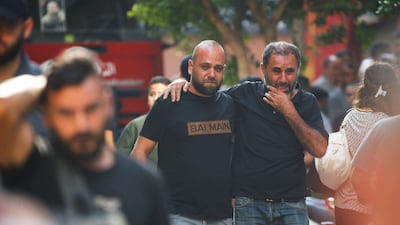
Dozens of relatives of missing people waited near a security cordon for news of their family members, possibly still trapped under the rubble.

A woman in a black hijab asked Red Cross workers for news of her daughter. “I went to St George hospital and St Therese and no one knows where my daughter is. There has to be some way you can find out,” she said to a group of paramedics.

“There is nothing we can do in these cases because most of the time we don’t know if the person who was rescued is alive or dead, or still under the rubble, or what hospital they went to,” a civil defence worker told The National.

Israeli army spokesman Daniel Hagari said Israeli forces killed Mr Aqil, along with other top operatives and the chain command of Hezbollah's elite Radwan forces.

“They gathered underground, under a residential building, in the heart of Dahieh, while using civilians as a human shield. They met to co-ordinate terror activities against Israeli civilians,” he said at a press conference.

Hezbollah did not comment on the alleged killing of other top operatives.

“It’s a dark series [of events] for Hezbollah,” Karim El Mufti, a professor of international relations at Sciences Po in Paris, told The National. “Israel has shifted from a defensive stance to an aggressive one. For Israel, the front has become a unified battlefield across the entire axis of resistance. There is no need to ask when the war is coming – it’s already unfolding before our eyes.”

Mr Mufti described the conflict as a “strategic war of attrition”. “Israel doesn’t need to bomb the whole southern suburbs when it can target commanders and thousands of militiamen without worrying about collateral damage and while keeping international support, particularly from the US,” he said. “Now, Hezbollah is cornered, as it does not want a full-scale war but is seeking retaliation – yet, what kind of response could match these attacks?”

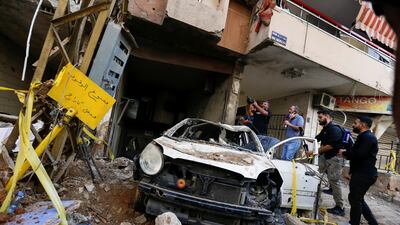
  • A damaged car at the site of the September 20 Israeli strike on a building in Beirut's southern suburb, Dahiyeh, as search and rescue operations continue. Reuters
    A damaged car at the site of the September 20 Israeli strike on a building in Beirut's southern suburb, Dahiyeh, as search and rescue operations continue. Reuters
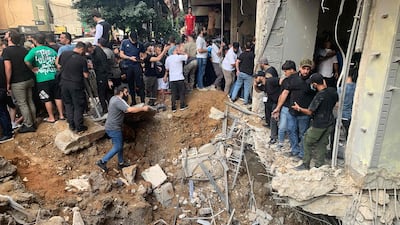
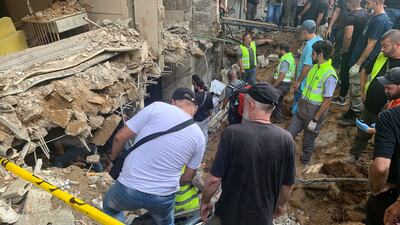
  • Emergency personnel work at the site of the deadly Israeli strike. The day after the strike, Lebanon's Health Minister said at least 31 people had been killed. Reuters
    Emergency personnel work at the site of the deadly Israeli strike. The day after the strike, Lebanon's Health Minister said at least 31 people had been killed. Reuters
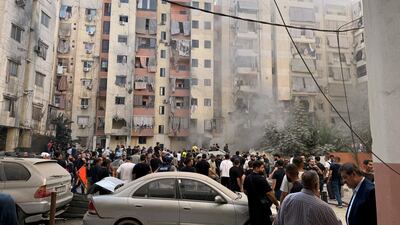
  • A view of a damaged building after the strike, which the Israeli army said targeted Hezbollah commander Ibrahim Aqil. Reuters
    A view of a damaged building after the strike, which the Israeli army said targeted Hezbollah commander Ibrahim Aqil. Reuters
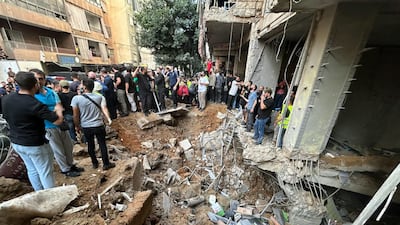
  • People gather near the site of the strike, waiting for news of loved ones believed to be trapped under the rubble. Reuters
    People gather near the site of the strike, waiting for news of loved ones believed to be trapped under the rubble. Reuters
  • People search the rubble of what was once a 10-storey apartment building. AFP
    People search the rubble of what was once a 10-storey apartment building. AFP
  • Hezbollah confirmed that Ibrahim Aqil and another senior commander were killed in the strike, among 14 of its fighters. Reuters
    Hezbollah confirmed that Ibrahim Aqil and another senior commander were killed in the strike, among 14 of its fighters. Reuters
  • First responders gather at the scene of the Israeli strike in Beirut. AFP
    First responders gather at the scene of the Israeli strike in Beirut. AFP
  • Medical staff wait for the arrival of an ambulance carrying injured casualties in Beirut. Reuters
    Medical staff wait for the arrival of an ambulance carrying injured casualties in Beirut. Reuters
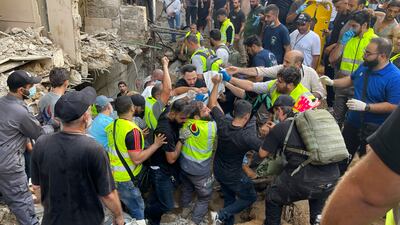
  • Rescuers lift an injured person out of the rubble. AP Photo
    Rescuers lift an injured person out of the rubble. AP Photo
  • People stand on top of a damaged car in the rubble. AP Photo
    People stand on top of a damaged car in the rubble. AP Photo
  • The building was hit by four missiles, state media reported. AP Photo
    The building was hit by four missiles, state media reported. AP Photo
  • A large number of women and children were reported injured in the strike. AFP
    A large number of women and children were reported injured in the strike. AFP

The Beirut strike is the third by Israel on the Lebanese capital since Israel and Hezbollah started exchanging fire on October 8 amid the Gaza war. The militant group announced the death of two of its fighters in Friday's attack. Lebanon's ministry of health said 14 people were killed and 66 wounded.

Israeli media reported that Mr Aqil was one of the primary commanders responsible for drawing up Hezbollah battle plans for a future takeover of northern Israel’s Galilee region.

Images from Dahieh showed plumes of smoke over the area. Clips shared on social media portrayed scenes of chaos, a building completely levelled, and mangled cars across a busy street. Ambulances were rushed to the scene.

Calls for blood donations for the victims were multiplying on social media. People searching for their loved ones also took to social media to ask for help, sharing pictures of their missing relatives, including children.

The General Directorate of Civil Defence urged “citizens to evacuate the site of the collapsed building” as rescue operations were under way to find those missing under the rubble. The security services imposed a cordon across the site, it added.

Lebanese Prime Minister Najib Mikati said the Israeli strike showed Israel “gives no weight to any humanitarian, legal, or moral considerations”.

White House National Security Council spokesman John Kirby said the US was “not aware of any prior notification of Israeli strikes on Beirut”.

“We continue to believe that a diplomatic solution is the best way to move forward in the Middle East,” added Mr Kirby, who said “no one has lost hope” regarding a hostage-release and ceasefire agreement in Gaza between Hamas and Israel.

The latest Israeli attack killed senior Hezbollah commander Ibrahim Aqil. EPA

Heightened tensions

The strike follows attacks across Lebanon on communication devices used by members of Iran-backed Hezbollah on Tuesday and Wednesday. Those explosions killed 37 people, injured thousands, and were widely blamed on Israel.

On Friday, Hezbollah fired around 150 rockets into northern Israel and the occupied Golan Heights, according to the Israeli army, in response to Israel's extensive overnight air strikes on south Lebanon. The intensification of Israel's air campaign came hours after a speech by Hezbollah chief Hassan Nasrallah in which he dared Israel's military to set foot on Lebanese soil.

Hezbollah said it fired “volleys of Katyusha rockets” at six Israeli military installations, including the northern command’s main air defence missile base, near Safad city, and another defence headquarters in the occupied Golan. Israel renewed its orders for civilians in the north and the Golan Heights to stay close to bomb shelters and limit their movements. The barrage caused several fires in parts of Safad, Israeli media reported.

The previous night, Israeli strikes ignited fires in parts of south Lebanon, including Jezzine, with the army saying it “struck hundreds of rocket launcher barrels that were ready to be used immediately to fire towards Israeli territory”. The Israeli army also said it hit “additional terrorist infrastructure sites” and it restated a commitment to “continue demolishing Hezbollah's infrastructure and capabilities”.

The bombardment occurred shortly after Hezbollah launched a barrage of Falaq missiles at Metulla in northern Israel, destroying about half of the houses in the town, according to media reports.

Israel's escalation of air strikes and espionage operations has stoked international fears that they are a prelude to a ground invasion of Lebanon.

Almost a year of cross-border fighting has prevented tens of thousands of residents on both sides of the border from returning to their homes. Hezbollah has vowed to prevent Israelis from returning if a ceasefire is not achieved in Gaza, while Israeli officials have consistently threatened an invasion that aims to create a security buffer zone between Israel and Lebanon and allow Israelis to return.

Fighter jets had carried out a series of heavy strikes on south Lebanon's frontier shortly before Mr Nasrallah's speech on Thursday.


Mercer, the investment consulting arm of US services company Marsh & McLennan, expects its wealth division to at least double its assets under management (AUM) in the Middle East as wealth in the region continues to grow despite economic headwinds, a company official said.

Mercer Wealth, which globally has $160 billion in AUM, plans to boost its AUM in the region to $2-$3bn in the next 2-3 years from the present $1bn, said Yasir AbuShaban, a Dubai-based principal with Mercer Wealth.

Within the next two to three years, we are looking at reaching $2 to $3 billion as a conservative estimate and we do see an opportunity to do so,” said Mr AbuShaban.

Mercer does not directly make investments, but allocates clients’ money they have discretion to, to professional asset managers. They also provide advice to clients.

“We have buying power. We can negotiate on their (client’s) behalf with asset managers to provide them lower fees than they otherwise would have to get on their own,” he added.

Mercer Wealth’s clients include sovereign wealth funds, family offices, and insurance companies among others.

From its office in Dubai, Mercer also looks after Africa, India and Turkey, where they also see opportunity for growth.

Wealth creation in Middle East and Africa (MEA) grew 8.5 per cent to $8.1 trillion last year from $7.5tn in 2015, higher than last year’s global average of 6 per cent and the second-highest growth in a region after Asia-Pacific which grew 9.9 per cent, according to consultancy Boston Consulting Group (BCG). In the region, where wealth grew just 1.9 per cent in 2015 compared with 2014, a pickup in oil prices has helped in wealth generation.

BCG is forecasting MEA wealth will rise to $12tn by 2021, growing at an annual average of 8 per cent.

Drivers of wealth generation in the region will be split evenly between new wealth creation and growth of performance of existing assets, according to BCG.

Another general trend in the region is clients’ looking for a comprehensive approach to investing, according to Mr AbuShaban.

“Institutional investors or some of the families are seeing a slowdown in the available capital they have to invest and in that sense they are looking at optimizing the way they manage their portfolios and making sure they are not investing haphazardly and different parts of their investment are working together,” said Mr AbuShaban.

Some clients also have a higher appetite for risk, given the low interest-rate environment that does not provide enough yield for some institutional investors. These clients are keen to invest in illiquid assets, such as private equity and infrastructure.

“What we have seen is a desire for higher returns in what has been a low-return environment specifically in various fixed income or bonds,” he said.

“In this environment, we have seen a de facto increase in the risk that clients are taking in things like illiquid investments, private equity investments, infrastructure and private debt, those kind of investments were higher illiquidity results in incrementally higher returns.”

The Abu Dhabi Investment Authority, one of the largest sovereign wealth funds, said in its 2016 report that has gradually increased its exposure in direct private equity and private credit transactions, mainly in Asian markets and especially in China and India. The authority’s private equity department focused on structured equities owing to “their defensive characteristics.”

Frankenstein in Baghdad
Ahmed Saadawi
​​​​​​​Penguin Press

CREW
%3Cp%3E%3Cstrong%3EDirector%3A%20%3C%2Fstrong%3ERajesh%20A%20Krishnan%3C%2Fp%3E%0A%3Cp%3E%3Cstrong%3EStarring%3A%20%3C%2Fstrong%3ETabu%2C%20Kareena%20Kapoor%20Khan%2C%20Kriti%20Sanon%26nbsp%3B%3C%2Fp%3E%0A%3Cp%3E%3Cstrong%3ERating%3A%3C%2Fstrong%3E%203.5%2F5%3C%2Fp%3E%0A
Tax authority targets shisha levy evasion

The Federal Tax Authority will track shisha imports with electronic markers to protect customers and ensure levies have been paid.

Khalid Ali Al Bustani, director of the tax authority, on Sunday said the move is to "prevent tax evasion and support the authority’s tax collection efforts".

The scheme’s first phase, which came into effect on 1st January, 2019, covers all types of imported and domestically produced and distributed cigarettes. As of May 1, importing any type of cigarettes without the digital marks will be prohibited.

He said the latest phase will see imported and locally produced shisha tobacco tracked by the final quarter of this year.

"The FTA also maintains ongoing communication with concerned companies, to help them adapt their systems to meet our requirements and coordinate between all parties involved," he said.

As with cigarettes, shisha was hit with a 100 per cent tax in October 2017, though manufacturers and cafes absorbed some of the costs to prevent prices doubling.

Company Profile

Company name: NutriCal

Started: 2019

Founder: Soniya Ashar

Based: Dubai

Industry: Food Technology

Initial investment: Self-funded undisclosed amount

Future plan: Looking to raise fresh capital and expand in Saudi Arabia

Total Clients: Over 50

UPI facts

More than 2.2 million Indian tourists arrived in UAE in 2023
More than 3.5 million Indians reside in UAE
Indian tourists can make purchases in UAE using rupee accounts in India through QR-code-based UPI real-time payment systems
Indian residents in UAE can use their non-resident NRO and NRE accounts held in Indian banks linked to a UAE mobile number for UPI transactions

The five pillars of Islam

1. Fasting 

2. Prayer 

3. Hajj 

4. Shahada 

5. Zakat 

The 12 Syrian entities delisted by UK 

Ministry of Interior
Ministry of Defence
General Intelligence Directorate
Air Force Intelligence Agency
Political Security Directorate
Syrian National Security Bureau
Military Intelligence Directorate
Army Supply Bureau
General Organisation of Radio and TV
Al Watan newspaper
Cham Press TV
Sama TV

Ten tax points to be aware of in 2026

1. Domestic VAT refund amendments: request your refund within five years

If a business does not apply for the refund on time, they lose their credit.

2. E-invoicing in the UAE

Businesses should continue preparing for the implementation of e-invoicing in the UAE, with 2026 a preparation and transition period ahead of phased mandatory adoption. 

3. More tax audits

Tax authorities are increasingly using data already available across multiple filings to identify audit risks. 

4. More beneficial VAT and excise tax penalty regime

Tax disputes are expected to become more frequent and more structured, with clearer administrative objection and appeal processes. The UAE has adopted a new penalty regime for VAT and excise disputes, which now mirrors the penalty regime for corporate tax.

5. Greater emphasis on statutory audit

There is a greater need for the accuracy of financial statements. The International Financial Reporting Standards standards need to be strictly adhered to and, as a result, the quality of the audits will need to increase.

6. Further transfer pricing enforcement

Transfer pricing enforcement, which refers to the practice of establishing prices for internal transactions between related entities, is expected to broaden in scope. The UAE will shortly open the possibility to negotiate advance pricing agreements, or essentially rulings for transfer pricing purposes. 

7. Limited time periods for audits

Recent amendments also introduce a default five-year limitation period for tax audits and assessments, subject to specific statutory exceptions. While the standard audit and assessment period is five years, this may be extended to up to 15 years in cases involving fraud or tax evasion. 

8. Pillar 2 implementation 

Many multinational groups will begin to feel the practical effect of the Domestic Minimum Top-Up Tax (DMTT), the UAE's implementation of the OECD’s global minimum tax under Pillar 2. While the rules apply for financial years starting on or after January 1, 2025, it is 2026 that marks the transition to an operational phase.

9. Reduced compliance obligations for imported goods and services

Businesses that apply the reverse-charge mechanism for VAT purposes in the UAE may benefit from reduced compliance obligations. 

10. Substance and CbC reporting focus

Tax authorities are expected to continue strengthening the enforcement of economic substance and Country-by-Country (CbC) reporting frameworks. In the UAE, these regimes are increasingly being used as risk-assessment tools, providing tax authorities with a comprehensive view of multinational groups’ global footprints and enabling them to assess whether profits are aligned with real economic activity. 

Contributed by Thomas Vanhee and Hend Rashwan, Aurifer

MATCH INFO

Barcelona 2
Suarez (10'), Messi (52')

Real Madrid 2
Ronaldo (14'), Bale (72')

Guide to intelligent investing
Investing success often hinges on discipline and perspective. As markets fluctuate, remember these guiding principles:
  • Stay invested: Time in the market, not timing the market, is critical to long-term gains.
  • Rational thinking: Breathe and avoid emotional decision-making; let logic and planning guide your actions.
  • Strategic patience: Understand why you’re investing and allow time for your strategies to unfold.
 
 
Our family matters legal consultant

Name: Hassan Mohsen Elhais

Position: legal consultant with Al Rowaad Advocates and Legal Consultants.

Bareilly Ki Barfi
Directed by: Ashwiny Iyer Tiwari
Starring: Kriti Sanon, Ayushmann Khurrana, Rajkummar Rao
Three and a half stars

Updated: September 24, 2024, 7:00 AM