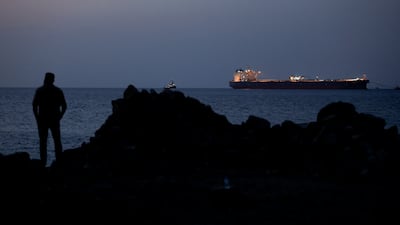

Iran's economic crisis is piling pressure on Tehran to break the US naval blockade, with regime-linked voices increasingly advocating measures such as a military-escorted tanker convoy that could trigger a wider confrontation.
US Treasury Secretary Scott Bessent said late on Monday that “Iran's economy is under water, and its leaders are panicking”, as his department unveiled sanctions targeting the country's financial networks.
Iran’s economy has been crippled by punitive measures and battered by the war that began with US and Israeli strikes on February 28. A US naval blockade of its ports has halted oil exports and, in response, Iran has sought to increase overland trade.
But footage has emerged of about 1,200 lorries stuck in a 42km queue as the blockade chokes trade across Iran’s land borders with Kazakhstan and Uzbekistan.
The disruption has driven shortages and rising prices, with inflation hitting 88.7 per cent year on year in October. Iran has imposed electricity cuts on consumers because power plants lack fuel as winter sets in.
Underlining the crisis, President Masoud Pezeshkian was filmed at the weekend working in a dimly lit office in a winter jacket, to show he is following his own calls for the public to conserve energy.
“Look, with just a little light, and by wearing warm clothes, people's work can still get done,” he said in the video broadcast on state television.
The Ministry of Industry, Mines and Trade warned on Monday that fuel allocated to mines must be used only on site, and that selling it on to third parties would incur legal action and penalties.
In another sign of the economic squeeze, the Road Maintenance and Transportation Organisation said that supplies of motor oil and tyres were down 30 and 40 per cent on last year, respectively.
'Red line'
Against that backdrop, Iran has been signalling that it could use a military-escorted tanker convoy to challenge the naval blockade, while warning that attempts to stop its oil shipments could trigger attacks on energy infrastructure across the Gulf.
“There are military ways to break the blockade, and we will pursue them in the near future,” said Iran's hardline parliament speaker, Mohammad Bagher Ghalibaf.
Foreign Minister Abbas Araghchi told the Ilna news agency: “The blockade must be broken.” Iran would make every effort to export oil while pursuing negotiations, he added.
Foreign Ministry spokesman Esmaeil Baghaei said on Monday that Iran would use all available means to confront the blockade, which he described as military aggression.
The threats have become more pointed. Sabereen News, which is affiliated with the Islamic Revolutionary Guard Corps, said in a post last week that dozens of Iranian tankers were preparing to sail for China. It also claimed Iran had warned regional governments it would go to war if the US attacked the vessels.
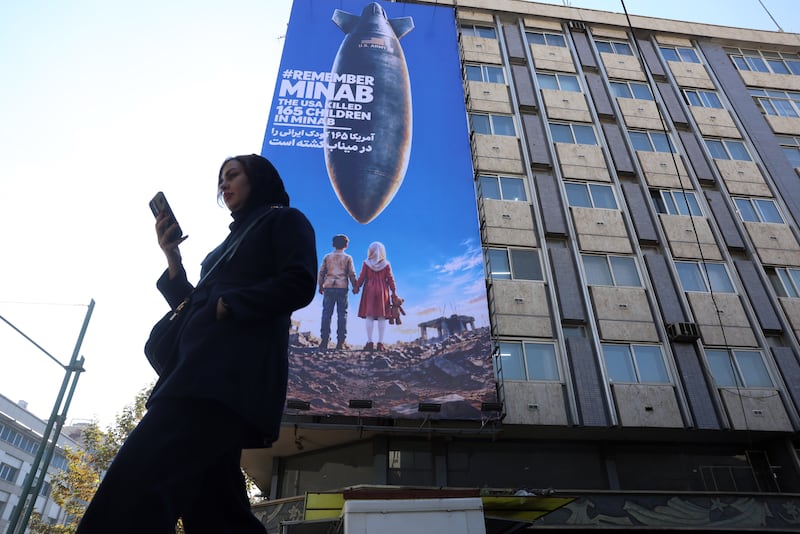
The report did not amount to an official announcement of a military operation. It was followed by a more explicit call from the IRGC-affiliated Fars news agency for Iran to send a tanker convoy to China and make enforcing the blockade too costly for the US.
Fars said that if even “one bullet” struck an Iranian tanker, oil terminals in Gulf Arab states could become targets for retaliation. The agency published an illustration of the mythical Iranian hero Fereydoun crossing a river on horseback to suggest Iran should force its way through the blockade.
“Fake routes will never replace real corridors, whether in Iran’s south or north,” Mohammad Mokhber, a senior adviser to Iranian supreme leader Mojtaba Khamenei, said, referring to US-backed routes, including one through the southern Strait of Hormuz.
“Iran's geopolitical interests in the region are our red line, and we will not allow them to be circumvented. Take a lesson from the Strait of Hormuz,” he wrote on X.
Emergency meeting
Iran's Supreme National Security Council reportedly held an emergency session on Saturday and decided to halt the dispatch of 14 oil tankers intended to challenge the US blockade. The reports, which could not be verified, did not say whether the decision was final.
State broadcaster Irib on Monday denied there were any plans to launch a convoy. “Contrary to the news wave of recent days, a convoy of Iranian tankers has not set sail to break the US naval blockade, and fundamentally no such operation in this manner and at this time was under way,” it said.
But it stopped short of ruling out such an operation. The broadcaster added that Iran had “various methods to bypass and break the blockade”, the details of which were “not necessarily publicised”. It also said the absence of the reported convoy should not be interpreted as a failure or halt in Iran’s efforts to counter the blockade.
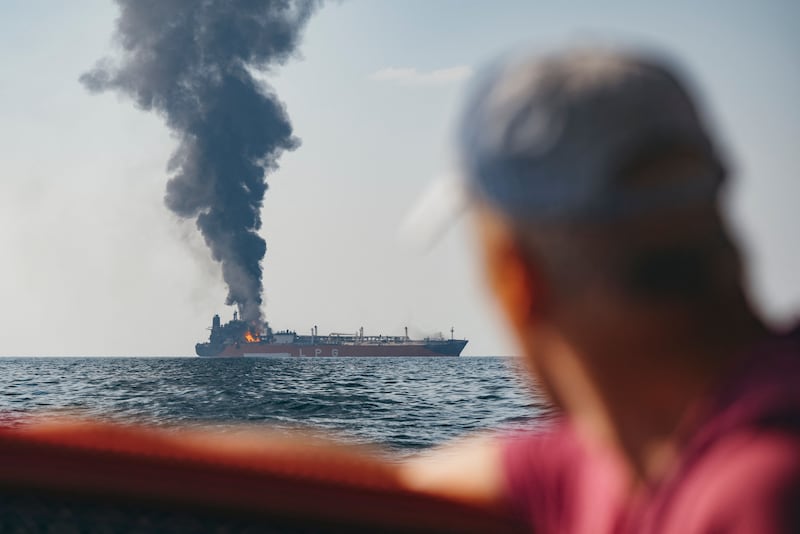
Tankers gathering near Kharg Island, Iran’s main oil export terminal, have fuelled speculation, but their presence does not show they are preparing to sail together or to try to breach the blockade. The Foreign Ministry has also dismissed reports about Iranian ships loading oil as speculation.
The latest rhetoric points to a broader strategy of turning the blockade into what an Ilna report described as a “lose-lose” choice for the US: maintain the pressure and risk a wider confrontation, or ease it and weaken US leverage over Tehran.
For now, Iran appears to be stepping up attacks on Gulf Arab states, including Bahrain and Kuwait, as well as tankers using the southern, US-backed route through the Strait of Hormuz.
On Tuesday, the IRGC claimed that three tankers had suffered explosions and intense fires after hitting sea mines in the waterway.
The claim has not been independently verified, and maritime agency reports of other recent tanker incidents have referred to unidentified projectiles rather than confirmed mine strikes.