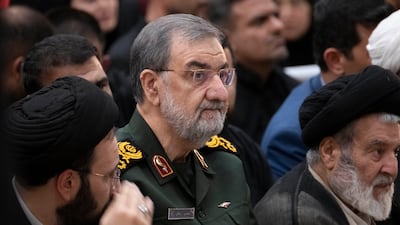
Iran's supreme leader, Ayatollah Mojtaba Khamenei, has appointed Mohsen Rezaei, a former head of the Islamic Revolutionary Guard Corps, as secretary of the Supreme National Security Council.
Mr Rezaei will replace Mohammad Bagher Zolghadr, who was appointed to the post after Ali Larijani was killed in US-Israeli strikes in March, weeks after the start of the Iran war, Press TV reported.
Quoting an official decree released on Sunday, state news agency Irna said the supreme leader praised Mr Rezaei’s “valuable experiences” and described him as “one of the pioneers of the eight-year Sacred Defence” – referring to the Iran-Iraq war that began in 1980.
Mr Rezaei, who commanded the IRGC from 1981 to 1997, was earlier a member of the Expediency Discernment Council – an advisory body to the supreme leader – and as secretary of the Supreme Council for Economic Co-ordination, Irna said.
As secretary, he is Mr Khamenei's representative on the Supreme National Security Council, which is formally chaired by President Masoud Pezeshkian. The council co-ordinates security and foreign policy and includes top military, intelligence and government officials.
Press TV said Mr Khamenei's decree also expressed gratitude to Mr Zolghadr, another veteran of the IRGC, for his “round-the-clock efforts” since taking over from Mr Larijani.
He later appointed Mr Zolghadr as his political adviser, Irna reported.
Mr Rezaie's appointment comes amid a standoff between Iran and the US over reopening the Strait of Hormuz, which Tehran has effectively closed since the war began, as a precursor to resuming negotiations on a peace deal.
Foreign Minister Abbas Araghchi said on Saturday that Iran was close to an agreement with Oman, which borders the southern side of the strait, on managing the waterway, but stressed that it would not reopen until the US met Tehran's demands.

