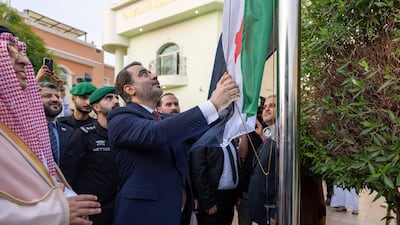
Syrian Foreign Minister Asaad Al Shibani inaugurated Syria's consulate in Jeddah, reopening it after a 14-year closure, in a ceremony attended by Saudi officials.
Syrian President Ahmad Al Shara chose Saudi Arabia as the destination for his first official international trip after ousting President Bashar Al Assad in December 2024.
Since then, ties between the two nations – and across the Gulf – have been thawing after they came to a standstill under the former president, with major announcements on investments and co-operation across sectors.

In February, Saudi Arabia launched an investment fund in Syria that will commit 7.5 billion Saudi riyals ($2 billion) to develop two airports in the Syrian city of Aleppo over multiple phases, Saudi Investment Minister Khalid Al Falih said.
Most recently, Syria’s Deputy Transport Minister Mohammad Omar Rahal said specialised technical teams had been established to draw on Saudi expertise in modernising Syria’s transport sector.
Arab Gulf states moved quickly to entrench themselves in Syria’s post-Assad future, to stabilise the war-ravaged country but also to reshape the regional balance of power.
Long seen as a pariah under Bashar Al Assad’s rule, Syria is now re-emerging in the region with speed.
Mr Al Shara, a former rebel fighter once linked to extremist factions, has recast himself as a pragmatist leading a transitional government. His administration, backed by a fragile coalition that includes Islamist-leaning Hayat Tahrir Al Sham (HTS), has been eager to secure Arab support and foreign investment to jump-start the economy and rebuild shattered infrastructure.
The Gulf response has been swift and substantial. In the months following Al Assad’s downfall, Saudi Arabia and Qatar jointly paid off Syria’s $15.5 million debt to the World Bank, unlocking access to critical reconstruction grants. Doha has also pledged $29 million monthly to fund salaries in Syria’s public sector for three months.
In May last year, the Syrian government signed an agreement with a consortium of companies led by Qatar's UCC Holding to double the country’s power supply.
Emirati firms have also moved early. DP World signed an $800 million agreement to develop the port of Tartus, while prominent Emirati businessman Khalaf Al Habtoor publicly urged greater investment in Syria’s recovery.
Recently, the head of Emaar Properties, one of Dubai's leading real estate companies, Mohamed Al Abbar, visited Syria to discuss investment opportunities there.