
Decade-old allegations of spies and betrayal in the Syrian desert, involving one of the world's biggest corporations which stands accused of crimes against humanity, are to be played out in a Paris courtroom.
French cement manufacturer Lafarge and eight former executives and middlemen go on trial on November 4 in a case expected to last six weeks.
The trial is "unprecedented", former Lafarge communications director Philippe Hardouin, who recently published a book on the case, told The National.
The trial marks the first time that a private company in France is accused of financing terrorism. It is expected to be closely watched in France, where companies are tentatively returning to Syria for business, nearly a year after the fall of the Assad regime.

Contracts have yet to be signed, with businesses telling The National they are worried about banking compliance issues and fears of inadvertently sending funds to sanctioned individuals, many of whom have struck deals with Syria's new rulers. Lafarge has reportedly ruled out the possibility of a return because of the scandal caused by the trial.
In the dock
Among the defendants are former chief executive Bruno Lafont and former deputy chief operating officer Christian Herrault, as well as two former security managers of the Syrian plant: Jacob Waerness, who used to serve in Norway's elite police force, and Ahmad Jaloudi, a former colonel in the Jordanian army. Defendants also include Bruno Pescheux, director of the factory from 2008 to 2014; Frederic Jolibois, who succeeded him in 2014; and Syrian-American intermediary Amro Taleb.
On trial in their absence is Syrian businessman Firas Tlass, a former minority stakeholder in Lafarge's Syria subsidiary, who is accused of distributing the cash to rebel groups through his contacts in Syria. He has not set foot in France since an international arrest warrant was issued against him, according to Mr Hardouin, who spoke to him at length for his book.
Defendants all stand accused of financing terrorist groups, while Mr Lafont is additionally charged with non-respect of international financial sanctions.
They potentially face up to 10 years in prison if found guilty.
The case has returned the spotlight to the controversy surrounding the company's role and wider French involvement in Syria under the regime of Bashar Al Assad.
The defence has highlighted services rendered by Lafarge to French intelligence services, which were hungry at the time for information on rebel groups operating around the factory.
Judges have dismissed this argument, saying that no one forced Lafarge to stay in Syria, and it had the choice to leave. French energy giant Total exited Syria in late 2011, months after the start of the civil war.
Lafarge, by contrast, stayed on for nearly three more years, in increasingly dangerous circumstances.
Civil war
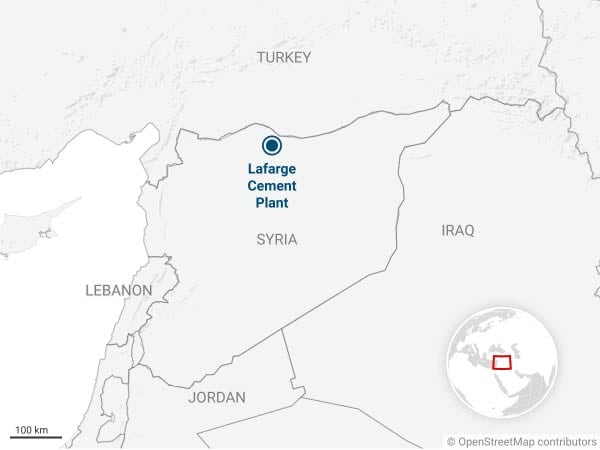
The Lafarge plant in Syria was in the north-west of the country near the Turkish border. It was inaugurated months before the start of the civil war in 2010 at a cost of about $680 million.
In the summer of 2012, the company started paying western-backed Kurdish forces that took over the area to keep the plant operating, according to reports. "It was clearly extortion, even if it was the 'good guys' that were doing the extortion," Mr Herrault told investigators at the start of the probe, according to Le Monde.
But the situation turned more dangerous after groups listed as terrorists by western and Arab states, including ISIS, swept across the area. Court documents show that Lafarge continued to pay until it was forced to leave when ISIS took over the plant in September 2014.
The court will have to consider whether those payments constitute terror financing and whether top executives such as Mr Lafont knew that those payments were happening.
In 2022, Lafarge was separately fined $778 million in the US Justice Department after pleading guilty to providing material support to ISIS and other terror groups. In a statement, it said: "We deeply regret that this conduct occurred."
Double standards
Lafarge has argued that payments originated from its subsidiary's accounts – Lafarge Cement Syria – and not the company’s account, and that it was not involved in the decisions made by the subsidiary’s executives, according to campaigners who filed a criminal complaint against Lafarge in 2016 after media reports emerged about the payments.

Large companies accused of human rights violations classically argue they are the acts of a few "bad apples", said two of the campaigners – the European Centre for Constitutional and Human Rights (ECCHR) and French association Sherpa – in a joint commentary published last week.
For years, it has been argued, there is a disparity between the French judiciary's treatment of people involved in Syria's civil war – such as a mother sentenced in 2017 to two years in prison for sending €2,800 ($3,220) to her son in Syria – and corporations active there.
"The case raises questions of corporate power, double standards, and the pursuit of accountability for those who enable or profit from grave human rights abuses in Syria and beyond," the ECCHR and Sherpa said.
Merger plan
One suggestion as to why Lafarge chose to prolong its stay in Syria is that a merger was ongoing with Swiss competitor Holcim, so it wanted its assets maximised. The merger was finalised in 2015.
Lafarge wanted the Syria plant to remain part of its assets as "each company took stock of its family jewels," even if the factory represented "very little on the scale of the group," Lafarge's former top security official, Jean-Claude Veillard, told French newspaper Le Parisien last year. Mr Veillard is the only defendant who has had charges against him dropped.

Mr Veillard also said Lafarge was worried about abandoning its employees. Former local staff turned against the company and joined the earlier stages of legal action in 2016, but, much to their disappointment, charges of endangering their lives were dropped in January 2024.
The staff told tales of kidnappings and threats against their lives as they continued work despite the fighting raging around them. Expats had been evacuated, but Syrians stayed.
Intelligence gathering
Lafarge's continued presence in Syria was allegedly a boon for French intelligence services. Reports suggest it hired people to collect information on foreign fighters fuelling the rise of extremist groups at the start of the civil war.
In his book, Mr Hardouin has suggested that the French state was more involved than it wants to admit. "Judges say that links between the French security services and Lafarge were simply circumstantial. That is entirely possible," he said.
Mr Hardouin, who left Lafarge in 2008, describes himself as a friend of Mr Lafont's, but said he did not set out to write his book to defend him. "What matters in my book is not whether I am friends with or have worked at Lafarge. What matters are the factual elements I talk about in the book and the questions they raise," he said.
If the company hoped to rely on ties to the French state for its defence, the approach has not worked. Though dismissed by judges, the allegations continue to hang over the case, triggering significant interest in France and highlighting the rarely discussed grey area of intelligence sharing between private companies and state security services operating in risky areas.

Mysterious Mr T
In his book, Mr Hardouin hints at intelligence rings operated in parallel at the factory. The first involved Mr Tlass, who is quoted as saying that his contact point was a DGSE agent referred to in court only as "Mr T".
Mister T was not interviewed by French police until 2021, during a brief stint working in the private sector. This timing conveniently blurs his alleged links to the DGSE, according to Mr Hardouin. "Evidence points to the fact that French state authorities and services tried to cover up their involvement in this case," he said.
In his deposition, which lasted under two hours, Mr T claimed that he was unaware that Mr Tlass used to be a minority stakeholder in Lafarge's Syria subsidiary or that Mr Tlass made payments to ISIS.
Mr Hardouin suggests it might have been expected that a French intelligence agent with experience in the Middle East would know more about Mr Tlass, whose family was part of the ruling elite.
His father, Mustafa Tlass, was Defence Minister for more than three decades. In 2012, France helped exfiltrate his brother Manaf Tlass, the first Syrian Republican Guard commander to publicly defect from the army of Mr Al Assad at the start of the civil war.

Mr Tlass, who fled Syria in 2012, has denied making payments direct to ISIS but has acknowledged paying "rebels". While he has refused to risk arrest in France, he has suggested being heard by judges by video-link – a suggestion which was not followed through, according to Mr Hardouin.
Lafarge 'served its country well'
Meanwhile, one of the Lafarge factory's ex-security managers, Mr Jaloudi, has told French media he drew a detailed map of Syria locating checkpoints controlled by Kurdish groups, ISIS, Ahrar Al Sham and the Syrian regime. This material ended up in the hands of an international anti-ISIS coalition.
Mr Jaloudi also said he formally identified in 2014 a French ISIS member named Kevin Guiavarch, despite this having nothing to do with Lafarge's operations. After his arrest, Guiavarch was sent back to France, where he was sentenced to 14 years in prison.
Mr Jaloudi has expressed pride in contributing to western efforts to fight terrorist groups and confusion about the accusations lodged against him by French investigative judges. Speaking to Le Monde in 2023, he said: "Everyone benefited from my intelligence work: the coalition against ISIS, the UN, NGOs. I am very proud of what I did."
In light of Lafarge's troubles, French companies might become more wary of collaborating with intelligence services, warned Mr Hardouin. "They understand now the extent to which it creates grey zones," he said. "This trial will be an important moment for them to position themselves."
One further thread from the intelligence community comes from Christophe Gomart, a former head of military intelligence and one-time special forces colleague of security chief Mr Veillard. In a 2023 French documentary on Lafarge, he said: "I can tell you that Lafarge employees served their country well."

