
Russian President Vladimir Putin has offered to help mediate between Israel and Iran, as the US signalled a preference for diplomacy over military action amid simmering tensions and widespread unrest in Iran.
Mr Putin on Friday held a phone call with Israeli Prime Minister Benjamin Netanyahu and said he was "in favour of intensifying political and diplomatic efforts to ensure stability and security in the region", the Kremlin said in a statement.
US special envoy Steve Witkoff had earlier said the administration of President Donald Trump prefers a diplomatic resolution to tensions with Iran, rather than military action. Those remarks also came as the White House claimed US pressure had led Tehran to halt the executions of 800 people detained during the protests.

Speaking at the Israeli-American Council conference in Florida on Thursday, Mr Witkoff said he favoured diplomacy to resolve the tensions. When asked if he thought a US military strike against Iran was likely, he said: “I hope there’s a diplomatic resolution. I really do.”
The US special envoy said a diplomatic agreement with Iran would address its nuclear enrichment and inventory, missiles and proxies. He suggested Iran may be willing to compromise on these issues due to economic pressures.
“If they want to come back to the league of nations, we can solve those four problems diplomatically, then that would be a great resolution. The alternative is a bad one,” he added.
Mr Trump has repeatedly threatened to intervene in support of protesters in Iran. A rights group said more than 2,600 people have been killed in the crackdown on one of the biggest waves of protest against the regime. The demonstrations began in late December.
Mr Trump has been considering military action, but adopted a wait-and-see approach this week after being told that protest killings were easing, saying he believed there was no current plan for large-scale executions in Iran.
The New York Times reported that Mr Netanyahu asked Mr Trump to postpone any potential military action against Iran, and senior officials from Qatar, Saudi Arabia, Oman and Egypt have also urged the administration to stand down, warning that a strike could spark a wider regional conflict.
Last Saturday, Oman’s Foreign Minister Badr Al Busaidi visited Tehran, where he met President Masoud Pezeshkian, Foreign Minister Abbas Araghchi and Ali Larijani, secretary of Iran’s Supreme National Security Council.
On Thursday, Mr Al Busaidi held phone calls with his Qatari, Iraqi, Saudi and Egyptian counterparts, discussing regional developments and ways to reduce tensions, Oman News Agency reported.

Executions halted
White House press secretary Karoline Leavitt claimed on Thursday that Iran had halted 800 executions under US pressure. She said Mr Trump was “closely monitoring the situation” in Iran, and that Washington warned Tehran there would be “grave consequences” if the killing of protesters continued.
All options remain on the table to “stop the slaughter”, US envoy to the UN Mike Waltz warned.
“President Trump is a man of action, not endless talk like we see at the United Nations. He has made it clear all options are on the table to stop the slaughter,” Mr Waltz told an emergency UN Security Council meeting that Washington had requested.
Iran's deputy UN ambassador Gholam Hossein Darzi said Tehran does not seek escalation or confrontation. “However, any act of aggression – direct or indirect – will be met with a decisive, proportionate and lawful response,” he said. “This is not a threat; it is a statement of legal reality.”
He accused Mr Waltz of resorting “to lies, distortion of facts and a deliberate misinformation campaign to conceal his country’s direct involvement in steering unrest in Iran to violence”.
There have been widespread protests across Iran's 31 provinces in one of the largest challenges to the clerical regime in more than a decade. The unrest has evolved from complaints about the country's dire economic situation to calls for regime change.
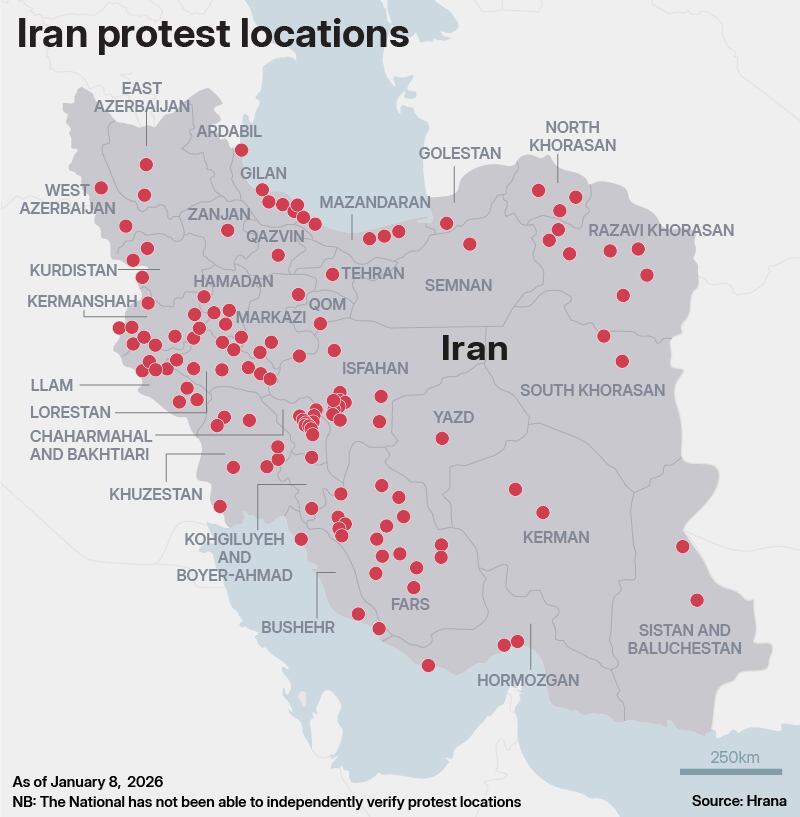
Tehran has accused the US and Israel of inciting chaos and unrest in the country, without offering evidence, and has blamed the deaths of civilians and security personnel on “terrorist operatives” backed by foreign powers.
At least 2,677 people have been killed in the unrest since December 28, according to the US-based Hrana rights group. Of these, 2,478 were protesters, including 16 children. It said 163 security personnel and government supporters were also killed, as well as 20 bystanders.
An additional 1,693 deaths remain under investigation, said the rights group in its latest statement, amid one of the longest internet blackouts on record.
Hrana data relies on the work of activists inside and outside the country. The National is not able to independently verify the tallies and Iran does not publish an official number of those killed in the demonstrations and surrounding chaos.
Confirming information is complicated by the internet shutdown, though some details have been seeping out through the Starlink satellite internet constellation, which works in the absence of wider connectivity. The shutdown has now lasted a week, NetBlocks said in a social media post on Thursday.
“Exactly one week ago … Iran fell into digital darkness as authorities imposed a national internet blackout,” said the online monitoring organisation.
While a US military attack seems to be deterred for now, the US has announced a series of sanctions on Iran. Treasury Secretary Scott Bessent said the sanctions were focused on “key Iranian leaders” involved in the suppression of protests.
The Treasury Department's Office of Foreign Assets Control designated several Iranian officials overseeing parts of the security forces.
Iran is reeling from dire economic circumstances, where high inflation, rising costs and a weak currency have fuelled growing public frustration. US sanctions and UN “snapback” sanctions against Tehran last year have worsened the country's economic woes.

