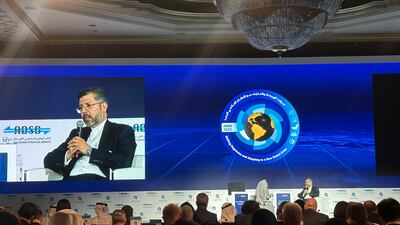

Tehran believes diplomacy is the “only way out” of an impasse over the future of its nuclear programme, but not as a means for the US and Israel to accomplish what they could not by force, a senior Iranian foreign ministry official said on Tuesday.
Speaking at the Abu Dhabi Strategic Debate, Deputy Foreign Minister Saeed Khatibzadeh said Iran was sending a “clear message” over the resumption of negotiations with the US.
“I think that diplomacy is the only way out. We need diplomacy in place, and diplomacy must be maintained,” he said. “But if the other side is trying to achieve through diplomatic means whatever it couldn't achieve through a military campaign, then the answer is no.”
Mr Khatibzadeh said diplomacy must be based on mutual respect, equal footing and a “give-and-take” approach. “Unfortunately, we are not there,” he told delegates.
Tehran and Washington held several rounds of talks earlier this year, mediated by Oman, to reach a deal that would place curbs on Iran's nuclear programme in exchange for the lifting of sanctions.
But three days before a sixth round of negotiations in June, Israel attacked Iran's nuclear and military sites as well as its military leaders. The US joined the war by bombing three Iranian nuclear sites, two days before President Donald Trump announced that a ceasefire had been agreed. Mr Trump claimed the strikes obliterated Iran's nuclear programme, but the true extent of the damage remains unclear.
“Iran was in the middle of negotiations, in the middle of diplomacy, when the Americans and Israelis attacked our safeguarded nuclear sites, ignoring the risks,” said Mr Khatibzadeh.
“They assassinated our off-duty commanders, not in the situation room, not on the front line, but in the middle of the night, while they were with their families, and they targeted university professors,” he continued.
“So if you put yourself in the shoes of Iran, are you going to accept being bullied by those who are violating international law?”

Mr Khatibzadeh reiterated that Iran has no plans to build nuclear weapons. “We didn't withdraw from the Nuclear Non-Proliferation Treaty (NPT) after this aggression, because we are committed to the peaceful use of our nuclear programme,” he said.
He accused Israel of sowing instability in the region, citing Oman's Foreign Minister Badr Al Busaidi, who described Israel, rather than Iran, as the “prime source of insecurity” in the Middle East during the Manama Dialogue in Bahrain.
“Israel are not at peace with anybody. They have moved on from the notion of coexistence,” said Mr Khatibzadeh. “They are attempting to make the state of Palestine impossible, and trying to ensure a technological, military and intelligence edge over other countries, including countries in this very region,” he said.
His sentiment was echoed by panel speaker Seyyed Mohammad-Kazem Sajjadpour, a professor at the School of International Relations in Tehran. “Israel is the cause of instability in the Middle East. Who can defend what Israel has done to people in Gaza?” he said.
Resistance to Israel
From Hamas in Gaza to Hezbollah in Lebanon, Mr Khatibzadeh said resistance groups were created in response to Israel's expansionist policy. “They are not fabricated or imported, they are members of society responding to Israel's aggressions,” he said.
Both Hamas and Hezbollah have been weakened considerably by Israeli attacks since the war in Gaza began two years ago, and are under pressure to disarm as part of the ceasefire agreements.
“We should not look at resistance movements as a liability. Do not exclude those elements that are resisting as illegitimate, and do not demonise them but encompass them. They are a response to a real cause and real concerns,” Mr Khatibzadeh said. “With or without Iran supporting them, resistance groups will exist.”

