

The US on Friday announced an agreement with Iraq that will result in the withdrawal of American troops from parts of Iraq, where they have been stationed for a decade to help fight ISIS, but some forces will remain in the country for years to come.
The plan consists of two main phases, US officials said. The first stage will bring an end to military operations conducted by Combined Joint Task Force Inherent Resolve, an international coalition that was founded to fight ISIS after the group seized large parts of Iraq and Syria in 2014.
This will result in “ending the presence of coalition forces in certain locations in Iraq, as mutually determined” with Baghdad by September 2025, a senior Biden administration official told reporters.
The second part of the agreement means US forces remain in Iraq until at least September 2026, but they will only be striking ISIS in neighbouring Syria, the official said. This time frame could be extended, “subject to conditions on the ground and obviously consultations among future political leaders of Iraq, the United States and coalition members”.
“To be clear, the United States is not withdrawing from Iraq,” the official said.
Even though ISIS remain a threat in Iraq and Syria, Prime Minister Mohammed Shia Al Sudani has been under sustained political pressure to end the US troop presence, which is seen by critics as antagonistic to Iran-backed groups in the region. Both sides were set to announce the deal in August but it was postponed after an attack on US troops at Ain Al Asad airbase in western Iraq.
Friday's announcement offered no details on how many US troops will stay in Iraq, and for how long. Currently, about 2,500 are based in Iraq, where they work with Iraqi and Kurdish partners against ISIS cells. Iraq is also a launch pad for US-led anti-ISIS operations in Syria, where the group continues to operate but no longer controls territory.
The US official said ISIS still poses a “real threat” but is diminished in Iraq and across the region.
“While ISIS is down, they are not out,” the official said. “Together, the US, Iraq and the coalition remain committed to defeat the core ISIS threat. We plan to continue focusing on that important task. As we head into the future, we will continue to work with the Iraqi Security Forces, including the Kurdish Peshmerga forces, to build up their capabilities and ensure an Iraqi-led enduring defeat of ISIS.”
In a joint statement, Iraq and the US stressed “the need to continue all efforts to ensure that the threat from this terrorist organisation does not return in any way”.
-
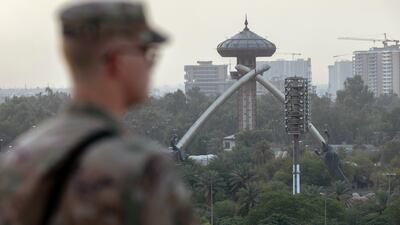
A US Army soldier looks over Baghdad from the International Zone in Iraq in 2021. All photos: Getty Images -
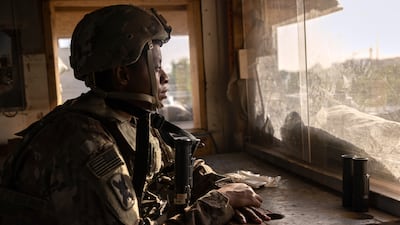
Troops are stationed in a guardhouse on the perimeter of the International Zone in Baghdad in 2021 -
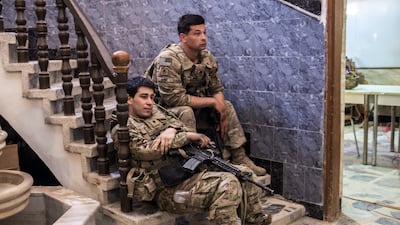
US Army 82nd Airborne Division soldiers at their base in western Mosul in 2017 -
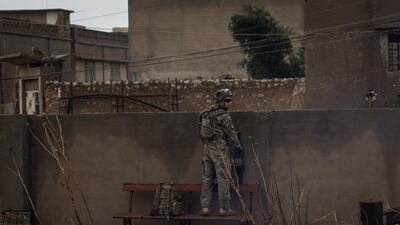
A US Army soldier stands guard during Christmas Day mass at Mar Hanna Church in Qaraqosh, Mosul, in 2016 -

On patrol outside Al Fadael School in northern Baghdad in 2009 -
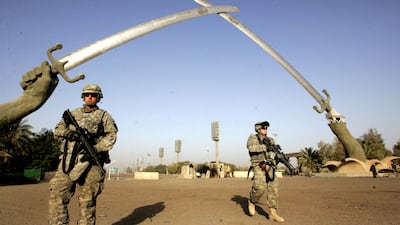
Keeping watch near a monument at the heavily fortified Green Zone area in Baghdad in 2009 -
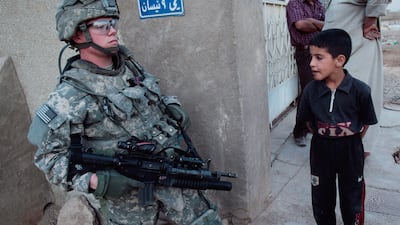
An Iraqi boy encounters a US soldier on ground patrol in the Baladiyat neighbourhood of Baghdad in 2008 -
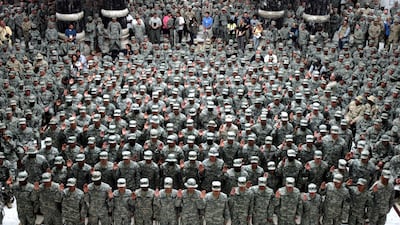
New US soldiers raise their hands during an oath ceremony at Camp Victory, Baghdad, 2007 -
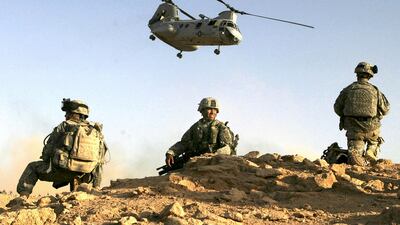
US soldiers set up security positions after landing in the desert at the start of Operation Diablo X in Baghdad in 2005 -
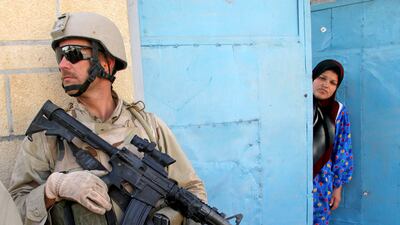
An Iraqi woman peers out of her house at a US soldier in Tall Afar in 2005 -
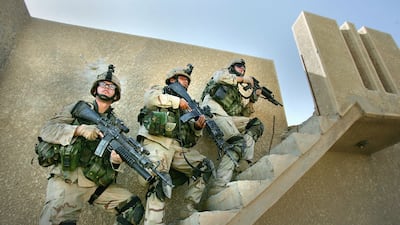
US Army troops clear abandoned houses of insurgent fighters in Fallujah in 2004 -
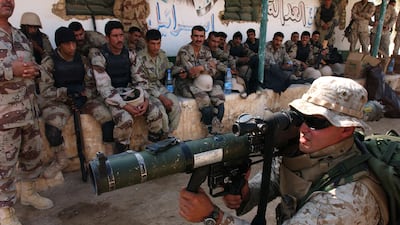
A US Marine shows new Iraqi Army soldiers how to use a missile, near Fallujah in 2004 -
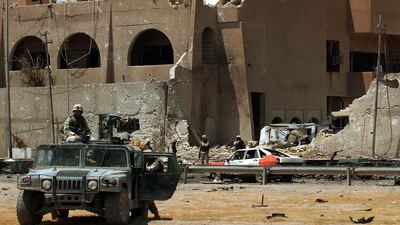
US soldiers and Iraqi police investigate the scene of a car bombing at the Jordanian embassy in Baghdad in 2003 -
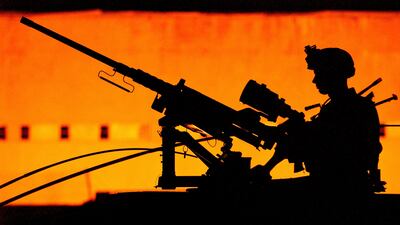
A serviceman with the US Army 101st Airborne 3-502 is silhouetted operating a 50-calibre Humvee-mounted machinegun in Mosul, 2003 -
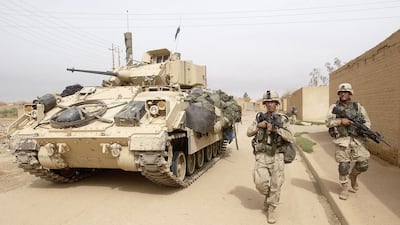
US infantry soldiers use a Bradley fighting vehicle for cover outside Baghdad International Airport in 2003 -
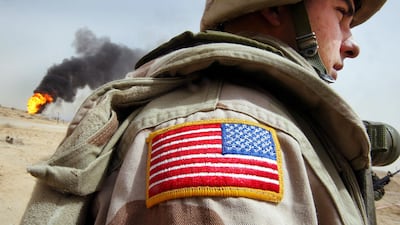
A US soldier stands next to a burning oil well at Rumaila oil fields in 2003


ISIS fighters carry out sporadic attacks, mainly in rural areas. This month, US troops took part in an operation alongside Iraqi forces in the west of the country in which they rooted out an ISIS hideout, killing 14 extremists, among them four major figures in the group.
Washington and Baghdad are striving to change public perception of the US presence in Iraq and have continually referred to the new “bilateral security relationship”.
A senior US defence official said the Iraqi government “has expressed continued willingness and interest to solidify and expand that partnership, including on counter-terrorism co-operation”.
“The details of that will take time to emerge, but it will be building on what already exists with the advise-and-assist mission of US forces to help the Iraqi Security Forces conduct counter ISIS missions,” the official said.
Dr Abbas Kadhim, director of the Iraq Initiative at the Atlantic Council, said Friday’s announcement served as a stopgap for the Iraqi government and the outgoing Biden administration to signal progress on withdrawing US forces without actually setting any drawdown numbers.
“There are lots of pressures on both governments, the Iraqi government and the US government, to accomplish this withdrawal, and especially now, given the chaotic situation in Palestine and Lebanon,” Dr Kadhim told The National. “So this is a great way to kick the can down the road.”
He also said the Iraqi government will open itself up to criticism if US forces withdraw from some parts of the country but not other places like Kurdistan.
“Symbolically, at least, it doesn't look good. The message it sends is that Kurdistan is safe for US forces and the rest of Iraq isn't. There is room for exploitation domestically,” he said.
Republican Congressman French Hill, who has led Washington policy on Syria and the Captagon drug trade, said now is “not the time to be withdrawing our forces”.
“Leaving the region now puts our allies, the Kurds, and the Syrian people at risk, as well as risks the re-emergence of ISIS without our support of the Kurds,” he told The National.
He urged Congress to “carefully assess” the preliminary exit plan to ensure it best ensures “long term US and Iraqi interests”.
US troops have been stationed in Iraq since 2003, when an international coalition invaded Iraq to topple Saddam Hussein’s regime, claiming he was developing and stockpiling weapons of mass destruction. No such weaponry was found and the invasion plunged Iraq into decades of civil war, chaos and political instability.

In 2008, Iraq and the US signed the Strategic Framework Agreement that led to the withdrawal of most US forces by the end of 2011, leaving behind a small number of troops to protect its embassy and to train and assist Iraqi forces. At its peak presence in 2007, the US military numbered about 170,000 soldiers. About 2,500 US troops remain stationed in Iraq as part of the coalition.
However, foreign troops returned in 2014, when ISIS seized about a third of the country in a vast takeover in Iraq and Syria, which the US-trained Iraqi security forces were not able to stop. The extremist group was defeated in 2017 and driven out of the main cities it captured such as Mosul and Tikrit.
Thereafter, the US gradually reduced the number of its troops in Iraq from about 5,000 to 2,500. Hundreds of soldiers from Europe are also part of the coalition. Washington also has about 900 troops in neighbouring Syria on a mission it says aims to advise and assist local forces to prevent a resurgence of the group.
Greater paramilitary powers?
Any reduction in US intelligence, air support or training capabilities could undermine efforts to contain any ISIS sleeper cells, raising concerns of a potential resurgence of the terrorist group.
It could force Iraq to rely more on its own security apparatus, which has been bolstered by the presence of the Popular Mobilisation Forces (PMF). Although the PMF officially integrated into Iraq’s state security forces in 2016, many of its militias maintain their allegiance to Iran, which has led to concerns over their role in Iraq’s political and security future.
Since declaring the end of the fight against ISIS in late 2017, these groups have grown in power and influence and have been calling for the full withdrawal of the US from Iraq. Their political clout has been also strengthened since October 2022, when Mohammed Shia Al Sudani became Prime Minister.
These calls intensified after the US assassinated Maj Gen Qassem Suleimani, commander of the Quds Force of Iran’s Islamic Revolutionary Guard Corps, and prominent Iraqi militia leader Abu Mahdi Al Muhandis in an air strike in Baghdad in 2020. Two days after the assassination, Shiites in Iraq's Parliament passed a resolution calling on the government to expel foreign troops. Sunnis and Kurds did not support the move.
The outbreak of the Israeli war in Gaza war ended a year-long calm between the Iraqi militias and the US forces that followed the establishment of Mr Al Sudani’s government. The groups started launching a wave of attacks on US interests after Israel began bombing Gaza relentlessly, demanding an immediate ceasefire in the Palestinian territory run by their ally Hamas.
In January, Baghdad, under domestic pressure, initiated talks with Washington to end the coalition's mission. The Iraqi government said it was willing to enter bilateral security agreements with member states. An unannounced truce that involved Tehran and the Iraqi government in February halted the militias' attacks against US forces in the Middle East. However, as the war in Gaza continued, attacks resumed and the truce with Washington collapsed after a few months.
Calls to end to the truce were renewed after at least four members of the PMF's 47th Brigade were killed in a US strike on a base in Babil province, south of Baghdad, at the end of July.
“The resistance factions in Iraq ended this truce and therefore all options are available to the resistance forces to target all US bases inside Iraq,” Haider Al Lami, a member of the political council of Al Nujaba Movement in Iraq, told The National at the time.
Around the same time, an Iraqi delegation led by Defence Minister Thabet Al Abbasi visited Washington to put the final touches to the withdrawal deal. Baghdad and Washington agreed in late July on a two-year plan to end the mission of the US-led coalition in Iraq. Both sides were set to announce the deal in August but this was postponed after the Ain Al Asad airbase attack.
Ellie Sennett contributed to this report in Washington


