


Live updates: Follow the latest news on Israel-Gaza
Seventeen judges led by an American and a Russian and including one each from Israel and South Africa sat on the panel which dismissed Israel's request to throw out a case accusing it of genocide in Gaza.
The judges on the International Court of Justice, the UN's highest judicial body, deliberated for two weeks behind closed doors on South Africa's request to order a halt to Israel's offensive.
The keenly awaited verdict on the Gaza war was delivered in The Hague on Friday. Judges stopped short of ordering a ceasefire but demanded that Israel try to contain death and damage in its military offensive.
The ICJ has 15 permanent judges who serve a nine-year term, are elected by UN members and swear to be impartial as they hear disputes between states.
In addition, a country involved in a dispute may nominate an “ad hoc judge” to hear its case, if there is nobody of that nationality already on the bench.
Both Israel and South Africa made use of that right when the court held oral hearings on January 11 and 12 to hear the claim the Palestinians are being subjected to genocide.
Israel chose its former supreme court president Aharon Barak, who was sworn in with South Africa's former deputy chief justice Dikgang Moseneke.

Why did Ugandan judge vote against the ICJ’s Israel-Gaza order?
In an 11-page dissent, Ugandan ICJ judge Julia Sebutinde has revealed why she disagreed with the court’s ruling on the Israel-Gaza war.
Ms Sebutinde cast the only dissenting vote on the 17-judge panel apart from Israeli appointee Aharon Barak.
She argued the dispute was “essentially and historically a political one” between Israel and the Palestinians rather than a legal matter for the court.
Provocative statements by senior Israeli officials, relied on by South Africa as evidence of genocidal intent, were “taken out of context” and referred to Hamas rather than the Palestinian people, Ms Sebutinde wrote.
In addition, she argued the order to Israel to do everything possible to prevent genocide merely restates its existing duties under international law and “is therefore redundant”.
German judge Georg Nolte meanwhile voted with the majority “even though I do not find it plausible that the military operation is being conducted with genocidal intent”.
He did so because the “dehumanising and discriminate language” used by Israeli officials gives rise to the risk of future violations of the genocide convention, according to a five-page justification of his vote.
Obama adviser leads judges
The only judge to speak during the hearings was court president Joan Donoghue, a US lawyer who advised on foreign policy under Barack Obama's administration.
Elected to the court in 2010, she became president in 2021, succeeding Somalia's Abdulqawi Yusuf, who still sits on the bench. Ms Donoghue's term on the court expires next month.
Russia's Kirill Gevorgian, a career diplomat, is the court's vice president but he too will soon leave the ICJ after UN Security Council members failed to back him for another term.
Candidates must win a majority of votes in the UN General Assembly (97 votes) and Security Council (eight votes). The court's statute says they must be of “high moral character”.
Mix of countries
Electors are asked to take to ensure the court represents “the main forms of civilisation and the principal legal systems of the world”. No country can have two judges in The Hague.
Morocco, Lebanon, Somalia, China, France, Germany, Japan, Australia, Brazil, Slovakia, Uganda, India and Jamaica each have a judge on the court.
Mohamed Bennouna of Morocco is one of the court's longest-serving members, sitting in The Hague since 2006 after previously working on the war crimes tribunal for the former Yugoslavia.
Lebanon's Nawaf Salam, a former ambassador to the UN, took his seat in 2018. He has remained in The Hague despite persistent rumours he could parachute into domestic politics as Lebanese prime minister.
-
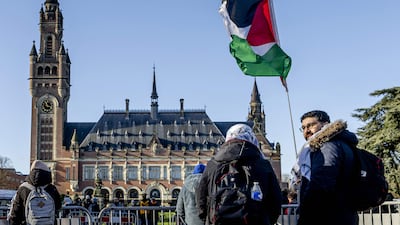
A demonstrator waves the Palestinian flag in front of the Peace Palace, which houses the International Court of Justice, in The Hague. AFP -
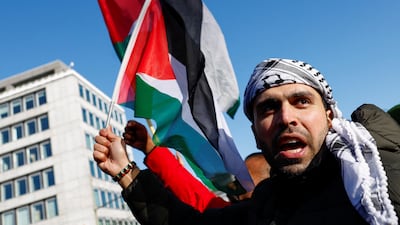
A pro-Palestinian demonstrator outside the International Court of Justice which was delivering an interim ruling on South Africa's genocide case against Israel. Reuters -
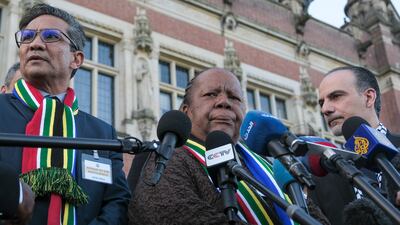
South Africa's Foreign Minister Naledi Pandor, centre, addresses reporters after the court session. AP -
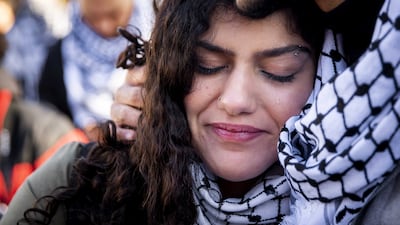
People embrace during a demonstration in solidarity with the Palestinian population, in The Hague. EPA -
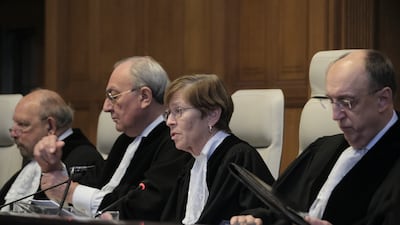
Presiding judge Joan Donoghue speaks during the session at the International Court of Justice. AP -
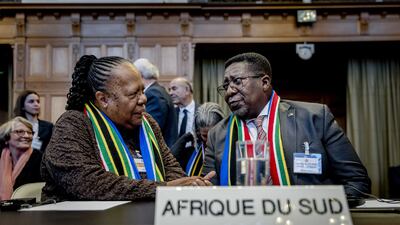
South African Foreign Minister Naledi Pandor and Vusimuzi Madonsela, the country's ambassador to the Netherlands, confer during the session. EPA -
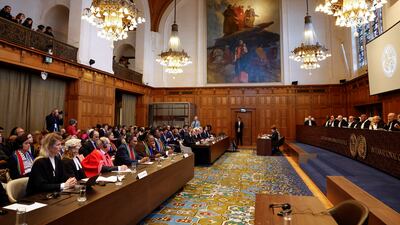
Judges at the International Court of Justice. Reuters -
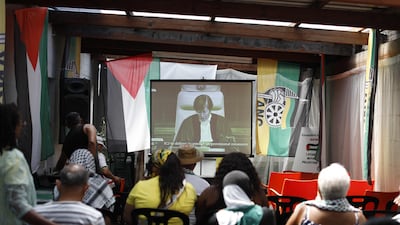
Residents gather at the Dullah Omar Centre in Cape Town to watch the ruling in The Hague. AFP -
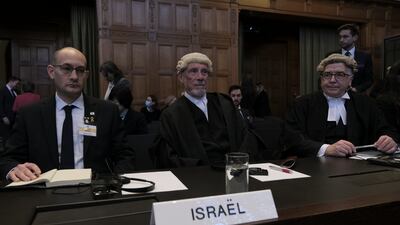
British jurist Malcolm Shaw, centre, and Gilad Noam, left, Israel's Deputy Attorney General for International Affairs, attend the session. AP -
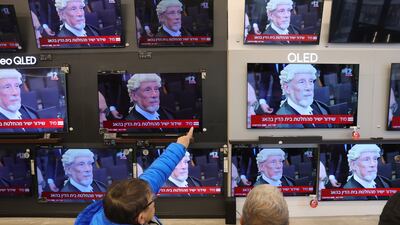
Israelis watch a live stream of the court session at a TV shop in Jerusalem. EPA -
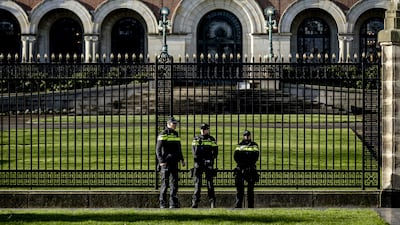
Police officers in front of the Peace Palace. EPA -
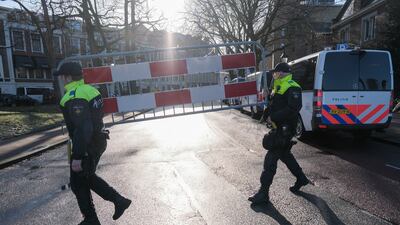
Police carry a security fence near the Peace Palace. AP


India's Dalveer Bhandari assumed his role the same year after pipping British candidate Christopher Greenwood, leaving the UK unrepresented for the first time.
Peter Tomka (Slovakia), Ronny Abraham (France), Xue Hanqin (China), Julia Sebutinde (Uganda), Patrick Robinson (Jamaica), Yuji Iwasawa (Japan), Georg Nolte (Germany), Hilary Charlesworth (Australia) and Leonardo Nemer Caldeira Brant (Brazil) are also hearing the Israel-South Africa case.
Judges decide cases by majority vote, with Ms Donoghue as president holding the power to break a tie. Members of the court receive an annual salary of $191,263, with a $25,000 bonus for the president.

