

Lebanon on Thursday marks the second anniversary of the Beirut port explosion, which killed at least 190 people, wounded thousands and damaged large parts of the capital.
Despite the devastation wrought by the blast, one of the biggest non-nuclear explosions ever recorded, a judicial investigation has brought no senior official to account.
With the probe frozen for months, many Lebanese see this as an example of the impunity enjoyed by a ruling elite that has long avoided accountability for corruption and bad governance, including policies that led to a financial collapse.
Here is a recap of how the blast happened, and the obstacles that have hindered the investigation.
What happened?
The explosion, which occurred shortly after 6pm on August 4, 2020, resulted from the detonation of hundreds of tonnes of ammonium nitrate, which ignited as a blaze tore through the warehouse where they were stored.
Originally bound for Mozambique aboard a Russian-leased ship, the chemicals had been at the port since 2013, when they were unloaded during an unscheduled stop to take on extra cargo.
The ship never left the port, becoming tangled in a legal dispute over unpaid port fees and ship defects.
No one ever came forward to claim the shipment.
The amount of ammonium nitrate that blew up was one fifth of the 2,754 tonnes unloaded in 2013, the FBI concluded, adding to suspicions that much of the cargo had gone missing.
The blast was so powerful that it was felt 250 kilometres away in Cyprus and sent a mushroom cloud over Beirut.
Who knew about the chemicals?
Senior Lebanese officials, including President Michel Aoun and Hassan Diab, prime minister at the time, were aware of the cargo.
Mr Aoun said shortly after the blast that he had told security chiefs to “do what is necessary” after learning of the chemicals. Mr Diab has said his conscience was clear.
Human Rights Watch said in a report last year that high-level security and government officials “foresaw the significant threat to life … and tacitly accepted the risk of deaths occurring”.
-
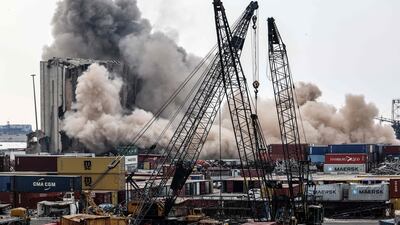
Part of the grain silos in Beirut's port collapse as Lebanon marks the second anniversary of a deadly explosion at the site. AFP -
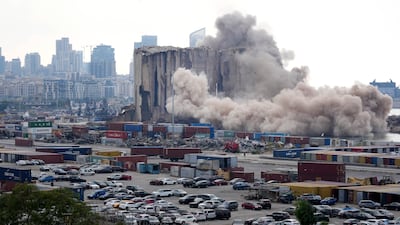
The silos were damaged during the blast in August 2020. AP -

The collapse happened as people gathered at the site to mark the anniversary. AP -

A fire at the silos blazed for weeks before the collapse. AFP -

Some people in Lebanon believe the government wants to use the fire as an excuse to demolish the silos. AFP -
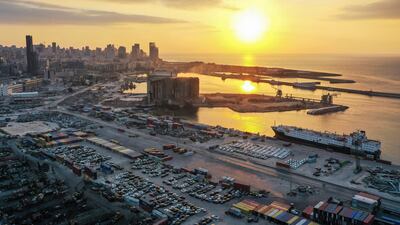
Relatives of those killed in the port blast wanted the silos to stand as a memorial to the victims. Reuters -
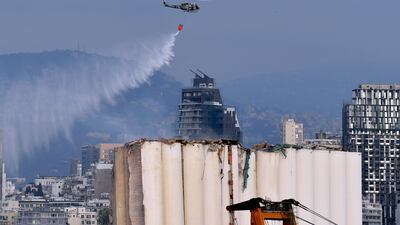
Water is dropped from a military helicopter to tackle the fire at the silos. EPA -
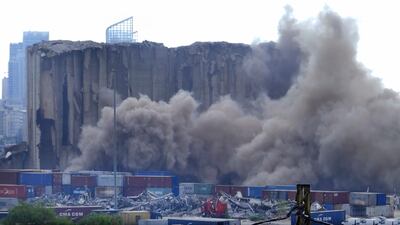
Video footage shows clouds of smoke and dust spreading across the port. AP -
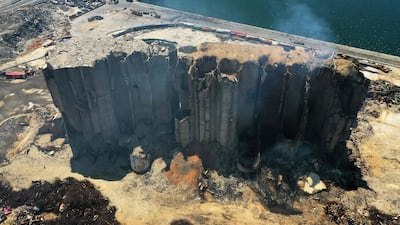
It is feared that other parts of the site will also collapse. AFP -
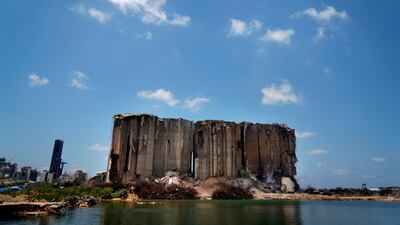
The fire was thought to have been sparked by the remnants of fermented grain in storage. AP -
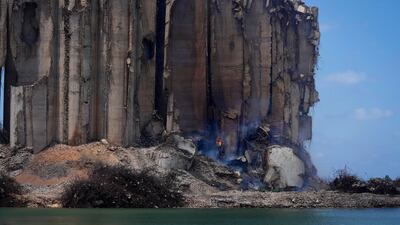
Lebanon's caretaker economy minister Amin Salam said the silos were at risk of collapse as the authorities struggled to contain the fire. AP -

Fire and smoke at the silos at Beirut port. EPA -
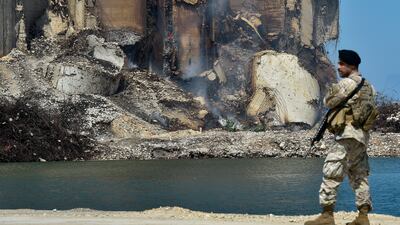
There were no reports of deaths or injuries after the collapse. EPA -
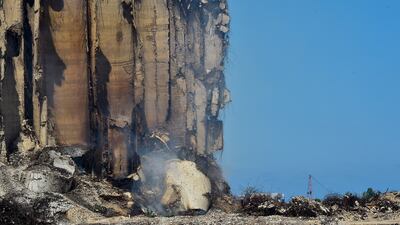
In April, the Lebanese Cabinet approved the demolition of the silos. EPA -

A survey had found that the silos were at risk of collapse. AFP -
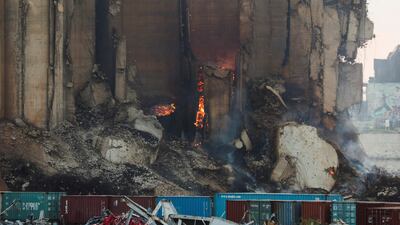
Rubble at the port after part of the silos collapsed. Reuters -
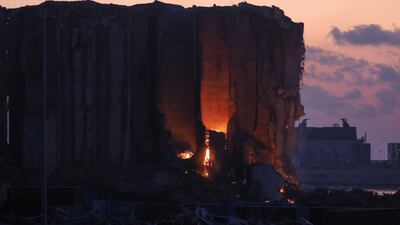
The fire burns at part of the silos that remains standing. Reuters


Who has investigated the blast?
The justice minister appointed Judge Fadi Sawan as head investigator shortly after the blast. Mr Sawan charged three former ministers and Mr Diab with negligence over the blast in December 2020, but then faced strong political pushback.
A court removed him from the case in February 2021 after two of the former ministers — Ali Hassan Khalil and Ghazi Zeitar — complained that he had overstepped his powers.
Judge Tarek Bitar was appointed to replace Mr Sawan. He sought to interrogate senior figures including Mr Zeitar and Mr Khalil, both of them members of Parliament Speaker Nabih Berri's Amal Movement and allies of the Iran-backed Hezbollah group.
He also sought to question Maj Gen Abbas Ibrahim, head of the powerful General Security agency.
All have denied wrongdoing.
Why has the investigation stalled?
All of the current and former officials Mr Bitar has sought to question as suspects have resisted, arguing that they have immunity or that he lacks authority to prosecute them.
This tussle has played out in the courts, in political life and on the streets.
Suspects swamped the courts last year with more than two dozen legal cases seeking Mr Bitar's removal over alleged bias and “grave mistakes”, leading to several suspensions of the investigation.
The former ministers have said any cases against them should be heard by a special court for presidents and ministers. That court has never held a single official accountable, and said it would pass control of the probe to ruling parties in parliament.
The probe has been in complete limbo since early this year due to the retirement of judges from a court that must rule on several complaints against Mr Bitar before he can continue.
The finance minister, who is backed by Mr Berri, has held off signing a decree appointing new judges, citing concerns with the sectarian balance of the bench.
Where does Hezbollah stand?
Mr Bitar has not pursued any members of the heavily armed, Iran-backed Hezbollah group.
However, Hezbollah campaigned fiercely against him last year as he sought to question its allies. One senior Hezbollah official sent Mr Bitar a warning, telling him that group would “uproot” him.
A protest against Mr Bitar, called by Hezbollah and its allies, last October escalated into deadly violence.
Hezbollah has accused the US, which lists the group as a terrorist organisation, of meddling in the probe. The US ambassador has denied this.
Hezbollah dismissed accusations made at the time of the explosion that it had stored arms at the port and said it had nothing to do with the blast.
Its adversaries have long accused the group of controlling the port — something it also denies.

