Former military court judge Fadi Sawan's appointment to investigate last August's Beirut port blast was coolly received by legal experts, who described him as a low-profile judge who had previously caved in to political pressure.
At the time, they told The National that they doubted Mr Sawan, 60, had the backbone to confront Lebanon's corrupt political establishment and find responsibility for the explosion that destroyed much of Beirut on August 4.
More than 200 people died, tens of thousands of homes were destroyed and 300,000 people were displaced. The World Bank estimated damages at $350 million.
Last December, Mr Sawan took legal experts and the country’s rulers by surprise when he pressed charges against four of the country’s top politicians.
Beirut Blast: Read More
How a Lebanese engineer transformed shattered glass from explosion
Six months on, families say government is burying the truth
At vigil for the dead, families refuse to forget
But this step was also the start of the end of his investigation.
Two of the politicians he indicted on Thursday succeeded in having him removed, after claiming that he was not neutral.
"It's an extraordinary message to all judges: you cannot go beyond red lines," Nizar Saghieh, head of the non-government organisation Legal Agenda, told The National.
“This is a judge who was not known for being brave, who is 60 years old, is at the end of his career and took very courageous decisions that he did not want to take at first. It’s a very important moment.
“It was like social pressure pushed him to make the final leap and press charges against politicians."
The port blast caused outrage among the Lebanese.
They were already reeling from the country’s worst economic crisis, which has pushed more than half of them into poverty, and widely blame Lebanon’s political class for the disaster.
Several politicians, including President Michel Aoun, publicly admitted they were aware that the 2,750 tonnes of ammonium nitrate that caused the explosion was unsafely stored for the past seven years.
None have taken responsibility for the explosion, instead trading blame.
But they were united in their condemnation of Mr Sawan when, on December 10, he charged caretaker prime minister Hassan Diab, former finance minister Ali Khalil and former ministers of public works Youssef Fenianos and Ghazi Zaiter with negligence.
Politicians impugned Sawan's integrity
A few days later, MPs Mr Zaiter and Mr Khalil, who belong to Amal, a political party allied with Hezbollah, wrote to the Court of Cassation.
They asked it to investigate Mr Sawan, claiming that he was not neutral or objective.
Mr Saghieh, who read the court’s report, said they based their claim on two arguments.
First, Mr Sawan allegedly said he would not be stopped by parliamentary or ministerial immunity, which was akin to him saying that he would not respect the law, the politicians said.
It was a real battle to broaden the duties of a judge so that he can go after politicians. And I'm afraid we lost the fight
“This is really far-fetched,” Mr Saghieh said. “This is not a reason to remove a judge.”
In Lebanese law, a legislator is immune to criminal prosecution but only for the duration of parliamentary sessions.
“It was a real battle to broaden the duties of a judge so that he could go after politicians," Mr Saghieh said. "And I’m afraid we lost the fight.".
The second argument put forward by Mr Zaiter and Mr Khalil was that Mr Sawan's house had been damaged in the explosion.
They claimed this meant he was not impartial.
But the scale of the disaster in a small country of about five million people should also have been taken into consideration, Mr Saghieh said.
“All the Lebanese were affected in one way or another. We’re talking about 300,000 displaced,” he said.
Mr Sawan’s successor will be appointed by caretaker justice minister Marie-Claude Najm and approved by the Higher Judiciary Council.
Poisoned chalice makes hunt for successor tough
When Mr Sawan was appointed, he was the council’s third choice after judges Samer Younes and Tarek Bitar.
Finding a replacement will be difficult, Mr Saghieh said.
“The investigation is becoming highly politicised. I don’t know who will want the job,” he said.
Media reports uncovered the role of Syrian businessmen in buying the chemical that was taken to Beirut's port in 2013.
Lebanese politics are highly divided among pro-Syrian parties, including Hezbollah, and those who oppose them.
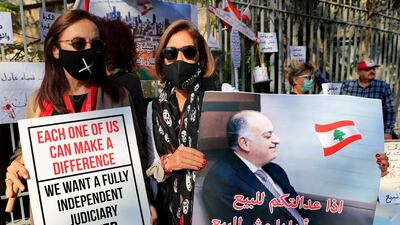
The news of Mr Sawan’s removal from the investigation caused anguish among the relatives of those killed in the blast.
“We want to tell Fadi Sawan: we implore you not to leave the case,” said Yesra Abu Saleh, 60, who took part in a sit-in with a handful of other victims’ relatives on Thursday afternoon in front of the Justice Ministry in Beirut.
Ms Abu Saleh briefly sat in the middle of the road to stop traffic.
“Take our rights from them and don’t be afraid,” she said, referring to Lebanese politicians. “We want to know who killed our children.
"Shame on them. They’re laughing at us."
Ms Abu Saleh’s son Ibrahim Amin, 20, worked at the port’s giant silos and died crushed by thousands of tonnes of grains on August 4.
Standing near by, Ahmad Lazakani, 23, said he had lost hope.
“I’m not angry. It’s a game," Mr Lazakani said. "The government does whatever it wants with Sawan or others.”
His father Mohammad, 55, died from injuries caused by a door in his home that was unhinged by the blast.
Mona Jawish, who lost her daughter Rawan Misto, 20, said Lebanese politicians wanted to cover up the truth and their possible responsibility.
“They don’t want us to know who killed our children," Ms Jawish said. "That’s why they got rid of Judge Sawan.”

RACECARD
%3Cp%3E5pm%3A%20Al%20Shamkha%20%E2%80%93%20Maiden%20(PA)%20Dh80%2C000%20(Turf)%201%2C400m%0D%3Cbr%3E5.30pm%3A%20Khalifa%20City%20%E2%80%93%20Handicap%20(PA)%20Dh80%2C000%20(T)%201%2C400m%0D%3Cbr%3E6pm%3A%20Masdar%20City%20%E2%80%93%20Handicap%20(PA)%20Dh80%2C000%20(T)%201%2C600m%0D%3Cbr%3E6.30pm%3A%20Wathba%20Stallions%20Cup%20%E2%80%93%20Handicap%20(PA)%20Dh70%2C000%20(T)%202%2C200m%0D%3Cbr%3E7pm%3A%20Emirates%20Championship%20%E2%80%93%20Group%201%20(PA)%20Dh1%2C000%2C000%20(T)%202%2C200m%0D%3Cbr%3E7.30pm%3A%20Shakbout%20City%20%E2%80%93%20Handicap%20(TB)%20Dh80%2C000%20(T)%202%2C400m%3C%2Fp%3E%0A
Mercer, the investment consulting arm of US services company Marsh & McLennan, expects its wealth division to at least double its assets under management (AUM) in the Middle East as wealth in the region continues to grow despite economic headwinds, a company official said.
Mercer Wealth, which globally has $160 billion in AUM, plans to boost its AUM in the region to $2-$3bn in the next 2-3 years from the present $1bn, said Yasir AbuShaban, a Dubai-based principal with Mercer Wealth.
“Within the next two to three years, we are looking at reaching $2 to $3 billion as a conservative estimate and we do see an opportunity to do so,” said Mr AbuShaban.
Mercer does not directly make investments, but allocates clients’ money they have discretion to, to professional asset managers. They also provide advice to clients.
“We have buying power. We can negotiate on their (client’s) behalf with asset managers to provide them lower fees than they otherwise would have to get on their own,” he added.
Mercer Wealth’s clients include sovereign wealth funds, family offices, and insurance companies among others.
From its office in Dubai, Mercer also looks after Africa, India and Turkey, where they also see opportunity for growth.
Wealth creation in Middle East and Africa (MEA) grew 8.5 per cent to $8.1 trillion last year from $7.5tn in 2015, higher than last year’s global average of 6 per cent and the second-highest growth in a region after Asia-Pacific which grew 9.9 per cent, according to consultancy Boston Consulting Group (BCG). In the region, where wealth grew just 1.9 per cent in 2015 compared with 2014, a pickup in oil prices has helped in wealth generation.
BCG is forecasting MEA wealth will rise to $12tn by 2021, growing at an annual average of 8 per cent.
Drivers of wealth generation in the region will be split evenly between new wealth creation and growth of performance of existing assets, according to BCG.
Another general trend in the region is clients’ looking for a comprehensive approach to investing, according to Mr AbuShaban.
“Institutional investors or some of the families are seeing a slowdown in the available capital they have to invest and in that sense they are looking at optimizing the way they manage their portfolios and making sure they are not investing haphazardly and different parts of their investment are working together,” said Mr AbuShaban.
Some clients also have a higher appetite for risk, given the low interest-rate environment that does not provide enough yield for some institutional investors. These clients are keen to invest in illiquid assets, such as private equity and infrastructure.
“What we have seen is a desire for higher returns in what has been a low-return environment specifically in various fixed income or bonds,” he said.
“In this environment, we have seen a de facto increase in the risk that clients are taking in things like illiquid investments, private equity investments, infrastructure and private debt, those kind of investments were higher illiquidity results in incrementally higher returns.”
The Abu Dhabi Investment Authority, one of the largest sovereign wealth funds, said in its 2016 report that has gradually increased its exposure in direct private equity and private credit transactions, mainly in Asian markets and especially in China and India. The authority’s private equity department focused on structured equities owing to “their defensive characteristics.”
WE%20NO%20LONGER%20PREFER%20MOUNTAINS
%3Cp%3E%3Cstrong%3EDirector%3A%3C%2Fstrong%3E%20Inas%20Halabi%3C%2Fp%3E%0A%3Cp%3E%3Cstrong%3EStarring%3A%20%3C%2Fstrong%3ENijmeh%20Hamdan%2C%20Kamal%20Kayouf%2C%20Sheikh%20Najib%20Alou%3C%2Fp%3E%0A%3Cp%3E%3Cstrong%3ERating%3A%3C%2Fstrong%3E%204%2F5%3C%2Fp%3E%0A
The Vile
Starring: Bdoor Mohammad, Jasem Alkharraz, Iman Tarik, Sarah Taibah
Director: Majid Al Ansari
Rating: 4/5
The White Lotus: Season three
Creator: Mike White
Starring: Walton Goggins, Jason Isaacs, Natasha Rothwell
Rating: 4.5/5
Key figures in the life of the fort
Sheikh Dhiyab bin Isa (ruled 1761-1793) Built Qasr Al Hosn as a watchtower to guard over the only freshwater well on Abu Dhabi island.
Sheikh Shakhbut bin Dhiyab (ruled 1793-1816) Expanded the tower into a small fort and transferred his ruling place of residence from Liwa Oasis to the fort on the island.
Sheikh Tahnoon bin Shakhbut (ruled 1818-1833) Expanded Qasr Al Hosn further as Abu Dhabi grew from a small village of palm huts to a town of more than 5,000 inhabitants.
Sheikh Khalifa bin Shakhbut (ruled 1833-1845) Repaired and fortified the fort.
Sheikh Saeed bin Tahnoon (ruled 1845-1855) Turned Qasr Al Hosn into a strong two-storied structure.
Sheikh Zayed bin Khalifa (ruled 1855-1909) Expanded Qasr Al Hosn further to reflect the emirate's increasing prominence.
Sheikh Shakhbut bin Sultan (ruled 1928-1966) Renovated and enlarged Qasr Al Hosn, adding a decorative arch and two new villas.
Sheikh Zayed bin Sultan (ruled 1966-2004) Moved the royal residence to Al Manhal palace and kept his diwan at Qasr Al Hosn.
Sources: Jayanti Maitra, www.adach.ae
