
Everything you need to know
The Crown Prince of Jordan, Hussein bin Abdullah, will marry fiancée Rajwa Al Saif on Thursday in Amman.
Celebrations have already begun, with eager Jordanians and Saudis preparing to watch the festivities online or in person.
Here's what you need to know about the day and events leading up to it.

The first-born son of Jordan's King Abdullah II and Queen Rania, Crown Prince Hussein, 28, will be married on Thursday.
He was named Crown Prince by royal decree in 2009. He was educated to secondary school level in Jordan, before studying international history at Washington's Georgetown University.
Prince Hussein then took an active role in his nation's military. He graduated from British royal military academy Sandhurst in 2017 and currently holds the rank of Captain.
His charitable foundation was established in 2015 and works with young people in Jordan to build their skills for the workplace and as citizens.
Prince Hussein often represents his father at important national events.
Who is soon-to-be Princess Rajwa Al Saif?
Prince Hussein's fiancée, Rajwa Al Saif, is a Saudi architect and the youngest of four siblings. Like Prince Hussein, she studied in her home nation before heading to the US for higher education.
She studied at Syracuse University.
Her family has strong ties to Saudi royal family.
What will happen on June 1?
Details of the day are still emerging but here's what we know so far:
- 5pm UAE time: Islamic marriage ceremony at Zahran Palace - with about 140 guests in attendance.
- Motorcade procession - The royal couple will be surrounded by red Land Rovers and BMW motorcycles on the journey.
- Wedding reception at Al Husseiniya Palace - 1,700 guests in attendance for royal banquet
- Performances by local and regional musicians
- 11pm UAE time : Wedding cake cutting
Who is on the guest list?
Heads of state and royals from around the world have already begun to arrive in Amman for the festivities.
Spain's former king Juan Carlos and wife Queen Sofia, Princess Catharina-Amalia of the Netherlands, Crown Princess Victoria and Prince Daniel of Sweden, and King Willem-Alexander and Queen Maxima of the Netherlands are among the royals expected to attend.
The UK's Prince William and his wife Catherine will attend the royal wedding, their representatives have confirmed
Prince Sebastien of Luxembourg is also expected. He attended the Sandhurst military academy in the UK with Prince Hussein.
Outside royalty, Jill Biden, wife of US President Joe Biden, confirmed she would be there, and has extended her visit to include Egypt and Morocco.
As yet, which leaders and royalty from the Arab world will be there has not been announced.
What events have already happened?
Prince Hussein and Ms Al Saif have attended pre-wedding events.
On May 22, she took part in a henna party with her mother-in-law to be, Queen Rania, and women from across Jordan. She wore a white abaya for the occasion made by Saudi designer Honayda Serafi.
Prince Hussein was honoured with a groom's party by his cousin Prince Omar bin Faisal. He mingled with family and friends, and members of the armed forces also attended, clapping and singing for him.
The night before the nuptials, King Abdullah hosted an elaborate dinner at the Madareb Bani Hashem at the Royal Hashemite Court for more than 4,000 Jordanians, where one of the country's national dishes, mansaf, was served.
“Our joy is complete with your presence,” the king told the dinner party.
How is Jordan’s future princess Rajwa Al Saif related to Saudi royalty?

Ismaeel Naar writes:
Royal wedding fever has gripped Jordan ahead of the marriage of Crown Prince Hussein and Rajwa Al Saif next week. But excitement is also building in neighbouring Saudi Arabia, the home country of the bride.
The future princess of Jordan is not only a Saudi citizen but has family connections to the ruling Saudi royal family. She is connected to the Al Sauds through another of Saudi Arabia's most influential families – the Sudairis.
Here's everything you need to know about her roots.
Al Sudairi and Al Saud
Rajwa Al Saif is the daughter of Saudi businessman Khalid Al Saif and Azza Al Sudairi.
Through her mother, she can trace her roots back to one of the most influential women in the kingdom's history, Hussa bint Ahmed Al Sudairi, known as the “mother of kings”.
Hussa bint Ahmed (1900-1969) is Rajwa Al Saif's great-grand-aunt and was the seventh wife of the founder of the Kingdom of Saudi Arabia, King Abdulaziz.
Their marriage helped solidify already close connections between the ruling Al Saud and the prominent Al Sudairi families – King Abdulaziz's mother, Sara bint Ahmed, also came from the Al Sudairi tribe.
King Abdulaziz, who ruled from 1902 until his death in 1953, is thought to have had about 100 children from dozens of wives and concubines.
These included seven sons with Hussa bint Ahmed, who were among King Abdulaziz's favourites and came to be known as the “Sudairi Seven” due to their prominence in the Saudi royal family.
Two of them – Fahd and Salman – ruled as kings of Saudi Arabia, while two others – Sultan and Nayef – became crown princes.
“The Sudairis were the powerhouse at the heart of the Al Saud, owing partly to their numbers (no other grouping of blood brothers numbered more than three), but mainly to their mutual loyalty, ambition and extraordinary appetite for work – qualities instilled in them by their mother,” historian Robert Lacey wrote in his book Inside the Kingdom.
“To her dying day, the formidable Hussa insisted that all seven of her boys, no matter how grand they had become, should gather in her home once a week for lunch.”
Hussa bint Ahmed was the daughter of Ahmed bin Mohammed Al Sudairi, a pivotal figure considered by many to have been one of King Abdulaziz’s right-hand men during his conquest of Arabia and foundation of the third state of the Kingdom of Saudi Arabia.

Rajwa's mother's grandfather, Abdulaziz bin Ahmed Al Sudairi, was the “mother of kings” Hussa bin Ahmed's brother.
Abdulaziz had run Al Jouf province, before being appointed governor of Al Qurayyat city. Later, King Abdulaziz named him the emir of the Al Qurayyat region, giving him responsibility for all of the north-western border strip of the kingdom at a time when the neighbouring governments of the region were riven with rivalry.
Like the Al Saud, the Al Sudairi hail from the Najd region of central Arabia. Their lineage can be traced back to the Badarin line of the wider Al Dawasir clan in Arabia. The tribe was considered a “sharifian” or noble tribe that lived on the edge of the Rub Al Khali desert in about 1400.
Nearly 150 years later, the Al Sudairi ruled the town of Al Ghat in Sudair, an area in Najd north-west of Riyadh which took its name from the tribe.
History lecturer and Ahmed Al Arf at Al Qassim University, who has studied and traced the history of the Al Sudairi tribe, said the family contributed heavily during all three eras of the states of Saudi Arabia.
“The Al Sudairi tribe from the town of Al Ghat played a pivotal role during the first, second and third states of the country. The first Ahmed bin Mohammed Al Sudairi was the father of Sara bint Ahmed who married King Abdulaziz. The second Ahmed Al Sudairi gave birth to Abdulaziz and Hussa, both of whom would play a role through their relation to King Abdulaziz during the third state of the country,” he said in a documentary.
With this background, Rajwa Al Saif's marriage to Crown Prince Hussein across the border in Jordan has generated considerable interest in Saudi Arabia.
Her engagement to Crown Prince Hussein took place in her father's home in Riyadh in August.
Zahran Palace: A wedding venue steeped in royal history
The ceremony will take place at Zahran Palace before the wedding procession moves to Al Husseiniya Palace.
In tying the knot at Zahran Palace, the couple will be following in the footsteps of many members of the Jordanian royal family.
Built in 1957, Zahran Palace was the home of the late Queen Zein Al Sharaf, mother of the late King Hussein.

A wedding venue steeped in royal history
In tying the knot at Zahran Palace, the couple will be following in the footsteps of many members of the Jordanian royal family.
Built in 1957, Zahran Palace was the home of the late Queen Zein Al Sharaf, mother of the late King Hussein.
The word “zahran” originates from the Arabic for “blooming flower”, which fits with the palace’s lush green grounds. It overlooks a boulevard in Jabal Amman where many of the city’s embassies are located.
It was at Zahran Palace where Crown Prince Hussein’s parents, King Abdullah II and Queen Rania, were married in 1993. The couple, who will celebrate their 30th wedding anniversary on June 10, just days after their son’s nuptials, left Zahran Palace in an open-top car, before taking part in a procession through the streets of Amman, where they waved to waiting crowds.
Zahran Palace also hosted the wedding of King Hussein to Antoinette Gardiner in 1961, as well the wedding of Jordan's former Crown Prince Hamzah bin Al Hussein and Princess Noor Hamzah.

Jordanian royal weddings through the years, from Princess Iman to Queen Rania
-
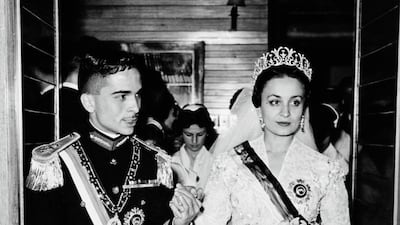
1955: King Hussein of Jordan weds first wife, Dina bint Abdul-Hamid, former Queen of Jordan, on April 19. Getty Images -
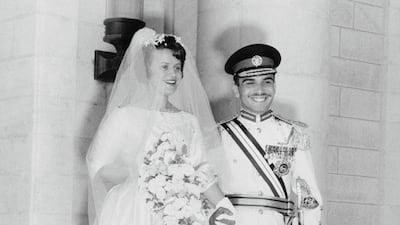
1961: King Hussein of Jordan and second wife, Antoinette Gardiner, who became Princess Muna al-Hussein upon marriage, leaving the Zahran Palace after their wedding ceremony, Amman on May 29. Getty Images -
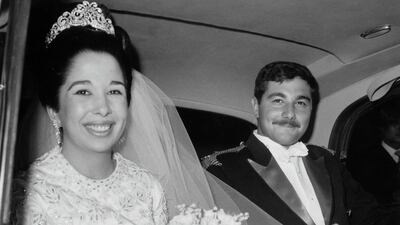
1970: Princess Basma of Jordan with Timoor Daghistani after their wedding ceremony on April 2. -

1993: The wedding of Abdullah II of Jordan and Queen Rania on June 10. AFP -
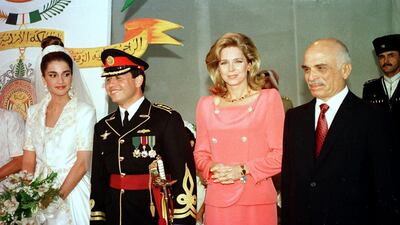
1993: The couple on their wedding day with King Hussein of Jordan, far right, and Queen Noor. AFP -
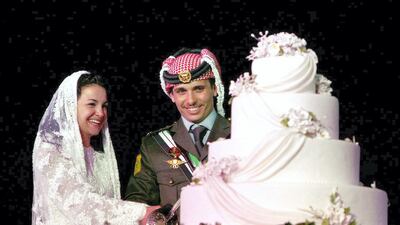
2004: The wedding of Prince Hamzah bin Hussein of Jordan and Princess Noor. Getty Images -
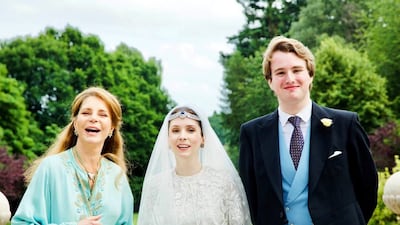
2020: Princess Raiyah, centre, daughter of Queen Noor of Jordan, left, marries Roald Dahl's grandson Ned Donovan in small UK ceremony. Photo: Arabia Royal Agency -

2020: The couple announced their engagement in 2019, and put a big wedding on hold because of pandemic. Photo: Twitter / RaiyahHKJ -

2023: Princess Iman married Jameel Alexander Thermiotis in Amman on March 12. AFP


This year is set to be a busy one for the Jordanian royal family, with two weddings taking place.
On Sunday, Princess Iman, 26, wed Jameel Alexander Thermiotis at the family’s palace on the outskirts of Amman, walked down the aisle by her elder brother, Crown Prince Hussein bin Abdullah, 28, who will also tie the knot this year.
Prince Hussein announced his engagement last year to Rajwa Al Saif. The engagement took place at Al Saif's father's home in Riyadh. The news was announced on Twitter with four photos showing the couple together, with Prince Hussein's parents, King Abdullah II and Queen Rania, pictured alongside members of Al Saif's family.
The pair will wed on June 1, the Royal Hashemite Court announced.
As the couple prepare for their nuptials, we take a look back at some of the most high-profile Jordanian royal weddings that have come before.
1955: King Hussein and Dina bint Abdul-Hamid
On April 19, 1955, King Hussein of Jordan married his first wife, Dina bint Abdul-Hamid. The pair were distant cousins, and first met in London three years earlier, while Dina was studying at the University of Cambridge.
Their engagement was announced in 1954 by King Hussein’s mother, Queen Zein Al Sharaf. Dina became the Queen of Jordan after the pair’s wedding, and 10 months later, on February, 13, 1956, she gave birth to the king's first child, Princess Alia.
However, the marriage ended in divorce in 1957, after which Dina became known as HRH Princess Dina Abdul-Hamid of Jordan.
1961: King Hussein and Antoinette Gardiner
Four years after the end of his first marriage, King Hussein married second wife, Antoinette Gardiner, on May 29, 1961.
Antoinette, who was born in Britain, is said to have meet King Hussein while working as a secretarial assistant on the set of Lawrence of Arabia.
After the pair married, she changed her name to Princess Muna al-Hussein. Together, the couple had four children, Abdullah II of Jordan, Prince Faisal, and twins Princess Aisha and Princess Zein.
The couple divorced in 1972.
King Hussein was also married to Alia Toukan on December 24, 1972, but she died in a helicopter crash in 1977. He then married Lisa Halaby on June 15, 1978, who became Queen Noor of Jordan.
1970: Princess Basma and Timoor Daghistani
Princess Basma bint Talal of Jordan, sister of King Hussein, married Colonel Timoor Daghistani on April 2, 1970.
Together, the couple had two children: Farah Daghistani and Ghazi Daghistani.
The pair divorced in the late 1970s. Princess Basma is the paternal aunt to current King Abdullah II of Jordan.
1993: King Abdullah II of Jordan and Queen Rania
At the time of their marriage in 1993, King Abdullah II was the Jordanian Crown Prince. He first met Rania Al-Abdullah in January 1993 at a dinner party. At the time, she was working in Amman in the marketing department of Apple.
Rania, who was born in Kuwait to Palestinian parents, had moved to Jordan two years earlier. Five months after first meeting, the pair were married on June 10, 1993. The day was considered a national holiday.
Together, the couple have four children: Crown Prince Hussein, Princess Iman, Princess Salma and Prince Hashem.
2004: Prince Hamzah and Princess Noor
Prince Hamzah bin Hussein, younger brother of King Abdullah II, married his second cousin, Princess Noor bint Asem bin Nayef, at Al Baraka Palace in Amman on August 29, 2003, although an official ceremony was held the following year, on May 27, 2004.
The couple had a daughter, Princess Haya bint Hamzah, born on April 18, 2007.
They divorced in 2009.
2020: Princess Raiyah and Ned Donovan
Princess Raiyah, daughter of the late King Hussein of Jordan and Queen Noor of Jordan, married Roald Dahl's grandson, Ned Donovan, in July 2020.
The couple got engaged on October 26, 2019, and a royal statement at the time read: “The Royal Hashemite Court extends its sincere congratulations to Her Royal Highness Princess Raiyah and to Mr Donovan on this occasion.”
The grandson of beloved British children's book author Roald Dahl, Donovan is a freelance journalist, and has contributed to The Spectator, New Statesman and The Telegraph. His mother is Tessa Dahl and his father is an entrepreneur, Patrick Donovan.
Donovan converted to Islam before the wedding, and took the name Faris.
2023: Princess Iman and Jameel Alexander Thermiotis
Princess Iman, the eldest daughter of King Abdullah II and Queen Rania, married Jameel Alexander Thermiotis on March 12, 2023.
The couple got engaged in July 2022 in the presence of the monarch and queen, as well as Princess Iman's three siblings and several members of Thermiotis's family.
Thermiotis was born in Caracas, Venezuela, in 1994 and is of Greek descent. He holds a bachelor's degree in business administration and works in finance in New York.
The wedding took place at the family’s palace on the outskirts of Amman in the presence of members of the royal family, friends and dignitaries. Princess Iman's elder brother, Crown Prince Hussein, walked her down the aisle.
She wore a custom Dior white gown with a lace neckline and cuffs, and a trailing veil, paired with a diamond tiara reportedly owned by her grandmother, Princess Muna Al Hussein, the mother of King Abdullah.
A version of this article was first published on July 7, 2022.

