


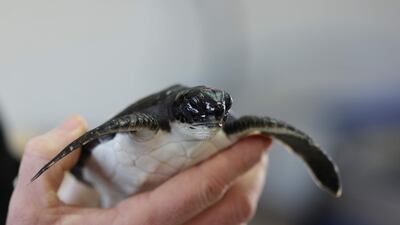
After being swept up in the worst environmental disaster to hit Israel's coastline in years, turtles had the tar cleaned off their shells and are recovering with a diet of mayonnaise.
“They are two years old and they’re full of tar and they can’t breathe, and they can’t eat,” said Yaniv Levy, manager of the National Sea Turtle Rescue Centre in the village of Mikhmoret.
In more than two decades at the rescue centre, the ecologist said he had never witnessed such a nightmare.
"They went into this tar. I assume it's because they thought it's either food or just a floating platform that they will be able to drift on," Mr Levy said.
Out to sea, the turtles unwittingly clambered aboard an oil slick in the eastern Mediterranean that washed ashore on February 17. The spill covered Israel and Lebanon's beaches in thick tar and prompted thousands of volunteers to join the huge clean-up operation.
By the time they were found, 15 turtles were dead and six were taken to the rescue centre for treatment.
“Most likely, this is just a small percentage of the turtles that were injured by this event,” said Mr Levy, who has heard of others being found on Lebanon’s coast to the north.
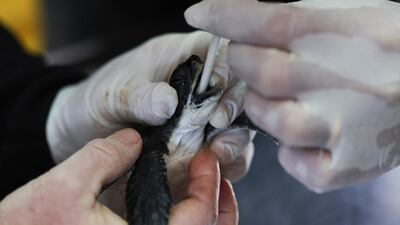
Aged between six and 18 months, the turtles that reached Mikhmoret were first cleaned with vegetable oil before being force-fed mayonnaise.
"Mayonnaise is actually really helpful for this situation, because it's oil-based, so it's diluting the tar from the intestines," Mr Levy said. The gelatinous condiment, he said, also contains protein, which gives the creatures an energy boost.
"Their immune system could react to the trauma that they suffered from."
A few days later the turtles were moved to a fish diet. "Now they're all eating very nicely and they're really happy," he said.
While the turtles recuperate, the Israeli government estimates about 1,200 tonnes of contaminated material will need to be collected and treated.
Jonathan Aikhenbaum, director of Greenpeace Israel, said some beaches are almost clean already after a huge collective effort involving volunteers, NGOs and state agencies.
“On some shores it will be quite easy to remove the tar,” he said. “On the other hand, where the shore is made of rocks, the sticky aspect of the tar is making the recovery something much more complex.”
Within a week of the spill hitting the coast, the government set aside 45 million Israeli shekels ($13.5 million) to respond to the disaster. But authorities came under fire for their apparent failure to prepare for such an event.
"Unfortunately Israel was not ready, because of the very small amount of budget and people that were planned to be allocated to the ministry of environment to take care of [an oil spill] … this didn't happen in reality," Mr Aikhenbaum said.
The government tabled a contingency programme in 2008 to deal with a future oil spill, but politicians never enshrined the plan in law.
Maya Jacobs, executive director of environmental NGO Zalul, said Israel was lacking equipment, expertise and human resources.
-

A clump of tar is seen on the sand after an offshore oil spill drenched much of Israel's Mediterranean shoreline with tar, at a beach in Ashdod, southern Israel. Reuters -
A worker at the Israeli Sea Turtle Rescue Centre cleans a turtle in the Israeli coastal area of Mikhmoret, north of Tel Aviv. AFP -
An offshore oil spill deposited tonnes of tar across more than 160 kilometres of coastline in what officials say is one of Israel's worst ecological disasters. AFP -
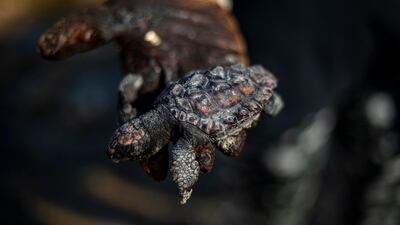
A woman holds a dead sea turtle covered in tar at Gador nature reserve near Hadera, Israel. AP -
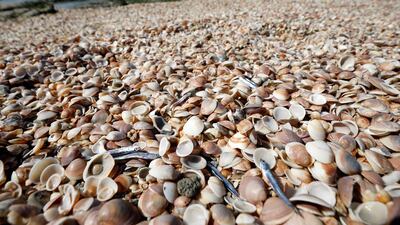
Dead fish are seen on shells at a beach in Ashdod. Reuters -
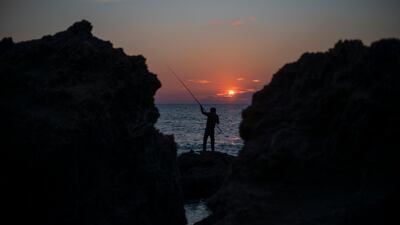
A man collapses his fishing rod at Gador nature reserve. AP -
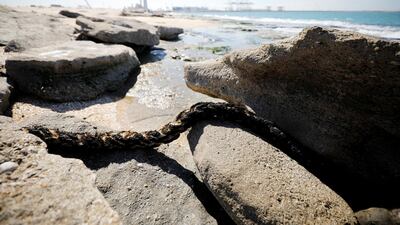
A rope covered in tar is seen on rocks at a beach in Ashdod. Reuters -
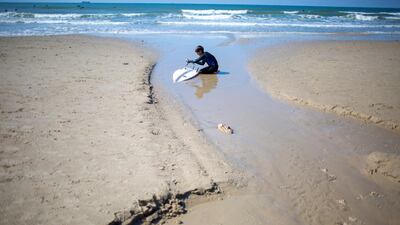
A surfer cleans his tar-covered surfboard at Gador nature reserve. AP


“It’s very frustrating because we have been talking about [how] this might happen for many years,” she said.
"We should have been prepared, we should have been able to go out to sea and clean up as much as possible" before the tar hit the shores.
Fred Arzoine, from the Ministry of Environmental Protection, acknowledged he saw only satellite images of the Mediterranean after the spill had hit Israel, although he said officials were prepared.
“We have equipment, we have training, the whole system is established, but obviously there is always a bigger need,” said Mr Arzoine, deputy director of the ministry’s marine environment protection unit.
The damage wrought by the oil spill could give new impetus to the 2008 plan, paving the way for legislation to provide funds and personnel.
"The management of an oil spill is complicated and demands us to have a fully established law, which defines and gives authority to the management of an oil spill," Mr Arzoine said.
Israel on Wednesday blamed a Libyan-owned, Panamanian-flagged tanker for the oil spill. The Ministry of Environmental Protection said it happened between February 1 and 2 in Israeli waters, while the vessel was allegedly transporting oil from Iran to Syria.
Before the announcement, Mr Arzoine said a “fugitive ship” was guilty of two crimes: “One is the spill, the second is not notifying the authorities.”
While it will take time to determine the full extent of the damage, at the turtle sanctuary, Mr Levy stressed Israel must get ready for the next wave of tar.
“This oil spill is an ecological disaster for Israel,” he said. “Unfortunately, there will be a next event.”
By then the rescued turtles should be far from Israel's coast – the team has plans to release them at sea in about a month.
"We will go with the boat and release them about two, three miles away from the shoreline," Mr Levy said. "And we'll hope they'll have a better life than they've had so far."

