


Iraq’s parliament approved a new government headed by Mohammed Shia Al Sudani as prime minster on Thursday, ending more than a year of political deadlock during which the country teetered on the verge of collapse.
The stalemate over the formation of a new government that followed October national elections last year was the longest in Iraq since the 2003 US-led invasion that toppled Saddam Hussein.
The stalemate turned bloody when clashes broke out earlier this year between Shiite militias in Baghdad's Green Zone, the heart of government that contains the parliament buildings and foreign embassies. Dozens of people were killed or wounded.
Mr Al Sudani, a long-time Shiite politician and former minister, had 21 ministries of his Cabinet confirmed, leaving two unfilled, pending agreement among political rivals on the candidates.
In his government agenda submitted earlier to parliament, Mr Al Sudani said he was forming “a coalition government based on the national partnership principle”, referring to an informal power-sharing arrangement — the Muhasasa in Arabic — established in 2003.
Under the agreement, Shiites are entitled to 12 ministries, Sunnis six, Kurds four and the rest distributed among other religious and ethnic groups.
The two unfilled posts are the minister of environment and the minister of construction and housing, to which Kurds are entitled.
Disagreement over government posts continued as preparations were under way for Thursday's session, forcing a postponement twice before being held at 7.30pm.

Mr Al Sudani chose deputy commander of Joint Operations Lt Gen Abdul Amir Al Shammari, a Shiite, as the interior minister and former military officer and MP Thabit Al Baldawi as defence minister.
He kept Kurdish politician Fuad Hussein as foreign minister for a second term and named the head of state-run South Gas Company Hayan Abdul Ghani Abdul Zahra as oil minister.
For the Finance Ministry, he chose long-time deputy finance minster Taif Sami Mohammed.
The Health Ministry went to former minister Salih Al Hasnawi, and the Electricity Ministry to Ziyad Ali Fadhil, who held several senior posts in the ministry.
Mr Al Sudani has set out ambitious plans to introduce economic and financial reforms, improve public services, fight endemic corruption and reduce unemployment and poverty.
He has also promised to amend the elections law within three months and to hold early national elections within a year.
The politician was the nominee of the Co-ordination Framework, the largest political group in parliament and compromising Shiite militias, which controls 138 out of 329 seats.
The UN mission in Iraq welcomed the confirmation of the new government, saying that it “faces many serious challenges that require decisive action”.
Among the challenges, the UN said, the government has to work on “ending impunity and making perpetrators accountable; and reining in non-state armed actors while asserting the state’s authority".
“A strong resolve, across the spectrum, to provide concrete solutions will prove vital,” it added, calling for the swift completion of the Cabinet.
Descended from a well-known tribe in the southern province of Maysan, Mr Al Sudani, 52, started his political career after 2003 as a member of the Shiite Dawa Party.
From 2004 to 2009, he served as member of the provincial council in his home town and as provincial governor for a year.
He ran for election with the State of Law Coalition led by former prime minister Nouri Al Maliki and has won three terms in parliament since 2014.
Among other posts, he served as minister of human rights from 2010 to 2014 and minister of labour and social affairs from 2014 to 2018.
Iraqi anti-government demonstrators — in pictures
-
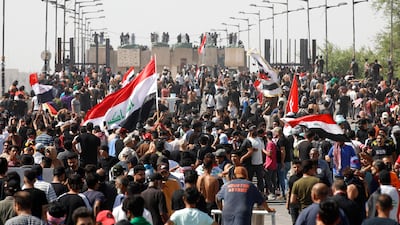
Protesters wave the Iraqi national flag as they attend a protest in Tahrir Square, Baghdad. AFP -
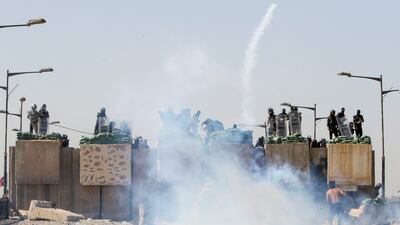
Anti-riot police, standing on barricades, disperse protesters with tear gas, in Baghdad. Reuters -
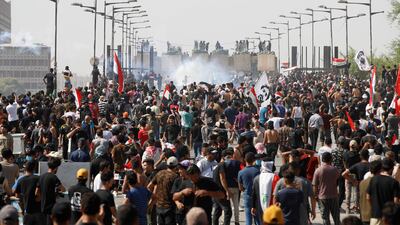
Tear gas rises as demonstrators gather in Tahrir Square in the centre of Baghdad. AFP -
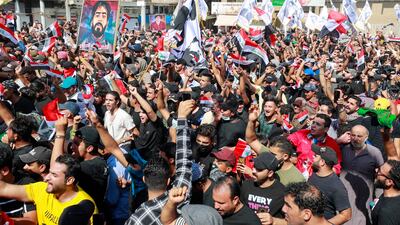
People were marking three years since anti-government protests swept through major cities in central and southern Iraq. AFP -
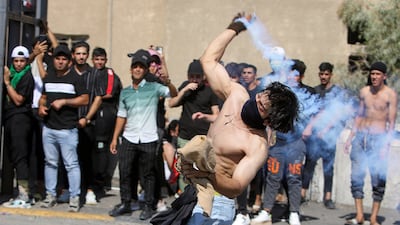
A protester hurls a tear gas canister. Reuters -
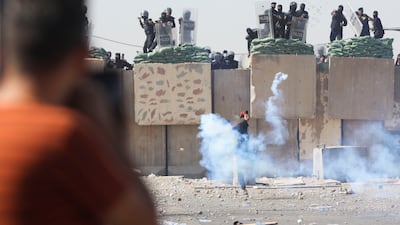
Anti-riot police clash with protesters. Reuters -
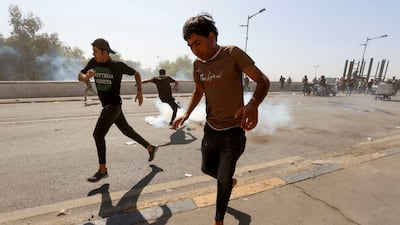
Fleeing from tear gas. Reuters -

A protester affected by tear gas is carried away. Reuters


He worked in an acting role for several ministries during Mr Al Maliki’s two terms in office from 2006 to 2014.
Mr Al Sudani begins his tenure facing a series of challenges, including the climate crisis, high unemployment, widespread corruption and dilapidated public services.
Frustration over the failure of previous governments to deal with the country’s chronic woes has sparked protests against the political elite who have been in power since 2003.
The largest protests since 2003 broke out in October 2019 in the central and southern parts of the country, leading to the resignation of the government and the approval of a new law that led to early elections, but these achievements came with a heavy price.
The leaderless, youth-led protests were met with a heavy-handed crackdown from security forces and Iran-backed militias.
About 600 protesters and members of security forces were killed in the violence, while tens of thousands were wounded.
Dozens of activists reported intimidation. There were also a number of kidnappings and assassinations.
Activists accused Iran-backed militias of being behind the assassinations while the government and the militias blamed “third parties”, without specifying who they were.
In early 2020, the protests ended due to the crackdowns and the coronavirus pandemic. Dozens of independent candidates who took part in the protests managed to win seats in parliament following the October 2021 elections.
For the first time since 2003, the Sadrist movement, a political group backed by influential Shiite cleric Moqtada Al Sadr, will be absent from the process of forming a new government.
Mr Al Sadr's political bloc emerged as the biggest in parliament after the elections, winning 73 of the 329 seats.
However, he asked his MPs to resign in June after failing to form a majority government with Sunni and Kurdish politicians. The resignation was in protest against what Mr Al Sadr called illegal attempts, mostly by the Co-ordination Framework, to block the formation of a government.
The resignations put the Co-ordination Framework in prime position to form a government, allowing it to name as prime minister Mr Al Sudani, who has been firmly rejected by Mr Al Sadr due to his ties to the cleric's bitter rival Mr Al Maliki.

