



Iraq was grappling with the prospect of all-out intra-Shiite civil strife after a day of clashes in central Baghdad and the south that analysts said could push the country into a protracted conflict resembling Yemen and Libya, where dozens of armed groups are fighting out competing agendas.
On Monday night, heavily armed rival militias battled in the streets around the seat of government in Baghdad's Green Zone. In the south, protesters set political party offices on fire and more clashes took place.
By Tuesday afternoon, there was a lull after nationalist cleric Moqtada Al Sadr, who has authority over one of the militias, ordered an immediate ceasefire. But analysts said any peace could be tenuous.
At least 30 people were killed in the worst violence in Iraq since militias crushed a national anti-government protest movement in 2019, killing hundreds then.
That followed a period of relative calm after the struggle to defeat ISIS between 2014 and 2018.
“It could be very much like a Yemen or Libya-style situation,” said Alex Almeida, a regional security consultant with the company Horizon Client Access, pointing to a situation where fighting between non-state groups has destroyed infrastructure, caused humanitarian disasters and embroiled the countries in protracted and complicated conflicts.
“It's very fluid, with groups rapidly coalescing and dispersing,” Mr Almeida said, warning that no side has the resources to gain the upper hand if fighting flares up again.
Rival militias in the Popular Mobilisation Forces (PMF), a collection of paramilitary groups ostensibly linked to the government, were once loosely held together by a common enemy — ISIS.
With that threat minimised there are growing divisions within the PMF about Iraq’s future — as well as mafia-style turf wars between factions that have involvement in continuing low-level violence, including assassinations.
But the rivalry has been supercharged after October 2021's disputed elections that have yet to produce a government.
Who are Iraq's rival militias?
-
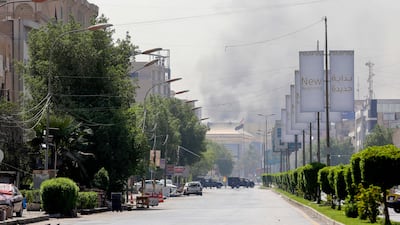
Smoke billows in the background in the capital Baghdad during an army-imposed nationwide curfew a day after 23 supporters of powerful Shiite leader Moqtada Al Sadr were shot dead during fighting in Baghdad's Green Zone. AFP -
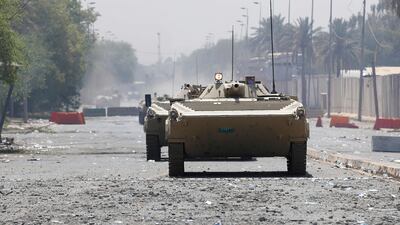
Iraqi armoured security vehicles clash with Saraya Al Salam (Peace Brigade), the military wing affiliated with Mr Al Sadr, as fighting between rival Iraqi forces resumed in Baghdad. AFP -
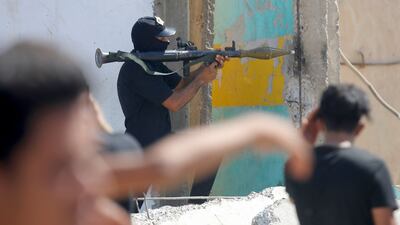
An armed member of the Peace Brigade aims a rocket-propelled grenade during clashes with Iraqi security forces in Baghdad's Green Zone. AFP -
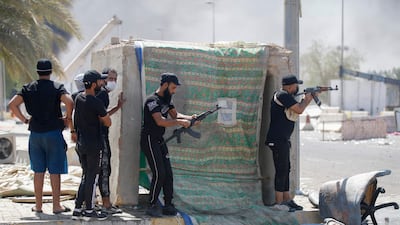
Armed members of the Peace Brigade during clashes in Baghdad's Green Zone. AFP -
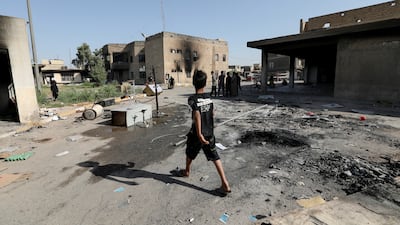
A boy walks near the office of Badr Organisation, which was burnt by supporters of Mr Al Sadr in Baghdad. Reuters -
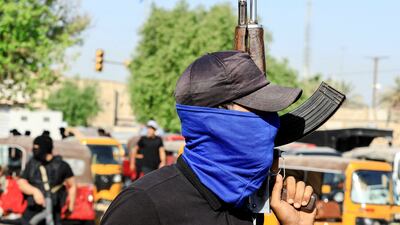
Members of Mr Al Sadr's Peace Brigade. Reuters -
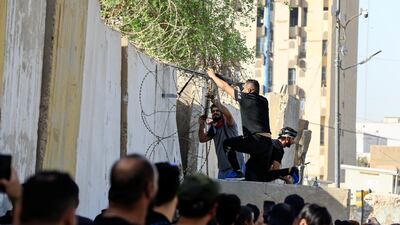
Mr Al Sadr's fighters fire their weapons. Reuters -
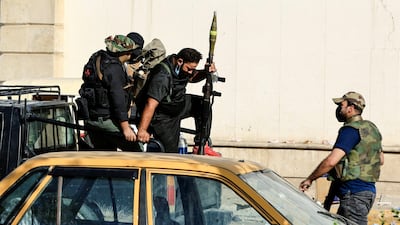
Peace Brigade fighters near the Green Zone. Reuters -
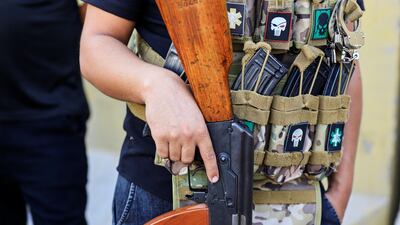
Ready to fight, a member of the Peace Brigade is laden with ammunition in Baghdad. Reuters -
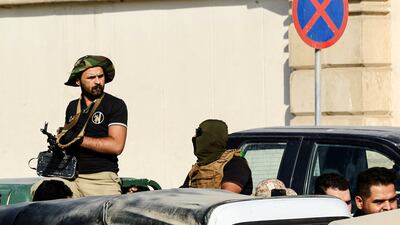
Sadrists gather during clashes with the Iraqi security forces. Reuters -
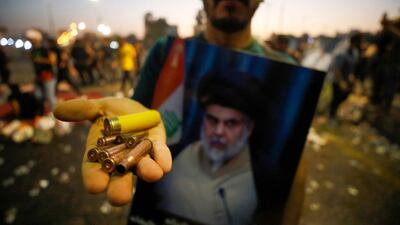
A supporter of Mr Al Sadr carries bullet casings and a spent shotgun shell in the Green Zone. AFP -
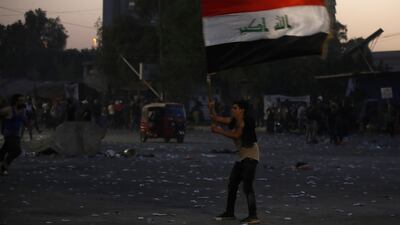
An Al Sadr supporter waves the Iraqi flag in Baghdad after the powerful Shiite cleric announced his retirement from politics. AFP -
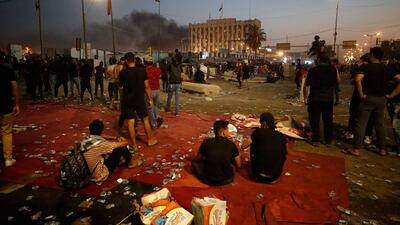
Dozens of angry supporters of Mr Al Sadr stormed the Republican Palace, a ceremonial building in the fortified Green Zone. AFP -
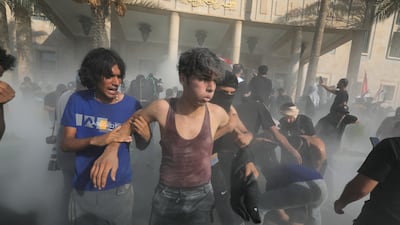
Supporters of Mr Al Sadr help injured protesters during clashes with riot police in Baghdad. EPA -
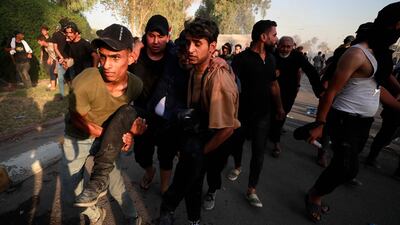
The Iraqi army has announced a Baghdad-wide curfew. AFP -
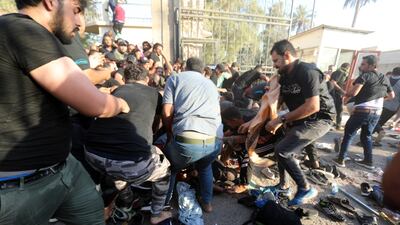
Supporters of Mr Al Sadr assist protesters injured during clashes with security forces near the prime minister's office in Baghdad. EPA -
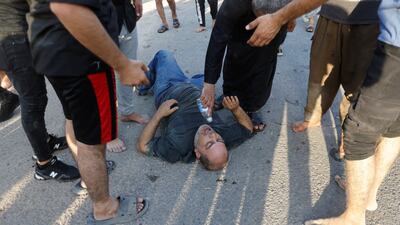
An injured supporter of Mr Al Sadr is given water during a protest in the Green Zone in Baghdad. Reuters -

Supporters of Mr Al Sadr gather in the Green Zone. AFP -
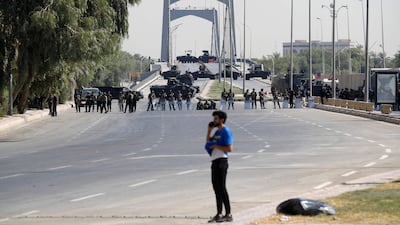
Iraqi police try to block the entrance to the Green Zone. AFP -
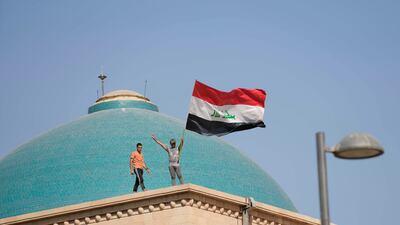
Supporters of Mr Al Sadr wave an Iraqi flag from the roof of the government palace during a demonstration in Baghdad. AP -
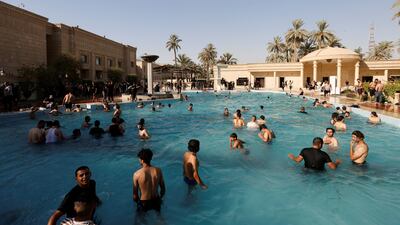
Mr Al Sadr's supporters swim amid a protest at the Republican Palace in the Green Zone in Baghdad. Reuters -
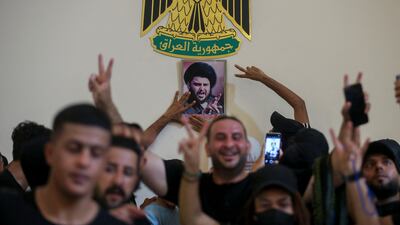
Mr Al Sadr's supporters make their feelings known through gestures inside the palace. Reuters -
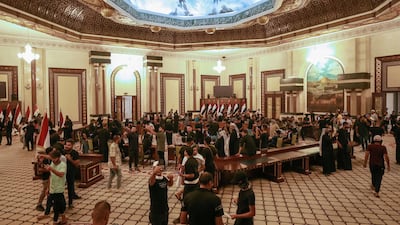
Dozens of angry supporters of Mr Al Sadr gather inside the palace in the capital Baghdad's Green Zone shortly after he said he was quitting politics. AFP -
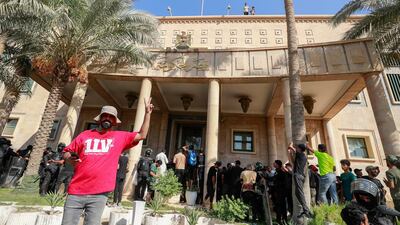
Supporters of the powerful cleric stormed the Republican Palace, a ceremonial building in the fortified Green Zone, a security source said. AFP -
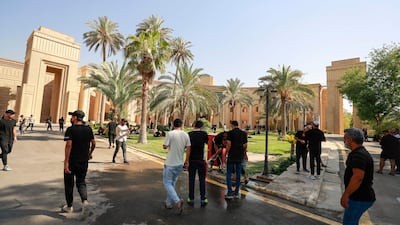
Clashes occurred between the protesters and security troops inside the palace. AFP -
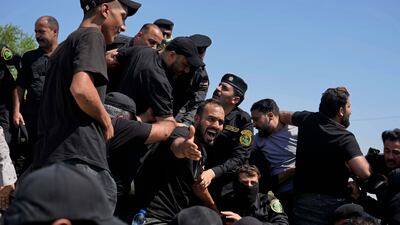
Iraqi security forces try to prevent protesters from entering the Federal Court during a demonstration in Baghdad. AP -
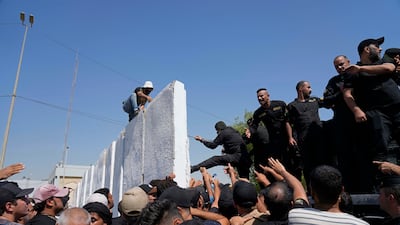
Since the end of July, Mr Al Sadr's followers have encamped around parliament, blocking access to critical government buildings. AP -
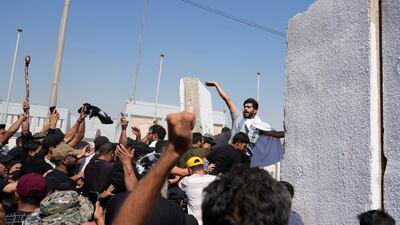
Supporters of Mr Al Sadr try to remove concrete barriers in the Green Zone area of Baghdad. AP -
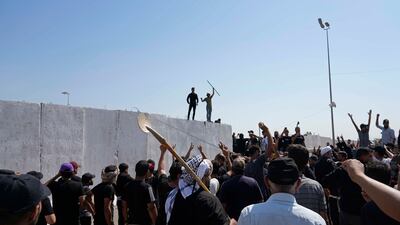
Iraqi security forces called for calm after the protesters entered the Green Zone. AP -

Iraqi security forces announced a nationwide curfew starting at 3.30pm local time following the protests. AP


On one side is Saraya Al Salam, loyal to nationalist cleric Moqtada Al Sadr. Mr Al Sadr has long rejected Iranian and US influence in Iraq, unlike his rivals in the Co-ordination Framework, who are largely linked to Iran.
Mr Al Sadr's party took the most seats in the 2021 election while the Iran-backed coalition suffered humiliating losses in the national vote.
But the cleric angrily withdrew from politics after 10 months of stalled government formation on Monday, condemning what he called corrupt and unconstitutional challenges to his right to form the next administration as the winner of the largest number of seats in October’s elections.
Facing him are a number of US and EU terrorist groups, including Kataib Hezbollah, Asaib Ahl Al Haq and Saraya Khorasani. They are associated with the Co-ordination Framework, which includes Mr Al Sadr’s rival and former prime minister Nouri Al Maliki.
Once anti-US insurgents, both groups are now heavily armed, having benefited from connections in government — including an annual budget of more than $2 billion to field tanks, drones and heavy artillery. The opposing sides have a long history of severe human rights abuses.
The bitter rivalry between these parties and their militias goes back to the period following the US invasion, long before they were merged into the fragmented PMF during the war against ISIS.
But, unlike previous intra-Shiite conflicts — which mainly focused on control of oil in cities such as Basra, holy sites in cities such as Karbala and illegal checkpoints that levied taxes, today’s friction points are across much of the country’s Shiite south, towns where many of the militiamen hail from.
These points of competition cross over tribal lines in a country that is one of the most heavily armed in the world, which worries analysts who say hopes for peace are slipping away.
Iraq can ill afford another conflict, still trying to rebuild after decades of turmoil since the Iran-Iraq war, Gulf Wars, international sanctions, the US invasion, civil strife and the fight against ISIS.
Why are the Shiites fighting?
At the heart of the latest dispute is an intra-Shiite battle for the regional alignment of Iraq, whether it will be closely aligned to Iran — including strict clerical rule along the lines of Iran’s Wilayat Al Faqih system, or whether religious Iraqi leaders in Najaf will hold sway, so-called quietists known for refraining from politics.
For Iran and Mr Al Sadr, it is a zero-sum game to dominate state institutions, their revenue and government funding, but also claims of religious authority.
“Here the state is besieged by multiple groups. It's on collision course ― and it’s interesting to see a fight in which neither side can afford to throw the first punch,” says Michael Knights, an Iraq analyst with the Washington Institute for Near East Policy.
An analysis by Mr Knights of Kataib Hezbollah, whose forces have entered the Green Zone in the past, estimates they could field a force of up to 10,000 fighters.
And he said that Iraq faces a protracted and bloody stalemate if this happens as Mr Al Sadr commands vastly more supporters but has fewer weapons than his Iran-backed rivals.
Mediation?
But Shiite political leaders have a long history of clashing, often violently, only to have last-minute meetings to defuse intra-Shiite violence and end deadlock. This happened in 2008 in Basra and in 2014 when former prime minister Mr Al Maliki was ousted.
“Chances are they will try to mediate again,” said Ruba Ali Al Hassani, postdoctoral research associate at Lancaster University.
“Prime Minister Kadhimi held talks a few weeks ago and Al Sadr refused to take part. But Al Sadr didn’t mention his Saraya Al Salam when he resigned from politics, so it raises a question, will Kadhimi and other politicians allow for violence to continue between the two coalitions,” she asked.
“I don’t like to predicate the future, but chances are that politicians will try to jump in and engage in some kind of dialogue to avoid violence.”
Sajad Jiyad, an analyst with The Century Foundation think tank, is warier that peace can be achieved.
“There is no serious mediator who will strike an agreement at this time. Nor do foreign powers know how to respond so it’s most likely that the escalation will continue. It is a serious moment but I think we still have room for more, things might get more serious,” he told The National on Monday, just before major fighting erupted.
What about the Iraqi Army?
Iraq has a regular army of more than 300,000 soldiers and — with the exception of some units, has relative political neutrality.
Iraq also has a renowned Counter Terrorism Service (CTS) trained by the US and credited with winning many battles against ISIS, as well as fighting Shiite militias during the US occupation.
Both the army and CTS were seen trying to hold the rival militias apart on Monday, but at one point appeared to have been caught up in fighting in Baghdad.
There are also other armed groups who could yet stay on the sidelines.
Firstly, there are around 10,000 militiamen in the PMF linked to Iraq’s Shiite religious leadership in Najaf and Karbala. Since Iraq’s holiest clerics, including Grand Ayatollah Ali Al Sistani, refrain from political statements and often call for peace, it’s unlikely they will mobilise for war.
Secondly, there are tens of thousands of Sunni fighters aligned with the PMF, who fought in the war against ISIS. It’s unclear whether they would wish to partake in what is, for now, a Shiite dispute.
Al Sadr’s religious challenge
On the religious front, analysts say a key development for Mr Al Sadr — who sent his fighters to defend his followers around the Green Zone in the past week ― is the retirement of Ayatollah Al Haeri, once an influential figure in the Sadrist movement.
Mr Al Haeri pledged allegiance to Iran’s Ayatollah Khamenei upon resigning, a humiliating snub for Mr Al Sadr.
"Ayatollah Al Haeri's resignation is very curious because Marjas don't really get to resign, it's a lifetime commitment. In his statement Al Haeri presses a number of political issues, talking about the Hashed (PMF) who must continue to operate outside the state's reach, calling for their endorsement and mobilisation so that the Baathists don't come back into power," Ms Al Hassani says.
"He called on all of those who emulate him to switch and emulate Khamenei and the timing is of the essence because as much as he follows Wilayat Al Faqih, why now?" she adds.
“It looks like Moqtada was really upset by Haeri's ‘retirement’ which, it seems, he's interpreting as Tehran turning the tables on him,’ said Omar Al Nidawi, an analyst with the NGO Enabling Peace in Iraq Centre.
Mr Nidawi’s outlook for Iraq’s near future is bleak, in part because Mr Al Sadr and his rivals have such a long history of using violent militias against each other.
“If Sadr feels cornered and facing an existential threat, he could lash out militarily to regain deterrence. But he also has an issue with discipline within his movement. If he loses control, things could spiral from there.
“When people don't know what to do, things can easily go wrong,” he says, pointing to the volatile character of leaders like Mr Al Maliki and Mr Al Sadr.

