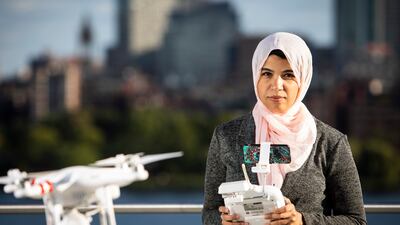
Norhan Bayomi, a postdoctoral research fellow and manager of the Climate Change and Cities Programme at MIT, deploys drones to figure out how to give communities most at risk from heatwaves a better way of life. Photo: MIT
Norhan Bayomi, a postdoctoral research fellow and manager of the Climate Change and Cities Programme at MIT, deploys drones to figure out how to give communities most at risk from heatwaves a better w

Drone and bass: Norhan Bayomi has the technology to change lives


Jacqueline Fuller
  • English
  • Arabic

Norhan Bayomi is looking flustered. She laughs and exhales at the same time, casting her eyes upwards in search of an answer.

There’s an embarrassed shrug of shoulders, a quick adjustment to her white hijab, and then she stutters out a response.

“Oh. Oh, that’s a … I don’t know. I wouldn’t … I wouldn’t call myself … I, I haven’t really reached the point, I would say, where I’ve contributed ... to science yet,” Bayomi tells The National.

What has thrown her off kilter is the suggestion that one day Mattel might bring out a Barbie in her guise, as the multinational toy company has done recently with six female healthcare professionals leading the fight against Covid-19.

Surely it can only be a matter of time before one-of-a-kind dolls are made in the image of those on the frontline of that other global crisis, climate change, to inspire girls into environmental activism or careers in science, technology, engineering and maths?

Bayomi, who is a postdoctoral research fellow and manager of the Climate Change and Cities Programme at Massachusetts Institute of Technology, briefly concedes that her work has added to the body of scientific knowledge, but says she is determined to make a “tangible impact”.

She is more interested in drones than dolls, using them to study how low-income urban communities in her home town in Cairo or the Bronx are adapting to rising temperatures and the construction methods that can improve residents’ resilience.

The thermal-imaging research for her PhD gave rise to a software start-up that Bayomi co-founded and named after Hedy Lamarr, the femme fatale with a star embedded in Hollywood Boulevard for achievements in the golden age of the entertainment industry.

By calling it Lamarr.ai, Bayomi is paying tribute to the work that the actress did in her trailer during breaks in filming, which led to the co-invention of a radio guidance system for Second World War torpedoes, which has been acknowledged as the forerunner of Wi-Fi, GPS and Bluetooth.

It seems likely that Lamarr, who once quipped that “Films have a certain place in a certain time period. Technology is forever”, would have approved.

“She got really underestimated for her innovation because she was pretty,” Bayomi says of the woman posthumously inducted into the US Inventors Hall of Fame in 2014. “She was only known for her acting career.”

This year, Bayomi cited Lamarr, the singer-songwriter and inventor Imogen Heap, and the designer and scientist Neri Oxman in a tweet wishing a happy International Women’s Day to “all the great ladies who inspired the world and more who will come”.

“Science and art, this is the pathway I see myself on in 20 years or so … if," she says with a self-conscious laugh, "I’m still alive."

Hedy Lamarr, left in the laboratory and in a still from the 1941 film 'Ziegfeld Girl', is a role model to multi-faceted scientists and artists such as Norhan Bayomi. Photo: Bombshell: The Hedy Lamarr Story / Getty

If the comment seems a little odd coming from someone who is only 33, there is a simple, but painful, explanation.

Born in Maadi, Cairo, Bayomi recalls a happy childhood amid the warmth of the weather and the Egyptian people, with Ramadan and the vibrant social interactions during iftar prominent among her favourite memories.

Having spent much time watching Hollywood movies, the young Norhan dreamt of a career in medicine in the US but she would deviate down the engineering path.

Because she had long been interested in the design of buildings, especially the modernist work of the British-Iraqi Zaha Hadid, further studies beckoned.

“Architecture is like a platform that links art and engineering,” Bayomi says. “It was the right choice for me.”

One morning in 2004, she set off for Cairo University for the first day of exams in the second year of that architecture degree.

Her older brother, Tamer, a police officer with special forces like their father, had gone to work where he was accidentally shot dead by a colleague. He was 22.

Born in Maadi, Cairo, the young Norhan had a happy childhood amid the warmth of the weather and the Egyptian people, with Ramadan and the vibrant social interactions during iftar favourite memories. Norhan Bayomi

There is an ache in her voice as she talks about the shock of returning home that afternoon to learn of the tragedy, of somehow pushing through the grief to complete the semester and − “Thank God,” she says − passing the academic year.

With the adversity came profound lessons that shaped the person Bayomi is today.

“I would say that the loss of my father, who passed away in 2017, and my brother taught me how to really pay attention to what is important and appreciate every minute I have,” she says.

“It taught me not to care too much about what other people think or materialistic things because life is very short. You don’t know if you are going to wake up the next day.”

Years of hard work have put her at the forefront of the next generation of multi-faceted scientists and artists pushing the boundaries of how women are perceived.

Modestly, Bayomi considers herself to be “a very average person”, but anyone who has read her curriculum vitae would disagree.

It runs to a daunting nine pages: of degrees (four, including a PhD and two masters, in architecture, building technology, planning, and science in environmental design and sustainability); research (12 years); the co-founding of two start-ups and an architectural firm with branches in Cairo and Riyadh; peer-reviewed journal articles (eight and counting); conference presentations and public talks; and honours and awards.

It doesn’t even mention what is perhaps the most surprising revelation of all: that Bayomi, also known as Nourey, is an electronic music producer and DJ signed to one of the biggest trance labels in the world, with regular residencies and live streams listened to by millions.

The parallels between Bayomi – architect, scientist, inventor, musician − and her role models are obvious. One of them is even a professor at MIT in the Media Lab.

“I’ve spoken at length to Neri Oxman,” she says. “It inspired me a lot.”

Much of Bayomi’s research at the institute has been guided by a desire to help the elderly, socially isolated and impoverished cope with the extreme impacts of climate change on their built environments.

During fieldwork for her graduate thesis in the low-income area of Al Darb Al Ahmar near her hometown in the capital, the vulnerability of residents to the region’s rising temperatures was powerfully illustrated by a family of five living in a single cramped room with no windows.

The sunset skyline of old Cairo from the Saladin Citadel, overlooking Al Darb Al Ahmar, the poor neighbourhood where Bayomi has conducted much of her research fieldwork.

“They didn’t even have a TV or an oven or something to cook,” she says. “They were just living with barely the minimum requirements.”

When Bayomi recounts stages like this along her “research journey”, the sentences are frequently punctuated with gratitude for her adviser, Prof John Fernandez.

Prof Fernandez was a former classical pianist who went into science, engineering and then on to design 2.5 million square feet of new construction in cities around the world as an architect.

He has been there for Bayomi through thick and thin, providing mental and emotional support when she could not attend her father’s funeral, and teaching her how to take risks and responsibility and dedicate herself.

Encouraged by Prof Fernandez to think about applying different technologies to her research as a PhD student at MIT, Bayomi returned to Cairo.

This time, she took drones with infra-red cameras to figure out how to give those most at risk from heatwaves a better way of life.

“These people are really overlooked in terms of support or providing capacity to cope with the climate challenges that they will face in the future,” Bayomi says.

“I saw that people, whether in Cairo or the Bronx, are desperate for the government to pay attention to their needs …

Bayomi with her adviser, Prof John Fernandez, at her masters commencement at Massachusetts Institute of Technology in 2017. Photo: Norhan Bayomi

“Research plays a huge role in highlighting the kind of problems that these areas are facing.

"I hope that my research will really get the attention of policymakers to understand that they need to put more resources into existing problems, in addition, of course, to looking at their sustainable development goals.”

Technology is integral, too, to Bayomi’s trance music, the more melodic offshoot from techno and house featuring a tempo lying between 125 and 150 beats a minute.

She uses it to convey messages that are important to her, not least the need for people to take action to address environmental issues.

Her signing by Anjunabeats was a “dream come true”, owing much to the fact that the London record label is owned by her idols Above & Beyond, arguably the world’s biggest electronic dance music act.

“They’re not just writing music,” she says. “They are writing music to inspire people, to change people’s lives, and their tracks have meaning behind them.”

The date of Bayomi’s first livestream, from her university dorm on July 15, 2020, is indelibly marked on her memory.

She rates it as her best so far, but it sparked a panic attack over potentially messing up, how people would react to seeing a woman in a hijab playing music or even if they would like the “vibe”.

Perhaps the most surprising revelation about Bayomi is that she is an electronic music producer and DJ - aka Nourey - signed to one of the biggest trance labels in the world. Photo: Norhan Bayomi

“People were really supportive, and trying to push me, saying: ‘Yes, you can … you should do this more often,” she recalls of the response.

The anxiety disorder makes her sceptical about whether she is ready to play in front of a live audience as big gigs start to return with the easing of coronavirus restrictions.

But she hopes to continue to manage her stress levels with meditation, yoga and a spot of kickboxing.

Bayomi’s interest in the trance genre began when her father, Magdy, came back from a work trip in the US with a CD by the Italian group Eiffel 65, which featured Blue, one of the biggest international hit singles of the 1990s.

The style was a shift from the Pink Floyd and Queen vinyl records that he would sing along to with his children in the family living room on his one day off work each week.

Her father was, Bayomi says, the reason she grew up loving music. The guitar he gave his daughter for her 10th birthday ignited a passion for rock that would result in her playing covers of Nirvana and Metallica at small events for friends in an all-girl band called Mascara as an undergraduate in Cairo.

The guitar given to Bayomi by her father when she was 10 ignited a passion for rock as evidenced by the Kiss T-shirt she sports, above. Stereotypes,' she says, 'are just rules made by other people.' Photo: Norhan Bayomi

Unusually, the grungy sound infuses her trance creations, partly due to this musical heritage but also perhaps an inevitable consequence of writing the tracks for guitar first before switching to electronic production.

There is an EP on the way, with the lyrics of the title single Meant to Be referencing identity, inclusion and diversity in what Bayomi describes as a musical reflection of her own lived experience.

“You should do whatever makes you happy in life,” she says. “Pursue whatever makes you feel like you, and don’t really pay much attention to stereotypes or social limitations because these are just rules made by other people.

“At the end, it matters who you are. The purpose of being humans is to be good to each other and not how people look. We should be looking for what is inside.”

What makes Bayomi happiest, she says, is seeing her mother, working on music or research that has a purpose “bigger than mine”… and celebrating special achievements by eating mint chocolate and coffee ice cream.

She is trying to cut back on the latter but, given her track record of triumph after triumph, enforcing any sort of scoop limit might just be her most difficult feat yet.


The Programme

Saturday, October 26: ‘The Time That Remains’ (2009) by Elia Suleiman
Saturday, November 2: ‘Beginners’ (2010) by Mike Mills
Saturday, November 16: ‘Finding Vivian Maier’ (2013) by John Maloof and Charlie Siskel
Tuesday, November 26: ‘All the President’s Men’ (1976) by Alan J Pakula
Saturday, December 7: ‘Timbuktu’ (2014) by Abderrahmane Sissako
Saturday, December 21: ‘Rams’ (2015) by Grimur Hakonarson

SPECS
%3Cp%3E%3Cstrong%3EEngine%3A%20%3C%2Fstrong%3E2-litre%204-cylinder%20petrol%20(V%20Class)%3B%20electric%20motor%20with%2060kW%20or%2090kW%20powerpack%20(EQV)%0D%3Cbr%3E%3Cstrong%3EPower%3A%3C%2Fstrong%3E%20233hp%20(V%20Class%2C%20best%20option)%3B%20204hp%20(EQV%2C%20best%20option)%0D%3Cbr%3E%3Cstrong%3ETorque%3A%3C%2Fstrong%3E%20350Nm%20(V%20Class%2C%20best%20option)%3B%20TBA%20(EQV)%0D%3Cbr%3E%3Cstrong%3EOn%20sale%3A%20%3C%2Fstrong%3EMid-2024%0D%3Cbr%3E%3Cstrong%3EPrice%3A%20%3C%2Fstrong%3ETBA%0D%3C%2Fp%3E%0A

Mercer, the investment consulting arm of US services company Marsh & McLennan, expects its wealth division to at least double its assets under management (AUM) in the Middle East as wealth in the region continues to grow despite economic headwinds, a company official said.

Mercer Wealth, which globally has $160 billion in AUM, plans to boost its AUM in the region to $2-$3bn in the next 2-3 years from the present $1bn, said Yasir AbuShaban, a Dubai-based principal with Mercer Wealth.

Within the next two to three years, we are looking at reaching $2 to $3 billion as a conservative estimate and we do see an opportunity to do so,” said Mr AbuShaban.

Mercer does not directly make investments, but allocates clients’ money they have discretion to, to professional asset managers. They also provide advice to clients.

“We have buying power. We can negotiate on their (client’s) behalf with asset managers to provide them lower fees than they otherwise would have to get on their own,” he added.

Mercer Wealth’s clients include sovereign wealth funds, family offices, and insurance companies among others.

From its office in Dubai, Mercer also looks after Africa, India and Turkey, where they also see opportunity for growth.

Wealth creation in Middle East and Africa (MEA) grew 8.5 per cent to $8.1 trillion last year from $7.5tn in 2015, higher than last year’s global average of 6 per cent and the second-highest growth in a region after Asia-Pacific which grew 9.9 per cent, according to consultancy Boston Consulting Group (BCG). In the region, where wealth grew just 1.9 per cent in 2015 compared with 2014, a pickup in oil prices has helped in wealth generation.

BCG is forecasting MEA wealth will rise to $12tn by 2021, growing at an annual average of 8 per cent.

Drivers of wealth generation in the region will be split evenly between new wealth creation and growth of performance of existing assets, according to BCG.

Another general trend in the region is clients’ looking for a comprehensive approach to investing, according to Mr AbuShaban.

“Institutional investors or some of the families are seeing a slowdown in the available capital they have to invest and in that sense they are looking at optimizing the way they manage their portfolios and making sure they are not investing haphazardly and different parts of their investment are working together,” said Mr AbuShaban.

Some clients also have a higher appetite for risk, given the low interest-rate environment that does not provide enough yield for some institutional investors. These clients are keen to invest in illiquid assets, such as private equity and infrastructure.

“What we have seen is a desire for higher returns in what has been a low-return environment specifically in various fixed income or bonds,” he said.

“In this environment, we have seen a de facto increase in the risk that clients are taking in things like illiquid investments, private equity investments, infrastructure and private debt, those kind of investments were higher illiquidity results in incrementally higher returns.”

The Abu Dhabi Investment Authority, one of the largest sovereign wealth funds, said in its 2016 report that has gradually increased its exposure in direct private equity and private credit transactions, mainly in Asian markets and especially in China and India. The authority’s private equity department focused on structured equities owing to “their defensive characteristics.”

Coffee: black death or elixir of life?

It is among the greatest health debates of our time; splashed across newspapers with contradicting headlines - is coffee good for you or not?

Depending on what you read, it is either a cancer-causing, sleep-depriving, stomach ulcer-inducing black death or the secret to long life, cutting the chance of stroke, diabetes and cancer.

The latest research - a study of 8,412 people across the UK who each underwent an MRI heart scan - is intended to put to bed (caffeine allowing) conflicting reports of the pros and cons of consumption.

The study, funded by the British Heart Foundation, contradicted previous findings that it stiffens arteries, putting pressure on the heart and increasing the likelihood of a heart attack or stroke, leading to warnings to cut down.

Numerous studies have recognised the benefits of coffee in cutting oral and esophageal cancer, the risk of a stroke and cirrhosis of the liver. 

The benefits are often linked to biologically active compounds including caffeine, flavonoids, lignans, and other polyphenols, which benefit the body. These and othetr coffee compounds regulate genes involved in DNA repair, have anti-inflammatory properties and are associated with lower risk of insulin resistance, which is linked to type-2 diabetes.

But as doctors warn, too much of anything is inadvisable. The British Heart Foundation found the heaviest coffee drinkers in the study were most likely to be men who smoked and drank alcohol regularly.

Excessive amounts of coffee also unsettle the stomach causing or contributing to stomach ulcers. It also stains the teeth over time, hampers absorption of minerals and vitamins like zinc and iron.

It also raises blood pressure, which is largely problematic for people with existing conditions.

So the heaviest drinkers of the black stuff - some in the study had up to 25 cups per day - may want to rein it in.

Rory Reynolds

Company%20profile
%3Cp%3EName%3A%20Cashew%0D%3Cbr%3EStarted%3A%202020%0D%3Cbr%3EFounders%3A%20Ibtissam%20Ouassif%20and%20Ammar%20Afif%0D%3Cbr%3EBased%3A%20Dubai%2C%20UAE%0D%3Cbr%3EIndustry%3A%20FinTech%0D%3Cbr%3EFunding%20size%3A%20%2410m%0D%3Cbr%3EInvestors%3A%20Mashreq%2C%20others%0D%3C%2Fp%3E%0A
The specs
 
Engine: 3.0-litre six-cylinder turbo
Power: 398hp from 5,250rpm
Torque: 580Nm at 1,900-4,800rpm
Transmission: Eight-speed auto
Fuel economy, combined: 6.5L/100km
On sale: December
Price: From Dh330,000 (estimate)
Ferrari 12Cilindri specs

Engine: naturally aspirated 6.5-liter V12

Power: 819hp

Torque: 678Nm at 7,250rpm

Price: From Dh1,700,000

Available: Now

Gender equality in the workplace still 200 years away

It will take centuries to achieve gender parity in workplaces around the globe, according to a December report from the World Economic Forum.

The WEF study said there had been some improvements in wage equality in 2018 compared to 2017, when the global gender gap widened for the first time in a decade.

But it warned that these were offset by declining representation of women in politics, coupled with greater inequality in their access to health and education.

At current rates, the global gender gap across a range of areas will not close for another 108 years, while it is expected to take 202 years to close the workplace gap, WEF found.

The Geneva-based organisation's annual report tracked disparities between the sexes in 149 countries across four areas: education, health, economic opportunity and political empowerment.

After years of advances in education, health and political representation, women registered setbacks in all three areas this year, WEF said.

Only in the area of economic opportunity did the gender gap narrow somewhat, although there is not much to celebrate, with the global wage gap narrowing to nearly 51 per cent.

And the number of women in leadership roles has risen to 34 per cent globally, WEF said.

At the same time, the report showed there are now proportionately fewer women than men participating in the workforce, suggesting that automation is having a disproportionate impact on jobs traditionally performed by women.

And women are significantly under-represented in growing areas of employment that require science, technology, engineering and mathematics skills, WEF said.

* Agence France Presse

Pearls on a Branch: Oral Tales
​​​​​​​Najlaa Khoury, Archipelago Books

Updated: August 11, 2022, 8:05 AM