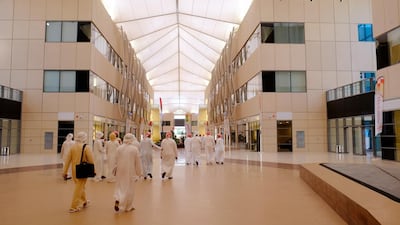
Students at the Zayed University Campus, Abu Dhabi, UAE. Antonie Robertson/The National

Why we need to encourage young Emirati women to take up Stem subjects


  • English
  • Arabic

Disruptive technologies are changing the way we plan for the future. As the UAE becomes a knowledge-based economy, jobs will soon be linked to an even greater extent to careers focused on science, technology, engineering and mathematics – the so-called Stem subjects. The 2020 Future of Jobs report by the World Economic Forum highlights that in the next five years, new jobs will be reserved for data analysts and scientists and software and applications developers.

The UAE government foresaw the importance of focusing its efforts on innovation and providing young people with opportunities to explore this and contribute to diversifying the economy. I also have my family to thank for encouraging me to pursue my passion. My father is an engineer and my mother studied IT, so I have always been surrounded by these conversations.

However, despite great efforts by families, the government, education providers and major employers, we need to do more to encourage our young people to remain engaged in science and technology. Children below the age of five can show signs of analytical thinking, and we need to nurture this skill early on.

The question is, how do we ensure that young people do not lose interest? How can we encourage them to continue embracing innovative thinking? I believe the key is to show them the fruits of their labours.

Children can show signs of analytical thinking, and we need to nurture this skill early on

I learnt to invent with a purpose. For example, I visited Tawam Hospital in Abu Dhabi and noticed that children with cancer were unable to attend school. This inspired me to invent the “smart teleporter”, a robot that attends school on behalf of students and records classes for them – similar to remote learning.

The government, as well as entities such as the Mubadala Investment Company, have continued to nurture Emirati talent and prepare us to pursue careers in Stem subjects, which essentially are the building blocks for economic diversification.

The Abu Dhabi government has been instilling the importance of innovation in our youth through initiatives such as Hub71, a platform to attract foreign talent, and Cleveland Clinic Abu Dhabi’s junior caregiver programme, which helps drive interest in healthcare careers. Companies such as Emirates Global Aluminium, meanwhile, have been funding student research. By leveraging these resources, emerging national talents are being equipped to lead across innovative sectors in line with the Abu Dhabi 2030 Economic Vision.

Fatima Al Kaabi poses with a robot as part of a project she worked on at an event organised by Expo 2020. Handout

In addition to increasing its efforts on preparing youth for tomorrow's world, the UAE is increasingly focusing on how innovation is changing the way we live and operate. This is one of the touchpoints of Mubadala's investigative documentary, Investing in innovation: the future is here, which I had the pleasure of hosting alongside prominent speakers such as Dr Sultan Al Jaber, Minister of Industry and Advanced Technology, and Waleed Al Mokarrab Al Muhairi, Mubadala's deputy group chief executive.

The documentary elaborates on Mubadala’s efforts, in parallel with our nation’s leadership and global partners, to help position the UAE as a hub for enhancing the global innovation ecosystem.

Throughout this experience, I sought to bring to light the challenges we face in these industries and how we are navigating them. I did this by interviewing some of Mubadala’s partners, including Kirsty Lloyd-Jukes, the investor relations principal at Waymo, an American autonomous driving technology development company. Ms Lloyd-Jukes described the machine-learning applications being utilised in building Waymo’s autonomous vehicles. I also spoke to Mark Gillett, the managing director of Silver Lake, about large-scale technology investing, how the firm identifies companies and technologies, and how disruption and technologies such as AI and cloud computing continue to change the way we work.

Clearly, inventing with purpose leads the younger generation to dream big. The UAE, for instance, is preparing to send the first female Arab astronaut to space. This is a perfect example of how moving the needle isn’t simply about reaching historical milestones but opening the doors for anyone to achieve their dreams.

Reem Al Marzouqi saw a video of an armless pilot in the US Air force in 2008. After finding out that this pilot could fly but not drive, she decided to make a car that would only require the use of one's feet. It is seen here along with its "innovator", in Al Ain, UAE, October 31, 2013. Lee Hoagland / The National

There are many young Emirati women leading the way. Reem Al Marzouqi is an inventor and engineer who created a car that can be driven with one’s feet, and an interactive robot for children on the Autism spectrum. Roudha bin Baher is an engineer who was the only female to participate in the World Skills competition, in the refrigeration and air conditioning category. She also started a mentoring programme with Danfoss Engineering to promote female representation in the field.

These are only some of the role models to have guided me through some of the obstacles women typically encounter.

With all these remarkable achievements, there are still global challenges that must and can be overcome.

Whether international leaders introduce initiatives across schools, or tech companies establish programmes to provide school children with the tools to discover these fields, the global community must do more.

By continuing to invest in innovation and providing the younger generations with these resources, we will pave the way for young Emiratis to become the technology stars of the future.

The documentary will be live on the Mubadala website on June 23. For details, visit mubadala.com

Fatima Al Kaabi is an award-winning student who was recognised in 2015 as the youngest Emirati inventor. She is currently studying computer engineering at Virginia Tech University


COMPANY PROFILE
Name: Mamo 

 Year it started: 2019 Founders: Imad Gharazeddine, Asim Janjua

 Based: Dubai, UAE

 Number of employees: 28

 Sector: Financial services

 Investment: $9.5m

 Funding stage: Pre-Series A Investors: Global Ventures, GFC, 4DX Ventures, AlRajhi Partners, Olive Tree Capital, and prominent Silicon Valley investors. 


Mercer, the investment consulting arm of US services company Marsh & McLennan, expects its wealth division to at least double its assets under management (AUM) in the Middle East as wealth in the region continues to grow despite economic headwinds, a company official said.

Mercer Wealth, which globally has $160 billion in AUM, plans to boost its AUM in the region to $2-$3bn in the next 2-3 years from the present $1bn, said Yasir AbuShaban, a Dubai-based principal with Mercer Wealth.

Within the next two to three years, we are looking at reaching $2 to $3 billion as a conservative estimate and we do see an opportunity to do so,” said Mr AbuShaban.

Mercer does not directly make investments, but allocates clients’ money they have discretion to, to professional asset managers. They also provide advice to clients.

“We have buying power. We can negotiate on their (client’s) behalf with asset managers to provide them lower fees than they otherwise would have to get on their own,” he added.

Mercer Wealth’s clients include sovereign wealth funds, family offices, and insurance companies among others.

From its office in Dubai, Mercer also looks after Africa, India and Turkey, where they also see opportunity for growth.

Wealth creation in Middle East and Africa (MEA) grew 8.5 per cent to $8.1 trillion last year from $7.5tn in 2015, higher than last year’s global average of 6 per cent and the second-highest growth in a region after Asia-Pacific which grew 9.9 per cent, according to consultancy Boston Consulting Group (BCG). In the region, where wealth grew just 1.9 per cent in 2015 compared with 2014, a pickup in oil prices has helped in wealth generation.

BCG is forecasting MEA wealth will rise to $12tn by 2021, growing at an annual average of 8 per cent.

Drivers of wealth generation in the region will be split evenly between new wealth creation and growth of performance of existing assets, according to BCG.

Another general trend in the region is clients’ looking for a comprehensive approach to investing, according to Mr AbuShaban.

“Institutional investors or some of the families are seeing a slowdown in the available capital they have to invest and in that sense they are looking at optimizing the way they manage their portfolios and making sure they are not investing haphazardly and different parts of their investment are working together,” said Mr AbuShaban.

Some clients also have a higher appetite for risk, given the low interest-rate environment that does not provide enough yield for some institutional investors. These clients are keen to invest in illiquid assets, such as private equity and infrastructure.

“What we have seen is a desire for higher returns in what has been a low-return environment specifically in various fixed income or bonds,” he said.

“In this environment, we have seen a de facto increase in the risk that clients are taking in things like illiquid investments, private equity investments, infrastructure and private debt, those kind of investments were higher illiquidity results in incrementally higher returns.”

The Abu Dhabi Investment Authority, one of the largest sovereign wealth funds, said in its 2016 report that has gradually increased its exposure in direct private equity and private credit transactions, mainly in Asian markets and especially in China and India. The authority’s private equity department focused on structured equities owing to “their defensive characteristics.”

Avatar: Fire and Ash

Director: James Cameron

Starring: Sam Worthington, Sigourney Weaver, Zoe Saldana

Rating: 4.5/5

The%20specs
%3Cp%3E%3Cstrong%3EEngine%3A%20%3C%2Fstrong%3E6.5-litre%20V12%3Cbr%3E%3Cstrong%3EPower%3A%20%3C%2Fstrong%3E725hp%20at%207%2C750rpm%3Cbr%3E%3Cstrong%3ETorque%3A%20%3C%2Fstrong%3E716Nm%20at%206%2C250rpm%3Cbr%3E%3Cstrong%3ETransmission%3A%20%3C%2Fstrong%3E8-speed%20dual-clutch%20auto%3Cbr%3E%3Cstrong%3EOn%20sale%3A%20%3C%2Fstrong%3EQ4%202023%3Cbr%3E%3Cstrong%3EPrice%3A%20%3C%2Fstrong%3EFrom%20Dh1%2C650%2C000%3C%2Fp%3E%0A
Brief scores:

Toss: Northern Warriors, elected to field first

Bengal Tigers 130-1 (10 ov)

Roy 60 not out, Rutherford 47 not out

Northern Warriors 94-7 (10 ov)

Simmons 44; Yamin 4-4