


The head of the UAE's space programme has been named in a list of the most influential women of 2020.
Sarah Al Amiri, Minister of State for Advanced Sciences and chair of the UAE Space Agency, was included in the BBC's 100 Women 2020.
A computer engineer who began her career building satellites, the minister oversaw the recent launch of the Mars space probe Hope in July, which made headlines across the globe.
The spacecraft is due to reach Mars in February and begin orbiting to collect important scientific data.
Ms Al Amiri will also lead the country's plans to send an unmanned craft to the Moon by 2024.
The minister, one of the youngest in the UAE Cabinet, was included in a list alongside Sanna Marin, who leads Finland's all-female coalition government, Hollywood actress Michelle Yeoh, star of the new Avatar and Marvel films and Sarah Gilbert, who heads the University of Oxford's research into a coronavirus vaccine. Jane Fonda, the actress and climate activist, was also among the top 100.
Sheikh Mohammed bin Rashid, Vice President, Prime Minister and Ruler of Dubai, congratulated Ms Al Amiri on Tuesday.
"She is leading a campaign to show Arab women that they can achieve anything," he wrote on Instagram.
"And nothing is impossible for her."
In a year of unprecedented turbulence, this year’s theme is ‘How Women Led Change in 2020’.
It celebrates some of the scientists, public health experts, and healthcare workers who have helped us weather the storm of the global pandemic.
Women from other industries who have all been leaders of change in their own way — from politicians, lawyers and architects to actors, writers, athletes, singers and those who have sought to improve the lives of others in their community — also made it to the list.
BBC’s top 100 women was established in 2013 as an annual series focused on a list of 100 inspirational women. It examines the role of women in the 21st century and celebrates their achievements.
UAE's space ambitions - in pictures
-
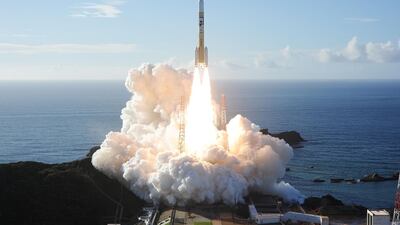
The Hope probe launches from Japan's Tanegashima Space Centre on July 20. AFP -
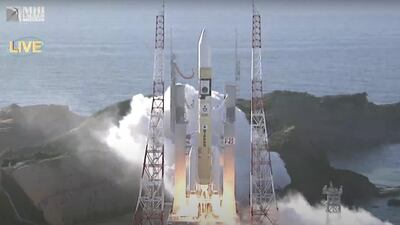
It will take the spacecraft, which later detached from the rocket, about 200 days to reach the Red Planet, arriving in February 2021. Courtesy: Mitsubishi Heavy Industries -

The launch of the rocket is captured on video at Japan's Tanegashima Space Centre. Courtesy: Mitsubishi Heavy Industries -
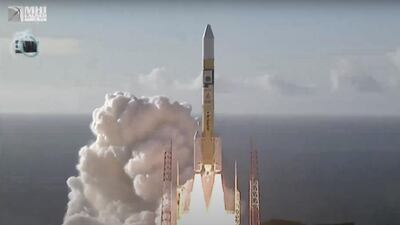
The first homegrown Arab space mission drew in interest from across the globe. Courtesy: Mitsubishi Heavy Industries -
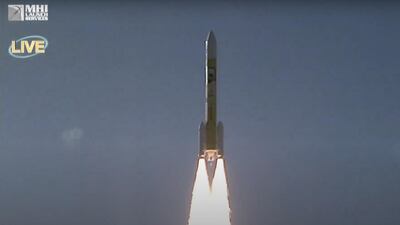
The launch of the rocket from Japan's Tanegashima Space Centre. Courtesy: Mitsubishi Heavy Industries -

Waiting for the launch in the morning light. MHI Launch Services twitter -

Emirati journalists clap as they watch the launch of the Hope space probe at Mohammed bin Rashid Space Centre in Dubai. AP -
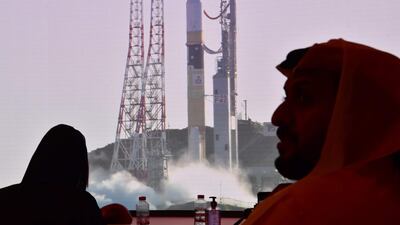
A broadcasting of the launch of the Hope Mars probe at the Mohammed Bin Rashid Space Centre in Dubai. AFP -
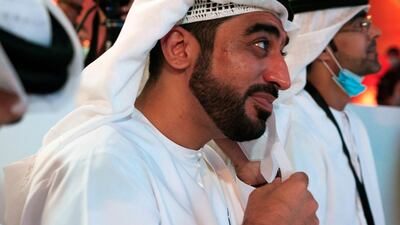
An Emirati man wipes a tear away with his face mask while watching the launch of the Hope space probe at Mohammed bin Rashid Space Centre in Dubai. AP -
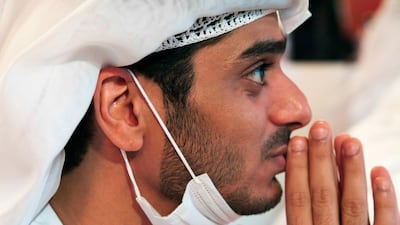
Mohammed Al Mannaee, an announcer with Dubai TV, reacts as he watches the launch. AP -

Sarah Al Ameeri and the UAE team watch the launch at at the Tanegashima Space Centre -
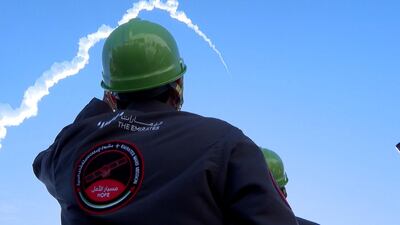
The UAE team watch the launch of the Mars Hope probe at at the Tanegashima Space Centre. -
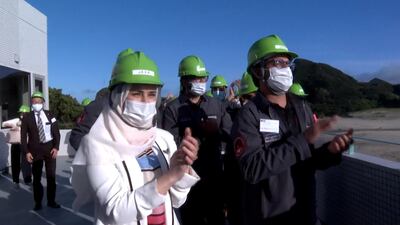
Sarah Al Ameeri and the UAE team watch the launch at at the Tanegashima Space Centre -
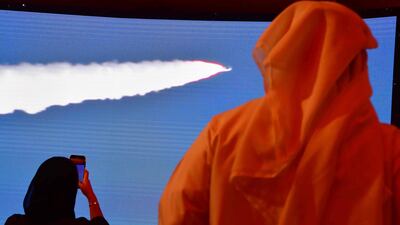
A screen broadcasts the launch of the Mars probe at Mohammed bin Rashid Space Centre in Dubai. AFP -
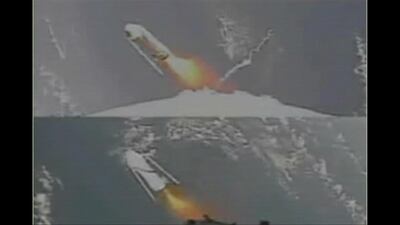
Solid rocket booster (SRB-A) was separated after burnout during the launch of the H-2A rocket carrying the Hope Probe, developed by the Mohammed Bin Rashid Space Centre (MBRSC) in the United Arab Emirates (UAE) for the Mars explore, are recorded by cameras onboard the rocket after the lauch from Tanegashima Space Center on the island of Tanegashima, Japan. REUTERS -
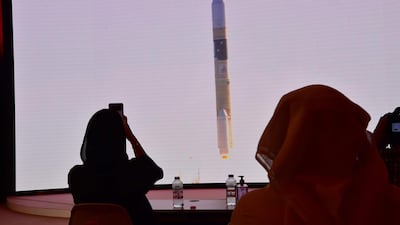
A screen broadcasts the launch of the Mars probe at Mohammed bin Rashid Space Centre in Dubai. AFP -
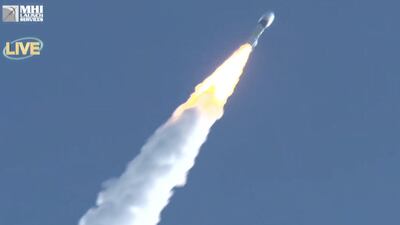
The launch of the rocket from Japan's Tanegashima Space Centre. Courtesy: MHI Launch Services -
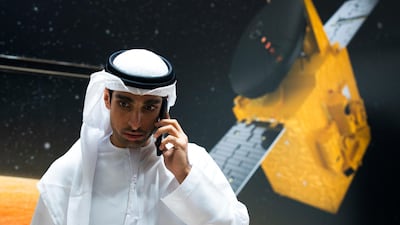
Omran Sharaf, the project director for the Hope space probe, speaks on his mobile phone at Mohammed bin Rashid Space Centre in Dubai. AP -
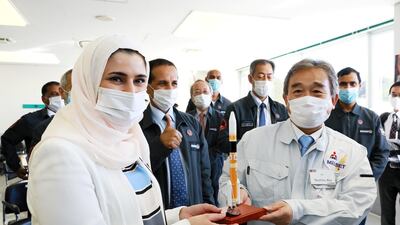
Sarah Al Ameeri, Minister of State for Advanced Sciences of United Arab Emirates, celebrates with Naohiko Abe, Mitsubishi Heavy Industries (MHI) Senior Vice President, Head of Integrated Defence and Space Systems, after the successful launch of the H-2A rocket carrying the Hope Probe, developed by the Mohammed Bin Rashid Space Centre (MBRSC) in the United Arab Emirates (UAE) for the Mars explore, at Tanegashima Space Center on the island of Tanegashima, Japan. REUTERS -
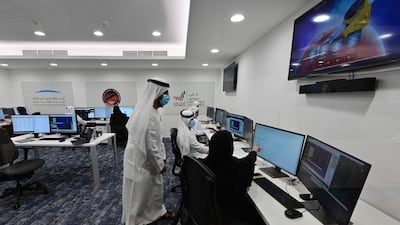
Emiratis are pictured at the Mohammed Bin Rashid Space Centre in Dubai ahead of the expected launch of the "Hope" Mars probe from Japan. AFP -
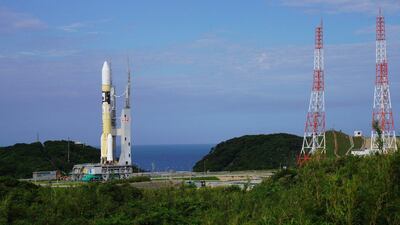
The weather was clear over Tanegashima Island in southern Japan on Sunday after weeks of rain and cloudy conditions. Courtesy: Dubai Media Office -
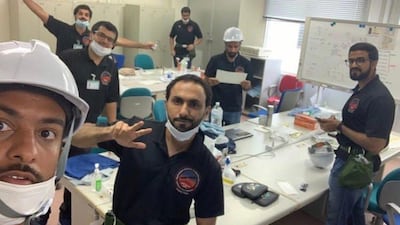
Emirati engineers wave in a picture taken on Sunday from Japan's Tanegashima Space Centre. Courtesy: Emirates Mars Mission / UAE Space Agency -

The launch of the rocket from Japan's Tanegashima Space Centre. Screengrab courtesy MHI Launch Services



