• The first crew to go to the International Space Station included (left to right) Sergei Krikalev, Bill Shepherd and Yuri Gidzenko. Courtesy: Nasa
    The first crew to go to the International Space Station included (left to right) Sergei Krikalev, Bill Shepherd and Yuri Gidzenko. Courtesy: Nasa
  • The new International Space Station after the crew of the Space Shuttle Endeavour captured the Zarya Control Module, left, and mated it with the Unity Node, right, inside the Shuttle's payload bay. This photo was taken after Endeavour undocked from the space station on Dec. 13, 1998, for the return to Earth. Almost two years later, the first crew _ American Bill Shepherd and Russians Sergei Krikalev and Yuri Gidzenko _ blasted off from Kazakhstan on Oct. 31, 2000, en route to the space station. Thus began 20 years of international cooperation and a steady stream of crew from around the world. (NASA via AP)
    The new International Space Station after the crew of the Space Shuttle Endeavour captured the Zarya Control Module, left, and mated it with the Unity Node, right, inside the Shuttle's payload bay. This photo was taken after Endeavour undocked from the space station on Dec. 13, 1998, for the return to Earth. Almost two years later, the first crew _ American Bill Shepherd and Russians Sergei Krikalev and Yuri Gidzenko _ blasted off from Kazakhstan on Oct. 31, 2000, en route to the space station. Thus began 20 years of international cooperation and a steady stream of crew from around the world. (NASA via AP)
  • The ISS as seen from the Space Shuttle Atlantis after the station and shuttle began their post-undocking relative separation on May 23, 2010. Twenty years after the first crew arrived, the space station has hosted 241 residents and grown from three cramped and humid rooms to a complex almost as long as a football field, with six sleeping compartments, three toilets, a domed lookout and three high-tech labs. (NASA via AP)
    The ISS as seen from the Space Shuttle Atlantis after the station and shuttle began their post-undocking relative separation on May 23, 2010. Twenty years after the first crew arrived, the space station has hosted 241 residents and grown from three cramped and humid rooms to a complex almost as long as a football field, with six sleeping compartments, three toilets, a domed lookout and three high-tech labs. (NASA via AP)
  • This Oct. 20, 2000 photo made available by NASA shows the International Space Station after separation of the Space Shuttle Discovery. Backdropped against the blackness of space, the Z1 Truss structure and its antenna, as well as the new pressurized mating adapter (PMA-3), are visible in the foreground. (NASA via AP)
    This Oct. 20, 2000 photo made available by NASA shows the International Space Station after separation of the Space Shuttle Discovery. Backdropped against the blackness of space, the Z1 Truss structure and its antenna, as well as the new pressurized mating adapter (PMA-3), are visible in the foreground. (NASA via AP)
  • On October 31, 2000, a cloud of smoke surrounds the Soyuz rocket seconds before liftoff from the Baikonur Cosmodrome in Kazakstan, carrying the first residents of the International Space Station. Two days later, U.S. astronaut Bill Shepherd, and Russian cosmonauts Sergei Krikalev, and Yuri Gidzenko arrived at the space station. (NASA via AP, File)
    On October 31, 2000, a cloud of smoke surrounds the Soyuz rocket seconds before liftoff from the Baikonur Cosmodrome in Kazakstan, carrying the first residents of the International Space Station. Two days later, U.S. astronaut Bill Shepherd, and Russian cosmonauts Sergei Krikalev, and Yuri Gidzenko arrived at the space station. (NASA via AP, File)
  • The Soyuz booster is transported to the launch pad at the Baikonur Cosmodrome in Kazakstan. Two days later, US astronaut Bill Shepherd, and Russian cosmonauts Sergei Krikalyov and Yuri Gidzenko blasted off to become the first residents on the International Space Station. (AP Photo/Mikhail Metzel, File)
    The Soyuz booster is transported to the launch pad at the Baikonur Cosmodrome in Kazakstan. Two days later, US astronaut Bill Shepherd, and Russian cosmonauts Sergei Krikalyov and Yuri Gidzenko blasted off to become the first residents on the International Space Station. (AP Photo/Mikhail Metzel, File)
  • The International Space Station continues its orbit around the Earth as seen from a Soyuz spacecraft departing with NASA astronauts Andrew Feustel and Ricky Arnold and Roscosmos cosmonaut Oleg Artemyev, who had spent 197 days in space. From the first crew to the most recent, the No. 1 pastime aboard the station is gazing down at Earth. It takes just 90 minutes to circle the world, allowing crews to soak in a staggering 16 sunrises and 16 sunsets every day. (NASA/Roscosmos via AP)
    The International Space Station continues its orbit around the Earth as seen from a Soyuz spacecraft departing with NASA astronauts Andrew Feustel and Ricky Arnold and Roscosmos cosmonaut Oleg Artemyev, who had spent 197 days in space. From the first crew to the most recent, the No. 1 pastime aboard the station is gazing down at Earth. It takes just 90 minutes to circle the world, allowing crews to soak in a staggering 16 sunrises and 16 sunsets every day. (NASA/Roscosmos via AP)
  • Humans on Earth can sometimes spot the ISS because of its large solar panels. (NASA via AP)
    Humans on Earth can sometimes spot the ISS because of its large solar panels. (NASA via AP)
  • A Progress supply ship arrives on Nov. 18, 2000 to link up to the International Space Station, bringing Expedition 1 commander Bill Shepherd, pilot Yuri P. Gidzenko and flight engineer Sergei K. Krikalev two tons of food, clothing, hardware and holiday gifts from their families. (NASA via AP)
    A Progress supply ship arrives on Nov. 18, 2000 to link up to the International Space Station, bringing Expedition 1 commander Bill Shepherd, pilot Yuri P. Gidzenko and flight engineer Sergei K. Krikalev two tons of food, clothing, hardware and holiday gifts from their families. (NASA via AP)
  • In this photo provided by NASA, the International Space Station is seen from the Space Shuttle Atlantis as the two spacecraft perform their relative separation on July 19, 2011. Above and to the right of the space station is the moon far in the distance. (NASA via AP)
    In this photo provided by NASA, the International Space Station is seen from the Space Shuttle Atlantis as the two spacecraft perform their relative separation on July 19, 2011. Above and to the right of the space station is the moon far in the distance. (NASA via AP)

From tourist attraction to retirement: What does the future hold for the International Space Station?


Daniel Bardsley
  • English
  • Arabic

History was made on November 2, 2000, when two Russian cosmonauts and one American astronaut became the first live-in guests on board the International Space Station.

Since that remarkable maiden journey, the vast floating facility has welcomed no fewer than 241 space travellers from 19 countries – including the UAE.

As with any major milestone, the 20-year anniversary has prompted space experts to look to the future of the iconic space station as well as honour its trail-blazing past.

There is plenty of discussion about when the ISS, a joint project of space agencies from Canada, Europe, Japan, Russia and the US, will eventually be retired.

Commercial space travel on the rise

Today the Low Earth Orbit (LEO) scene, of which the ISS is part, is increasingly commercial, with multiple private enterprises involved, and it is they, rather than national space agencies, that may replace the $150bn (Dh550.95bn) facility.

The commercial sector’s growing input to ISS has been demonstrated most dramatically this year by Elon Musk’s SpaceX aerospace organisation, which took two Nasa astronauts up to the facility at the end of May using a Crew Dragon spacecraft and Falcon 9 rocket.

At the time, Nasa noted that it was the first time its astronauts had been taken up to the space station from American soil by a commercially built spacecraft.

Another commercial transportation programme is being developed by Boeing, which has a long history of involvement in the ISS, having been selected by Nasa as its main contractor for the facility back in 1993.

Boeing’s attempt in December to send its Starliner spacecraft up to the ISS went awry when a timing issue prevented a planned docking of the uncrewed vehicle, but another attempt is scheduled for January.

Before then, in mid-November, SpaceX is set to take three American and one Japanese astronaut to the ISS on its second crewed mission to the facility.

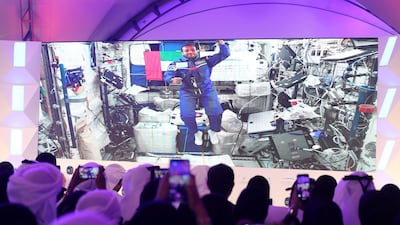
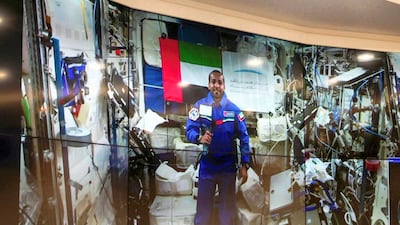
  • The UAE's first astronaut, Maj Hazza Al Mansouri, takes part in a Q&A session from the International Space Station with an audience at the Mohammed bin Rashid Space Centre, Dubai, in 2019. Chris Whiteoak / The National
    The UAE's first astronaut, Maj Hazza Al Mansouri, takes part in a Q&A session from the International Space Station with an audience at the Mohammed bin Rashid Space Centre, Dubai, in 2019. Chris Whiteoak / The National
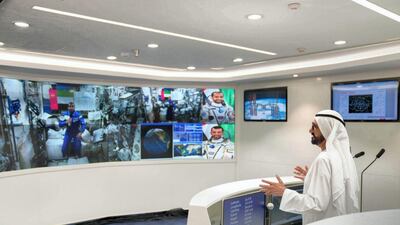
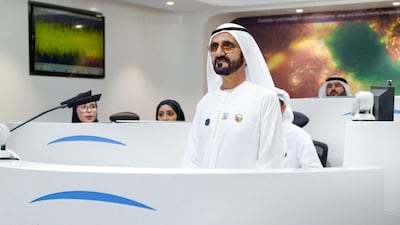
  • Sheikh Mohammed bin Rashid, Vice President and Ruler of Dubai, talks with Emirati astronaut Maj Hazza Al Mansouri, during a live satellite feed from the International Space Station. Courtesy: Dubai Media Office
    Sheikh Mohammed bin Rashid, Vice President and Ruler of Dubai, talks with Emirati astronaut Maj Hazza Al Mansouri, during a live satellite feed from the International Space Station. Courtesy: Dubai Media Office
  • The Emirati astronaut takes questions from the audience gathered at the Mohammed bin Rashid Space Centre. Chris Whiteoak / The National
    The Emirati astronaut takes questions from the audience gathered at the Mohammed bin Rashid Space Centre. Chris Whiteoak / The National
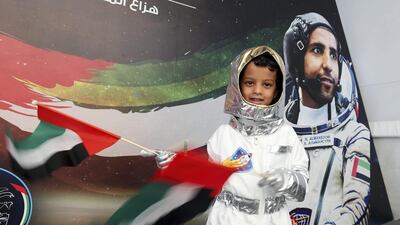
  • An aspiring young astronaut poses in front of a picture of the first Emirati in space, Maj Hazza Al Mansouri. Chris Whiteoak / The National
    An aspiring young astronaut poses in front of a picture of the first Emirati in space, Maj Hazza Al Mansouri. Chris Whiteoak / The National
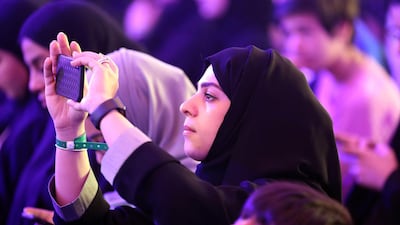
  • A woman films the Q&A session with Maj Hazza Al Mansouri from the International Space Station. Chris Whiteoak / The National
    A woman films the Q&A session with Maj Hazza Al Mansouri from the International Space Station. Chris Whiteoak / The National
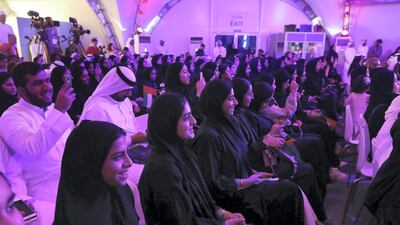
  • The audience at the Mohammed bin Rashid Space Centre are delighted to hear from Maj Hazza Al Mansouri. Chris Whiteoak / The National
    The audience at the Mohammed bin Rashid Space Centre are delighted to hear from Maj Hazza Al Mansouri. Chris Whiteoak / The National
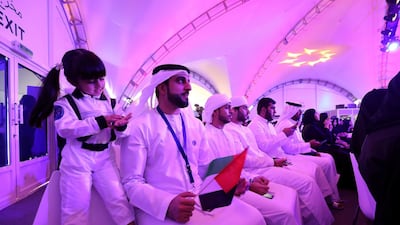
  • An aspiring young astronaut and her family at the Mohammed bin Rashid Space Centre event. Chris Whiteoak / The National
    An aspiring young astronaut and her family at the Mohammed bin Rashid Space Centre event. Chris Whiteoak / The National
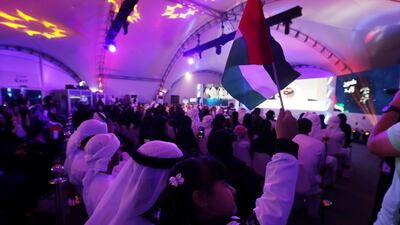
  • A young audience member celebrates the first Emirati in space. Chris Whiteoak / The National
    A young audience member celebrates the first Emirati in space. Chris Whiteoak / The National
  • Sheikh Mohammed bin Rashid talks to Maj Hazza Al Mansouri. Courtesy Dubai Media Office
    Sheikh Mohammed bin Rashid talks to Maj Hazza Al Mansouri. Courtesy Dubai Media Office
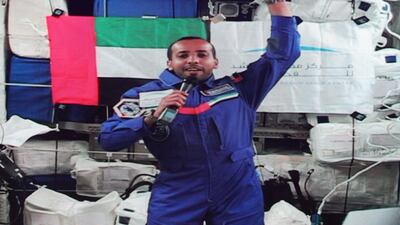
  • Emirati astronaut Hazza Al Mansouri, during a live satellite feed from the International Space Station. Courtesy Dubai Media Office
    Emirati astronaut Hazza Al Mansouri, during a live satellite feed from the International Space Station. Courtesy Dubai Media Office
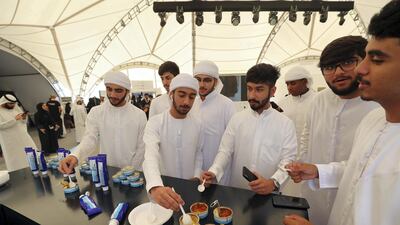
  • Audience members at the Mohammed bin Rashid Space Centre event sample space food. Chris Whiteoak / The National
    Audience members at the Mohammed bin Rashid Space Centre event sample space food. Chris Whiteoak / The National
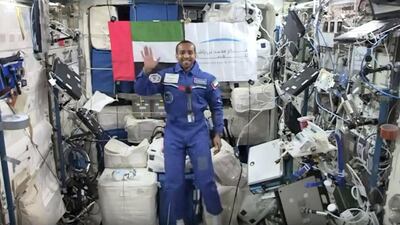
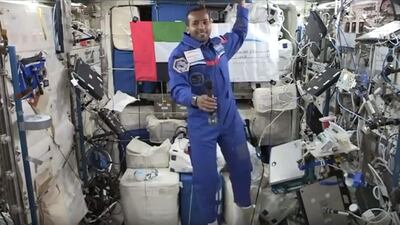
  • Emirati astronaut Maj Hazza Al Mansouri gives his audience on Earth a tour of the International Space Station. Screengrab via Youtube Live
    Emirati astronaut Maj Hazza Al Mansouri gives his audience on Earth a tour of the International Space Station. Screengrab via Youtube Live
  • Maj Hazza Al Mansouri demonstrates the effects of weightlessness. Screengrab via Youtube Live
    Maj Hazza Al Mansouri demonstrates the effects of weightlessness. Screengrab via Youtube Live
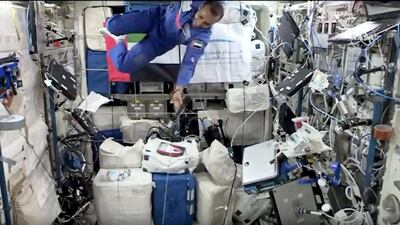
  • Hazza Al Mansouri takes a live Q&A from space. He spent eight days on the International Space Station, in a mission from September 25 to October 3, 2019. Screengrab via Youtube Live
    Hazza Al Mansouri takes a live Q&A from space. He spent eight days on the International Space Station, in a mission from September 25 to October 3, 2019. Screengrab via Youtube Live
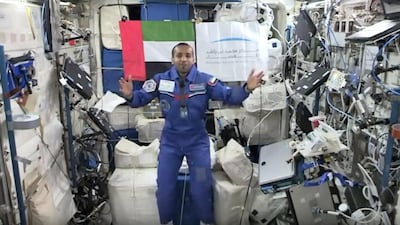
  • Emirati astronaut, Hazza Al Mansouri, takes live Q&A from space and gives a station tour. Screengrab via Youtube Live
    Emirati astronaut, Hazza Al Mansouri, takes live Q&A from space and gives a station tour. Screengrab via Youtube Live

Their arrival will expand to seven the number of people at the ISS, which currently plays host to two Russian cosmonauts, Sergey Ryzhikov and Sergey Kud-Sverchkov, and one American astronaut, Kathleen Rubins. They have been there since mid-October and are due to return to Earth in April 2021.

Life on space station offers unique challenges

Speaking from the ISS during a recent question-and-answer session to mark the 20th anniversary, Dr Rubins said the toughest activities they had to undertake were space walks or extravehicular activity (EVA), two of which she completed during her first ISS mission, in 2016.

“This is probably the foremost mental and physical challenge we have as astronauts – to be outside in the vacuum of space in a 400-pound space suit moving that mass around with very, very expensive equipment,” she said.

“That being said, it’s also one of the most fun things we do, so we’re looking forward to many space walks, many EVAs ... It’s going to be a great expedition.”

Lt Col Ryzhikov, the mission commander, and Mr Kud-Sverchkov are set to carry out a space walk in mid-November, according to reports.

As well as space walks and routine maintenance, ISS residents have over the years undertaken nearly 3,000 experiments analysing things such as how the human body functions in space.

In recent years more commercially funded technical projects have been undertaken, an indication of Nasa’s keenness for private-sector involvement.

Nasa to sell off ISS stake?

Analysts say Nasa is keen to ultimately hand over its portion of the ISS to the private sector so that the billions of dollars a year it spends on the ISS could go to other programmes, notably those involving the moon.

Dr Rubins, a microbiologist, compared the facility to a scaled down university campus with cutting-edge equipment including DNA sequencers and sophisticated microscopes.

“We’re going to continue some of the work on growing cells – we’re going to be growing heart cells,” she said.

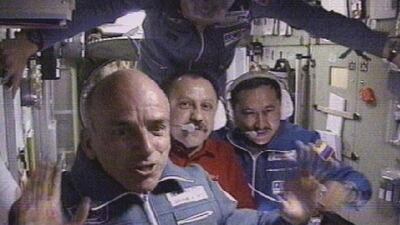
  • The world's first space tourist Dennis Tito waves in front of the International Space Station crew on April 30, 2001. Courtesy: RTV
    The world's first space tourist Dennis Tito waves in front of the International Space Station crew on April 30, 2001. Courtesy: RTV
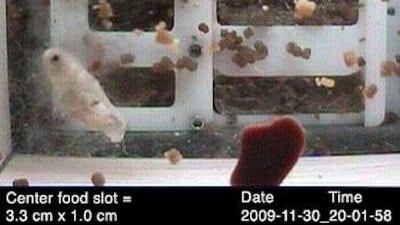
  • Painted Lady butterflies live in their habitat aboard the International Space Station. Courtesy: Nasa
    Painted Lady butterflies live in their habitat aboard the International Space Station. Courtesy: Nasa
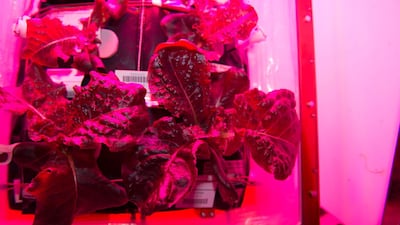
  • Red romaine lettuce was the first vegetable to grow in space in August 2015. Courtesy: Nasa
    Red romaine lettuce was the first vegetable to grow in space in August 2015. Courtesy: Nasa
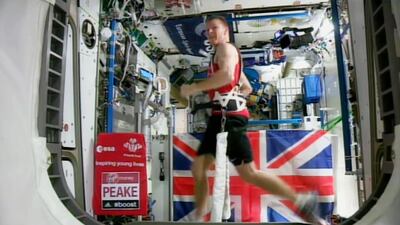
  • In 2016, British astronaut Tim Peake completed the fastest marathon in space. Courtesy: European Space Agency
    In 2016, British astronaut Tim Peake completed the fastest marathon in space. Courtesy: European Space Agency
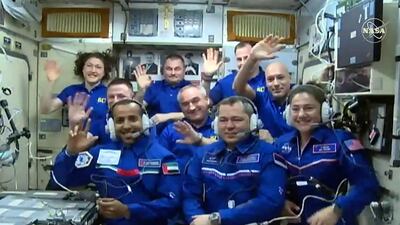
  • Maj Hazza Al Mansouri meets the rest of the team at the International Space Station shortly after docking. Courtesy: Nasa
    Maj Hazza Al Mansouri meets the rest of the team at the International Space Station shortly after docking. Courtesy: Nasa

“I’m looking forward to a lot of the microbial experiments. I’m looking forward to looking at the station’s microbiome [complement of microorganisms].

“I’m interested in learning who’s here in terms of the microbial populations. Who’s here and who’s changing over time.”

The ISS is not just focused on biological experiments, as it also has specialist equipment for research in fields such as physics or materials science.

When he spent eight days on board the facility after arriving on a Soyuz rocket in September last year, the UAE’s first astronaut, Major Hazza Al Mansouri, undertook a series of experiments, including some with a robotic camera aimed at offering insights into how the orientation of spacecraft can be controlled.

After Maj Al Mansouri’s trip, the UAE recorded another key milestone in its space programme in July this year, when the country’s Mars Mission, Hope, which is spearheaded by the Mohammed Bin Rashid Space Centre, blasted off from Japan. It is scheduled to reach the Red Planet in early 2021.

One experiment due to happen on the ISS in the coming months is the growing of radishes, work NASA says could optimise methods to cultivate the vegetable in space.

Could space station be a tourist attraction? 

In the years to come, Nasa is opening up the ISS to visits by tourists – with transport there and back on commercial craft costing tens of millions of dollars – and, in January, it gave approval for a private space company, Axiom, to attach a commercial module to the ISS.

Axiom, which is run by a former Nasa ISS programme manager, ultimately hopes to attach several modules to the ISS, the first of which could be launched in 2024 and allow for new experimental facilities and living space.

The company has said work on the ISS could move over to the commercial modules when decommissioning finally happens.

Once it is retired, the ISS would probably be crashed into a remote part of the Pacific Ocean, joining the remains of Russia’s Mir space station, which burned up before reaching its watery grave.

The ISS’s retirement is, however, not imminent: it is scheduled to remain in operation until at least 2024 and much of its hardware is certified for use until several years after that.

Speaking at the recent press conference, Lt Col Ryzhikov acknowledged there is currently a leak in the ISS that needs fixing, but said the overall structure was sound. Boeing too said earlier this year the ISS was in good shape.

“It has very reliable construction,” said the Russian cosmonaut, who is his second ISS mission. “It has various small leaks every day. Now it’s a little bit more than standard. We’re working to find it and replace it. So don’t worry.”