

King Abdullah of Jordan said Russian presence in Syria is a "good thing", repeating earlier assertions that Moscow's military intervention in the country seven years ago brought stability.
"We have seen the presence of the Russians in Syria as a good thing. They have been a source of stability," King Abdullah said in an interview with CNBC broadcast on Thursday.
Jordan, one of the biggest recipients of US aid, supported the 2015 Russian intervention that propped up the regime of Bashar Al Assad.
In August last year, King Abdullah met President Vladimir Putin near Moscow and praised Russia's contribution to stability in Syria, the main source of an illicit regional trade in Captagon.
Jordanian officials said last month that Syrian army units and militias supported by Iran are behind a sharp increase in Captagon smuggling over the border into Jordan and towards the Gulf. It was the first time that the kingdom publicly implicated Iran in the drug trade.
The more direct stance came days after King Abdullah said in Washington that he expects Iran to extend its influence into Syrian areas along the border with Jordan, as Russia focuses on its invasion of Ukraine.
"Since the [Ukraine] conflict started, there has been less of a Russian presence in Syria," King Abdullah told NBC.
"As a result, we've had more problems with shared militias creating problems on our borders, drug-smuggling and weapons smuggling. ISIS has arisen," he said.
"From the Jordanian point of view, they [Russia] were ... an essence of calm."
President Sheikh Mohamed meets King of Jordan in Abu Dhabi - in pictures
-

President Sheikh Mohamed receives King Abdullah II of Jordan in Abu Dhabi on June 23. All photos: Ministry of Presidential Affairs -

Sheikh Mohamed and King Abdullah at Al Shati Palace. -
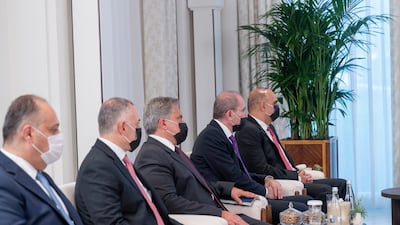
Members of King Abdullah's delegation during a meeting. -

Sheikh Mohamed and King Abdullah before their meeting at Al Shati Palace. -
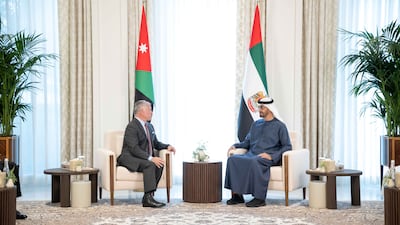
The leaders discussed increasing ties between the two countries. -

Sheikh Mohamed and King Abdullah during their meeting. -

From left, Sheikh Tahnoun bin Zayed, National Security Adviser, Sheikh Mansour bin Zayed, Deputy Prime Minister and Minister of Presidential Affairs, Dr Anwar Gargash, Diplomatic Adviser to the President, Sheikh Hamdan bin Mohamed, and Sheikh Mohammed bin Hamad bin Tahnoun, Private Affairs Adviser at the Ministry of Presidential Affairs, at the meeting with King Abdullah of Jordan at Al Shati Palace.


He said pressure on supplies of commodities is another outcome of the Ukraine war that Jordan has been dealing with, but that countries in the region have been "coming together and saying how can we help each other?".
King Abdullah said he also favours more Arab military co-operation.
“I would be one of the first people that would endorse a Middle East Nato,” he said. “The mission statement has to be very, very clear. Otherwise, it confuses everybody,” he said.

