


The coup in Sudan last week has led to hostility, a deadly crackdown on protesters and an internet blackout, which are proving costly to the country's young entrepreneurs and emerging business community.
The political turmoil forced the closure of not just online stores, but also the suspension of contracts with western investors and multinationals, while international aid is threatened again.
Mostafa Mohamed Soliman, 29, is passionate about e-commerce. In September last year, he launched an online marketplace for men’s clothing, offering affordable prices.
His business employs a dashboard administrator as well as an operation and stock managers. He also deals with a network of delivery drivers in Khartoum. The start-up used to average between $300 and $500 a day in sales before the coup. Now he feels the economic pinch.
“We have become offline because they are blocking the internet. Traffic is zero and we receive no orders,” Mr Soliman told The National. "We used to have 500 visitors a day."
Khartoum after the downfall of Omar Al Bashir, the lifting of US sanctions and getting pledges of signficant economic support and multilateral loans has become a very promising and attractive market for many business-oriented Sudanese.
Sudanese entrepreneur
“The market in Khartoum is hungry for any kind of business. Even if you open a bakery or a café, you will make handsome profits,” said Mr Soliman, who studied business administration in the Westminster International College in Malaysia and returned to Khartoum in 2015.
"Unlike other markets in the region. Cairo, for example, is saturated and it’s very competitive out there, not just because of the competition, but also the hegemony of big companies. Now our gains and dreams are at stake because of politics."
The latest takeover in a country that has suffered one coup after another since its independence in 1956 could derail the hard-won economic gains and reforms to bring back Sudan into the global financial system after decades as a pariah state under Al Bashir.
The World Bank has paused its economic aid and stopped processing any new operations in the country.
The current political stalemate did not come without warning. Last month, there was a failed coup attempt blamed by the army on people loyal to Al Bashir, the former dictator who ruled Sudan for nearly three decades and was removed by a coup in April 2019 after mass protests.
-
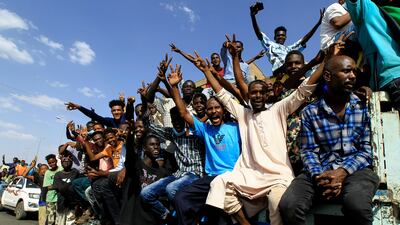
Protesters demonstrate against the Sudanese military's seizure of power and removal of the civilian government, in the capital Khartoum. Reuters -
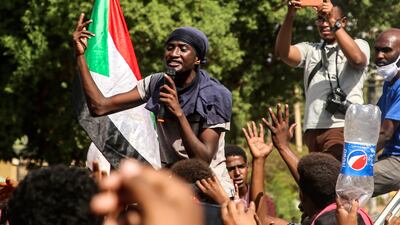
Thousands of Sudanese people took to the streets in the capital of Khartoum, above, and other major cities across the country to demand the country's transition to democratic rule be put back on track. EPA -
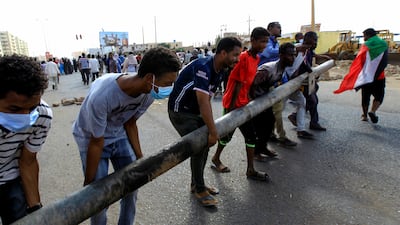
Protesters carry a barricade as they demonstrate against the Sudanese military, in the capital Khartoum. Reuters -

A Sudanese protester flashes a victory sign near a burning tyre as thousands of people joined anti-coup protests in Khartoum. EPA -
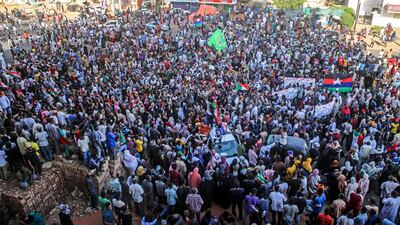
Thousands of Sudanese people participated in anti-military protests in the capital Khartoum. EPA -

A Sudanese protester dressed up as Spider-Man, stands on car during an anti-coup protest in the capital Khartoum. EPA -
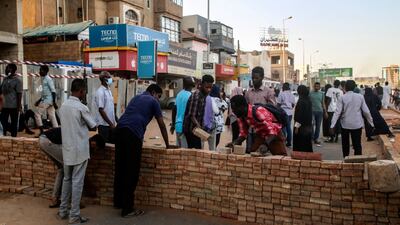
Demonstrators build a barricade on a street in the capital Khartoum during an anti-coup protest. EPA -
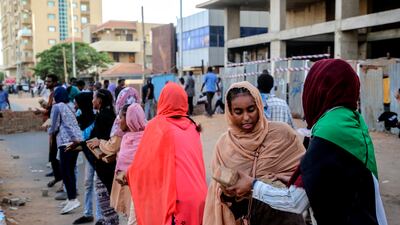
Sudanese women during anti-coup protests as a part of nationwide demonstrations against the military takeover of the government on October 25, in the capital Khartoum. EPA -

Protesters raised slogans demanding the exit of Gen Abdel Fattah Al Burhan, in the capital Khartoum. AP Photo -

Protesters declared 'the revolution will continue' during a demonstration in Khartoum. AP -

'Going back is impossible' was among slogans raised by Sudanese protesters in the capital Khartoum. AP


Just weeks later, the army dissolved the Cabinet of Prime Minister Abdalla Hamdok and detained several ministers. Mr Hamdok has been placed under house arrest, though he was allowed to meet Sudanese mediators close to the military and the civilian politicians in an effort to convince him to lead a new government.
The situation has become a full-blown crisis and looks trapped in a vicious circle. Mr Hamdok insists on a playback of the days before the coup, reinstating a constitutional declaration and setting the stage to free elections and involving his colleagues in a split civilian alliance that led the protests against Al Bashir two years ago.
The army does not want any involvement by civilian politicians who were at the forefront during the transitional period. The protesters on the streets, in turn, vow to remove Mr Hamdok, again, if he agrees to deal with the military and revive his brainchild of a power-sharing model.
Multinationals scared away
One of the consequences of the political labyrinth is that foreign investors become nervous.
Husameldin Elnasri, managing director of a business consultancy, tweeted in Arabic earlier in the week that he lost four contracts with multinational companies as a result of the political crisis.
The Sudanese Twitterati’s response revealed many examples of people with similar experiences.
“I have been working on a project on capacity building for Sudanese university professors. I managed to convince Mastercard and University of Toronto to invest more than $3 million. Everything ended at a glance because of the stupidity of the army. I won’t forgive anyone who believes coups are a good thing,” was one of the replies.
The military head, Gen Abdel Fattah Al Burhan, paid tribute to the civilian leader he removed from power, saying he agreed with Mr Hamdok's initiatives on numerous occasions but, ultimately, the prime minister was unable to work freely as long as he was being held back politically.
The general's main criticism was reserved for the Forces of Freedom of Change, a group of allied politicians, civilians and rebel groups that called for the removal of Al Bashir.
Gen Al Burhan has insisted the military takeover was not a coup. Instead, he said, he wanted to "rectify the course of the Sudanese transition".
Protest leaders are not convinced and insist that the general wants to maintain the army’s traditional control over Sudan.

Referring to the economic and political lessons of the past three decades under Al Bashir, Jonas Horner, the Deputy Director for the Horn of Africa and senior analyst for Sudan at International Crisis Group, could sense the frustration of the aspiring entrepreneurs of Khartoum.
“Sudan's economy is probably the most important component of this transition. If Sudan does not get on top of its economic problems, probably very little else matters and a lot of the political wrangling will itself be subsumed by the weight of economic collapse,” Mr Horner told The National.
Until he was removed by the military on October 25, Mr Hamdok ran the country's transition as a former World Bank economist, laser-focused on repairing the ties to international bodies that can help bail out the country, pushing through reforms he hoped would solve the country's financial woes.
But the impact these reforms have on the 44 million people, already squeezed by years of neglect, a deep financial crisis and the Covid-19 pandemic, was painful. Fuel subsidies have been fully lifted and food prices have increased significantly. Inflation soared and ordinary people struggle to get by.
But now, the political instability is the biggest obstacle to a prosperous economy for everyone.
The takeover has sparked a chorus of international condemnation and punitive aid cuts, with world powers demanding a swift return to civilian rule.
Mr Horner says that the military and civilian politicians speak loudly to hear each other, but they don’t listen. They need to speak softly to save the country.
“Sudan has a range of real economic opportunities. It sits on the Nile,” he said.

