• Lebanon's Prime Minister Najib Mikati gestures as he speaks to the press after meeting President Michel Aoun at the presidential palace in Baabda. Reuters
    Lebanon's Prime Minister Najib Mikati gestures as he speaks to the press after meeting President Michel Aoun at the presidential palace in Baabda. Reuters
  • President Michel Aoun meets Parliament Speaker Nabih Berri and Prime Minister-designate Najib Mikati at the presidential palace in Baabda before the announcement of the formation of a new government under Mr Mikati. Dalati and Nohra / AFP
    President Michel Aoun meets Parliament Speaker Nabih Berri and Prime Minister-designate Najib Mikati at the presidential palace in Baabda before the announcement of the formation of a new government under Mr Mikati. Dalati and Nohra / AFP
  • Mr Aoun (L) and Mr Mikati before the announcement of the formation of a new Lebanese government ending a 13-month vacancy. Dalati and Nohra / AFP
    Mr Aoun (L) and Mr Mikati before the announcement of the formation of a new Lebanese government ending a 13-month vacancy. Dalati and Nohra / AFP
  • Lebanese Prime Minister Najib Mikat attends Friday prayers at a mosque in downtown Beirut. AP
    Lebanese Prime Minister Najib Mikat attends Friday prayers at a mosque in downtown Beirut. AP
  • Najib Mikati arriving at the presidential palace in Baabda, Lebanon. Reuters
    Najib Mikati arriving at the presidential palace in Baabda, Lebanon. Reuters
  • Lebanese Speaker of the Parliament Nabih Berri arrives at the presidential palace in Baabda. Reuters
    Lebanese Speaker of the Parliament Nabih Berri arrives at the presidential palace in Baabda. Reuters
  • The government palace in Beirut, Lebanon. Reuters
    The government palace in Beirut, Lebanon. Reuters
  • Protesters in Beirut.
    Protesters in Beirut.
  • Anti-government protesters during a demonstration outside the French embassy in Beirut, Lebanon. EPA
    Anti-government protesters during a demonstration outside the French embassy in Beirut, Lebanon. EPA
  • Demonstrators with placards appealing to French President Emmanuel Macron. EPA
    Demonstrators with placards appealing to French President Emmanuel Macron. EPA
  • Protesters outside the French embassy in Beirut, Lebanon. EPA
    Protesters outside the French embassy in Beirut, Lebanon. EPA

Doubt over diaspora vote for Lebanon’s 2022 election


Sunniva Rose
  • English
  • Arabic

Lebanon’s Hezbollah says the country’s large diaspora should not vote in the country’s elections next year because sanctions would hinder its ability to campaign abroad.

But analysts accuse the Iran-backed group and allies of fearing that voters would massively reject traditional parties.

The vote of the Lebanese diaspora, which voted for the first time in 2018, is under tight scrutiny owing to the high number of citizens who have left the country in the past two years.

Its worst economic crisis caused nation-wide protests for several months when it began in 2019.

There are no precise figures regarding the number of emigrants, but MPs The National spoke to said they believe that between 200,000 and 300,000 people had left the country in the past two years.

They are widely believed to be dissatisfied with the country’s ruling political class, which is blamed for causing the crisis after decades of corruption.

“At this point, I’d vote for anyone except for those who are in power,” said Cesar Kastoun, a finance professional in New York.

Most established parties with representation in Parliament fear the free, liberal and uncontrolled vote of expatriates
Ghassan Moukheiber,
a former independent MP

Despite the controversy regarding the diaspora’s vote, the 2017 electoral law has yet to be amended.

It calls for the non-resident Lebanese citizens to vote for six additional MPs next year, and the Foreign Affairs Ministry has issued a circular allowing them to register between October 1 and November 20 to vote.

The elections, initially scheduled for May, are expected to be moved to March 27 following statements by Prime Minister Najib Mikati last week.

Parliament’s vice-president, Elie Ferzli, said this was to avoid the need for campaigning during Ramadan, which will fall in April, and that while technical amendments to the law to change the elections’ date would be straightforward, the diaspora’s participation posed a “serious problem”.

Negotiations among members of an informal parliamentary committee indicate they want to change the law so the diaspora does not vote for six MPs next year. The debate within the committee is focused on whether Lebanese living abroad will vote for politicians representing their district of origin in Lebanon – as happened in 2018 – or not vote at all.

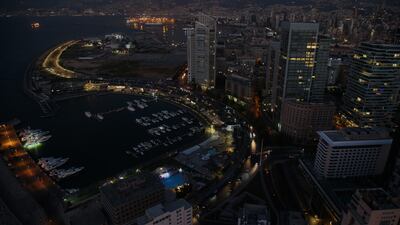
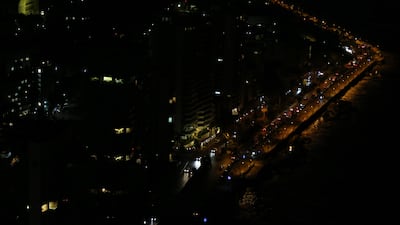
  • A view of Lebanon's capital, Beirut, with the lights on only in some buildings. Lebanese rely on highly polluting diesel generators run by private neighbourhood operators to make up for shortfalls in electricity supply from the state utility. EPA
    A view of Lebanon's capital, Beirut, with the lights on only in some buildings. Lebanese rely on highly polluting diesel generators run by private neighbourhood operators to make up for shortfalls in electricity supply from the state utility. EPA
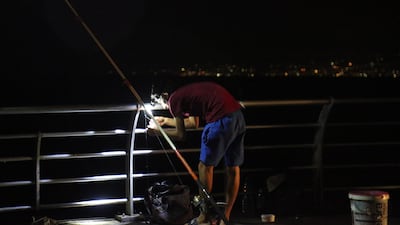
  • A fisherman uses a headlamp at the seaside corniche in Beirut, Lebanon. EPA
    A fisherman uses a headlamp at the seaside corniche in Beirut, Lebanon. EPA
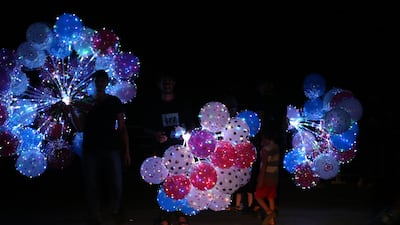
  • A vendor sells LED balloons in full darkness at the corniche in Beirut. EPA
    A vendor sells LED balloons in full darkness at the corniche in Beirut. EPA
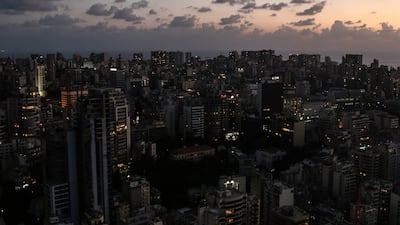
  • The near collapse of the national grid has increased the duration of power cuts across Lebanon. EPA
    The near collapse of the national grid has increased the duration of power cuts across Lebanon. EPA
  • Residents of Beirut are experiencing power cuts of up to 20 hours a day. EPA
    Residents of Beirut are experiencing power cuts of up to 20 hours a day. EPA

Four members of the committee The National spoke to said that while they support the diaspora voting, Hezbollah and its ally, the Amal Movement, did not. Hezbollah’s representative in the committee, Ali Fayad, did not respond to requests for comment.

The four MPs said it was difficult, if not impossible, to organise elections for six MPs abroad as specified in the law, which respects the country’s sectarian-sharing power agreement. Assumptions regarding the distribution of Lebanese citizens around the world have coloured discussions, with some suggesting that the Maronite seat should go to the US MP, the Shiite Muslim seat to the Africa MP and the Sunni Muslim seat to the Middle East MP.

But the idea of arbitrarily appointing a continent to a sect is unpopular. Mr Ferzli, the committee’s head, described this system as “illogical”; MP Samir Jisr, from the Sunni Muslim Future Movement, called it “anti-constitutional”; and Mr Aoun, from the Christian Free Patriotic Movement, said it was “silly”.

“I think that we have to do everything so that expatriates can vote for all members of Parliament, not just six MPs,” said MP Bilal Abdallah, from the Druze Progressive Socialist Party.

On Friday, Mr Fayad told Lebanese TV station Al Jadeed that while the party had not adopted a definite position, the diaspora’s vote was “sensitive” and his party had asked for its postponement because of “difficulties” “in some essential countries, like America, European countries and Canada”.

Mr Fayad referenced the large Shiite Muslim community in Michigan, an example echoed among his colleagues.

“They say, there’s a lot of Shiites in Michigan. How are we going to communicate? Suppose our supporters vote for our candidate. They’ll be exposed to the American government,” Mr Ferzli said.

Mr Jizr said: “They are reasonable arguments, but we [the Future Movement)] are for the expatriate vote.”

Hezbollah in the spotlight

Hezbollah supporters rally as a convoy of tanker trucks carrying Iranian fuel oil arrive in Baalbeck. Reuters

The US designated Hezbollah a terrorist organisation in 1997 but this did not stop many Lebanese from voting for the group three years ago. One of the MPs to receive the most votes among non-resident Lebanese in 2018 was Hezbollah member Amin Sherri, who was personally blacklisted by the US the following year.

Voting for Hezbollah in Lebanese elections in the US is illegal yet it was not criminalised in 2018. David Daoud, a lawyer by training and a research analyst on Hezbollah at United against a Nuclear Iran, an advocacy group in New York, expects Washington to turn a blind eye once again next year.

“It seems that we have placed not harming Lebanon’s very fragile stability as our number one priority ahead of taking action against Hezbollah,” he said.

Hezbollah’s recent imports of US sanctioned Iranian fuel, which it says it has donated in part to hospitals, bakeries and water organisations, has triggered no legal backlash.

Mr Daoud said party supporters were allowed to ostensibly show their affiliation by carrying Hezbollah flags in the US. Independent advocacy, as long as it is done without party authorisation or payment, is not criminalised, according to him.

“What the US criminalises is material support, which is defined as training, expert advice or assistance, services and provision of personnel to a designated Foreign Terrorist Organisation,” he said.

Last year, Hezbollah was banned by Germany. Some European countries and the EU make a distinction between its political and armed activities.

Lebanese electoral experts argue that the real reason Hezbollah is against the diaspora vote is because it fears expatriates will massively reject traditional political parties because of the crash of the Lebanese economy. It is a worry that unites all parties, despite their assertions to the contrary.

“They are putting the blame on Hezbollah. But I believe there is no political will,” said Aly Sleem, executive director of the Lebanese Association for Democratic Elections.

“Most established parties with representation in Parliament fear the free, liberal and uncontrolled vote of expatriates,” agreed Ghassan Moukheiber, a former independent MP who has been involved in electoral reform since 1995.

While expatriate turnout in 2018 was low, at close to 47,000, Mr Sleem said this number was expected to at least double in 2022.

“It’s a real threat,” he said. “Some candidates win seats with as little as 77 votes.” At 56.4 per cent, expatriate turnout was slightly higher in 2018 than for in-country residents, 49.2 per cent.

At the time, only one member of civil society was elected to Parliament. More independents in 2022 would represent a headache for Hezbollah, said Mr Daoud.

“They’d rather not deal with more opposing voices as Lebanon’s fragility increases,” he said. “Even so-called pro-western traditional political parties like the Future Movement and the PSP [Progressive Socialist Party] talk a big game but have to play ball.”

Cancelling the vote altogether would come as a disappointment for expatriates, both young and old, said John Zabbal, 25, a law student in Canada. His father, who left Lebanon decades ago and voted in 2018 for a traditional party, plans to back reformists this time around.

“For sure, he’ll give the youth a chance. You’re not going to vote for the same people again and again and expect different results, right?”


Email sent to Uber team from chief executive Dara Khosrowshahi

From: Dara

To: Team@

Date: March 25, 2019 at 11:45pm PT

Subj: Accelerating in the Middle East

Five years ago, Uber launched in the Middle East. It was the start of an incredible journey, with millions of riders and drivers finding new ways to move and work in a dynamic region that’s become so important to Uber. Now Pakistan is one of our fastest-growing markets in the world, women are driving with Uber across Saudi Arabia, and we chose Cairo to launch our first Uber Bus product late last year.

Today we are taking the next step in this journey—well, it’s more like a leap, and a big one: in a few minutes, we’ll announce that we’ve agreed to acquire Careem. Importantly, we intend to operate Careem independently, under the leadership of co-founder and current CEO Mudassir Sheikha. I’ve gotten to know both co-founders, Mudassir and Magnus Olsson, and what they have built is truly extraordinary. They are first-class entrepreneurs who share our platform vision and, like us, have launched a wide range of products—from digital payments to food delivery—to serve consumers.

I expect many of you will ask how we arrived at this structure, meaning allowing Careem to maintain an independent brand and operate separately. After careful consideration, we decided that this framework has the advantage of letting us build new products and try new ideas across not one, but two, strong brands, with strong operators within each. Over time, by integrating parts of our networks, we can operate more efficiently, achieve even lower wait times, expand new products like high-capacity vehicles and payments, and quicken the already remarkable pace of innovation in the region.

This acquisition is subject to regulatory approval in various countries, which we don’t expect before Q1 2020. Until then, nothing changes. And since both companies will continue to largely operate separately after the acquisition, very little will change in either teams’ day-to-day operations post-close. Today’s news is a testament to the incredible business our team has worked so hard to build.

It’s a great day for the Middle East, for the region’s thriving tech sector, for Careem, and for Uber.

Uber on,

Dara

SPEC%20SHEET
%3Cp%3E%3Cstrong%3EProcessor%3A%3C%2Fstrong%3E%20Apple%20M2%2C%208-core%20CPU%2C%20up%20to%2010-core%20CPU%2C%2016-core%20Neural%20Engine%3C%2Fp%3E%0A%3Cp%3E%3Cstrong%3EDisplay%3A%3C%2Fstrong%3E%2013.6-inch%20Liquid%20Retina%2C%202560%20x%201664%2C%20224ppi%2C%20500%20nits%2C%20True%20Tone%2C%20wide%20colour%3C%2Fp%3E%0A%3Cp%3E%3Cstrong%3EMemory%3A%3C%2Fstrong%3E%208%2F16%2F24GB%3C%2Fp%3E%0A%3Cp%3E%3Cstrong%3EStorage%3A%3C%2Fstrong%3E%20256%2F512GB%20%2F%201%2F2TB%3C%2Fp%3E%0A%3Cp%3E%3Cstrong%3EI%2FO%3A%3C%2Fstrong%3E%20Thunderbolt%203%20(2)%2C%203.5mm%20audio%2C%20Touch%20ID%3C%2Fp%3E%0A%3Cp%3E%3Cstrong%3EConnectivity%3A%3C%2Fstrong%3E%20Wi-Fi%206%2C%20Bluetooth%205.0%3C%2Fp%3E%0A%3Cp%3E%3Cstrong%3EBattery%3A%3C%2Fstrong%3E%2052.6Wh%20lithium-polymer%2C%20up%20to%2018%20hours%2C%20MagSafe%20charging%3C%2Fp%3E%0A%3Cp%3E%3Cstrong%3ECamera%3A%3C%2Fstrong%3E%201080p%20FaceTime%20HD%3C%2Fp%3E%0A%3Cp%3E%3Cstrong%3EVideo%3A%3C%2Fstrong%3E%20Support%20for%20Apple%20ProRes%2C%20HDR%20with%20Dolby%20Vision%2C%20HDR10%3C%2Fp%3E%0A%3Cp%3E%3Cstrong%3EAudio%3A%3C%2Fstrong%3E%204-speaker%20system%2C%20wide%20stereo%2C%20support%20for%20Dolby%20Atmos%2C%20Spatial%20Audio%20and%20dynamic%20head%20tracking%20(with%20AirPods)%3C%2Fp%3E%0A%3Cp%3E%3Cstrong%3EColours%3A%3C%2Fstrong%3E%20Silver%2C%20space%20grey%2C%20starlight%2C%20midnight%3C%2Fp%3E%0A%3Cp%3E%3Cstrong%3EIn%20the%20box%3A%3C%2Fstrong%3E%20MacBook%20Air%2C%2030W%20or%2035W%20dual-port%20power%20adapter%2C%20USB-C-to-MagSafe%20cable%3C%2Fp%3E%0A%3Cp%3E%3Cstrong%3EPrice%3A%3C%2Fstrong%3E%20From%20Dh4%2C999%3C%2Fp%3E%0A
What is dialysis?

Dialysis is a way of cleaning your blood when your kidneys fail and can no longer do the job.

It gets rid of your body's wastes, extra salt and water, and helps to control your blood pressure. The main cause of kidney failure is diabetes and hypertension.

There are two kinds of dialysis — haemodialysis and peritoneal.

In haemodialysis, blood is pumped out of your body to an artificial kidney machine that filter your blood and returns it to your body by tubes.

In peritoneal dialysis, the inside lining of your own belly acts as a natural filter. Wastes are taken out by means of a cleansing fluid which is washed in and out of your belly in cycles.

It isn’t an option for everyone but if eligible, can be done at home by the patient or caregiver. This, as opposed to home haemodialysis, is covered by insurance in the UAE.

How to wear a kandura

Dos

  • Wear the right fabric for the right season and occasion 
  • Always ask for the dress code if you don’t know
  • Wear a white kandura, white ghutra / shemagh (headwear) and black shoes for work 
  • Wear 100 per cent cotton under the kandura as most fabrics are polyester

Don’ts 

  • Wear hamdania for work, always wear a ghutra and agal 
  • Buy a kandura only based on how it feels; ask questions about the fabric and understand what you are buying
Updated: October 05, 2021, 2:02 AM