A generation ago, the first men from villages in Telangana and Uttar Pradesh left for the Gulf. Most departed because of a letter from someone who had gone before, or a rumour from the tea shop, or just knowing that someone from the next village had gone and had come back with something to show for it. They didn’t really know what to expect. They went anyway.
Many of those men later returned. But not all of them, and not always in the ways they hoped. But most came back with real results – enough that everyone around them understood what the journey was worth. A finished house. A child who received more schooling than the village offered. A family who progressed, however slowly, from just getting by to building something.
Because of them, the next group went with more confidence. And the group after that did, too. Seven Indian workers died in an Emirates Road crash in Dubai in June 2026, leaving behind families across Telangana and Uttar Pradesh.

Burjeel Holdings chairman Dr Shamsheer Vayalil announced a financial support programme for all seven affected families following the accident.
The Gulf has been woven into village life across India for four decades, with knowledge of working abroad passed down through generations.
The workers were not seeking permanent lives overseas but using earnings abroad to fund homes, education and weddings back in India.
“The Gulf was never the destination – it was the path back to where they were always meant to be,” the delegation's head of communications said.
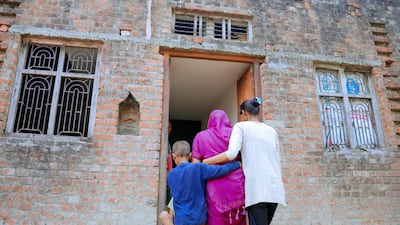
I kept thinking about those early journeys during four days in June, when I travelled through villages in Telangana in southern India and Uttar Pradesh in the north to meet the families of workers who died in the Emirates Road accident in Dubai in June 2026. We went to offer support on behalf of Dr Shamsheer Vayalil, chairman and chief executive of Abu Dhabi healthcare company Burjeel Holdings, who had already announced a support programme for all seven families, and to make sure they knew they were not forgotten.
I gained something else, too – a close, unhurried look at what the relationship between the Gulf and those villages actually is after four decades. It is not what people assume.

In those villages, the Gulf is not an abstraction, nor does it represent a distant aspiration. It is a part of everyday life. Someone is in the region now. Someone returned to their village last year. A young man from the neighbourhood is saving up money to go. Knowledge of how to get there, what working life is like and what the first summer feels like passes from person to person, tested by real experience and refined over years.
In the Jagtial district of Telangana, where we met the families of two of those killed in the crash, Saleem Sayyed and Thirupathi Gollapally, almost every conversation turned to the Gulf. Not because we brought it up, but because it was already part of how people thought about their future.
That’s what four decades of this relationship have created.
Sayyed, from the Telangana village of Namilakonda, had gone to the UAE just months before the accident. One of his children had health problems that needed more money for treatment than he could earn locally. His daughter’s wedding was also being planned. He wanted a better house, better schooling and the means to pay for all of it.
Those demands had piled up all at once, as they often do for families with little margin for error. Working in the Gulf was the only option that could enable him to address them all quickly enough.
Gollapally was only 22 and was abroad for the first time. He used to call his parents to talk about getting used to the outdoor work, the heat and everything new. His family in Thakkallapalle, in Telangana, remembers those calls well. Now, that’s all they have left.
Another of the crash victims, Abdul Rafiq, had returned to the Gulf, having left the region during the pandemic. His daughter is very young, too little to understand what happened. His father, who had already lost two sons in an earlier road accident, sat with us quietly for a while. We didn’t need words.

In the Mau district of Uttar Pradesh, the family of another of those killed, Markandey Chauhan, led us along narrow, unpaved lanes to a house that was still unfinished. We saw this in every village – houses built in stages, a new room added whenever someone working abroad sent money, before construction was suspended when the funds ran out and families waited for the next transfer to arrive.
Chauhan's daughter, Ankita, had just finished Grade 12 when her father died. She didn’t complete her application for the state entrance exam this year. During our visit, Dr Vayalil, who joined on a video call, asked Ankita what she wanted to study. She said nursing. He told her without hesitation that her education would be fully paid for, and that a job would be waiting for her at his hospital in the UAE once she graduated.

Dr Vayalil had moved to the Gulf with big ambitions and built something there. It wasn’t a coincidence that he was the one making this offer to a girl in a village in Mau. It was the promise made a generation ago, still being kept. The atmosphere in the room changed when he spoke because something her father had worked for was going to continue.
What struck me most, in every home we visited, was something the families kept saying in different ways. What moved them wasn’t just the financial support. It was that someone from the country where their loved one had worked had come all the way to sit with them, that the place where they had gone had not treated him as replaceable, that it had sent people to his village.
That is the part of the India-Gulf relationship that the statistics and the official programmes do not capture. There is an understanding with no official treaty behind it. It is built on something learnt over a generation: that the Gulf offers work and families who send their sons and brothers aren’t simply making a business deal. They are trusting that, in the event that something goes wrong, the place their loved one went to will remember that he was a person with a village, a half-built house, children in school and parents waiting for his call.

That trust was honoured after the accident in June. Families in those villages know exactly what that means. They have been watching how the relationship works for four decades.
In Kopaganj, Uttar Pradesh, we met the loved ones of Abdul Rasheed, who was also killed in June. A family member told us quietly that before his final trip he thought it would be his last. He planned to save enough money to return home for good.
We heard some version of that ambition in almost every home. These weren’t men trying to leave their villages behind. They were using years abroad to build the life they had always wanted at home. The Gulf was never the destination – it was the path back to where they were always meant to be.
That’s the thought the trip left us with. Those men weren’t chasing a life overseas. They were building one in India, with whatever work in the UAE could give them, for as long as it took.
M Unnikrishnan is head of communications at VPS Health. He was part of the delegation to India that visited the families of those killed in the accident in June 2026