

This year, Saudi Arabia has a lot celebrate on its 92nd Saudi National Day.
The festivities take place on Friday, September 23, as the nation lauds its economic, technological and cultural transformation, in line with its Vision 2030 strategy.
An official website has been launched by the kingdom's Entertainment Authority to celebrate the day, with in-depth information and traditional artwork that can be downloaded by residents to mark the occasion.
Here are eight of Saudi Arabia's most ambitious projects that aim to create a better quality of life for residents and attract more tourists.
-
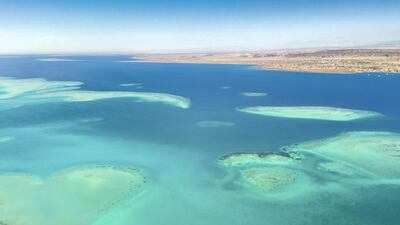
The site of the $500bn Neom project in the Tabuk Province of northwestern Saudi Arabia. Photo: SCTH -
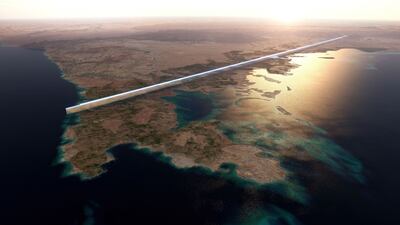
The Line, a civilisational revolution that will preserve the surrounding nature. Photo: NEOM -
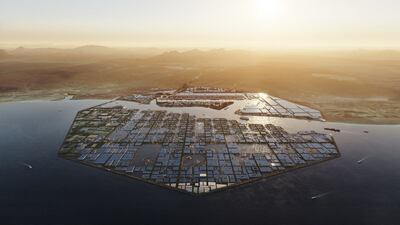
Oxagon is planned to be the largest floating industrial complex in the world. Photo: PRNewsfoto / NEOM -
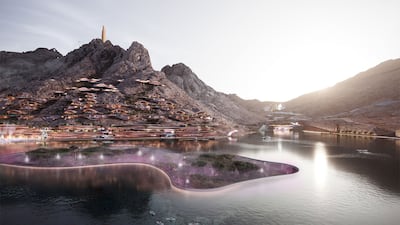
The tourist destination Trojena will open in 2026 as part of Saudi Arabia's mega-city of the future, Neom. Photo: Neon -
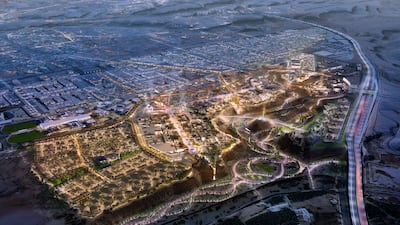
Mohammed bin Salman Foundation “Misk” revealed details on the masterplan for Prince Mohammed Bin Salman Nonprofit City. Photo: MISK -
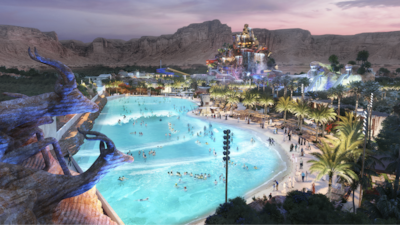
Saudi Arabia is to open its first waterpark. The $750-million Qiddiya Water Theme Park will be the region's largest, with 22 rides and slides. Photo: QIC -
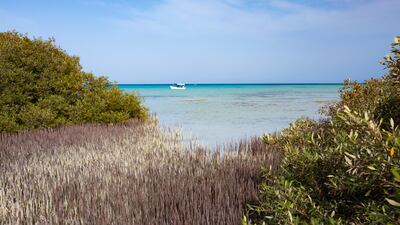
The Red Sea Project will turn untouched coastlines into one of Saudi Arabia's biggest tourism projects where conservation is key. Photo: The Red Sea Development Company -
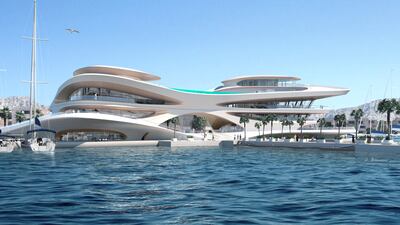
Amaala's design for its Triple Bay Yacht Club. Photo: Amaala -
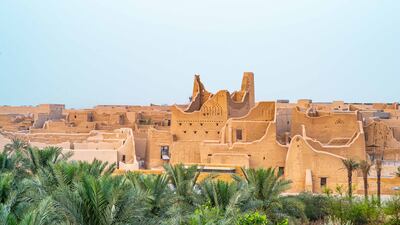
Silhouette of Salwa Palace in At-Turaif in Ad Diriyah with palm trees in foreground. The $17bn development will encompass several luxury resorts. Photo: Meshari Almuhanna / DGDA -
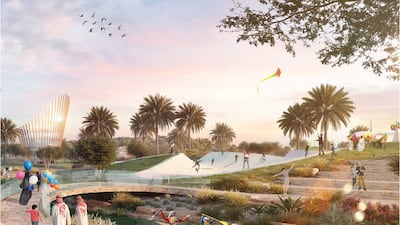
Water features at King Salman Park. Photo: Royal Commission for Riyadh city -

The beginning of construction at Jeddah Tower. Photo: Jeddah Economic Company


Diriyah Gate
Located in the heart of the capital, the historic city of Diriyah will reveal 300 years of culture and history through heritage and educational experiences, plus shopping, entertainment and dining venues.
It is home to Unesco sites including At-Turaif, a World Heritage Site and open-air museum of Saudi Arabia’s history.
Diriyah was an ancient trade and pilgrimage route and a meeting point for those travelling between Asia, Africa and Europe.
Salwa Palace is the largest standing structure in the citadel and is known as the “home of kings and heroes”. The project is extremely popular with local people and international tourists during Riyadh Season, held at the end of each year.
Saudi Arabia aims to make Diriyah the cultural and heritage capital, “a landmark for Saudis and an icon for the whole world” as it became the capital of the First Saudi State in 1727 and is the legacy of the founding royal family, Al Saud.
The $50.6bn heritage project aims to attract 27 million domestic and international visitors by 2030.

Shaheen Sat
The Saudi satellite Shaheen Sat is one of a new generation of miniaturised satellites, weighing 75 kgs.
Shaheen Sat carries a camera telescope and marine traffic automatic identification system.
It was launched by King Abdul-Aziz City for Science and Technology, which has launched 17 satellites between 2000 and 2021, while also participating in space tests in collaboration with Nasa and Stanford University.
Shaheen Sat aims to serve development objectives in the kingdom and provides the public and private sectors with images from space.
Saudi Arabia is seeking to contribute space technologies and systems to the space sector through national and international collaborations.
Train Projects
Saudi Arabia plans a “large transformation in public transportation” to provide easier, more comfortable and safer transport.
This year, the kingdom announced that it would more than triple the size of its rail network, with 8,000 kilometres of new track added to the 3,650km of track on the Saudi rail network, on three lines.
“New rail that will criss-cross the kingdom and add to the network we already have,” Investment Minister Khalid Al Falih said. He said the Gulf nation was working on a new investment law that would address both domestic and foreign investors.
The Line (Neom)
Saudi Arabia's Neom, the kingdom's $500 billion city of the future, will be powered entirely by clean energy, a major step in Saudi Arabia's shift away from an oil-based economy.
The Line is to be built in Neom and will be home to nine million people, who will live in interconnected societies run by artificial intelligence designed to co-exist with nature. The Line will be 170km long and up to 500 metres tall, with a mirror facade that will allow its footprint to “blend with nature”.
It will be the first city in the world to be powered by renewable energy, including wind, solar and hydrogen power.
By 2050, it is predicted that a billion people will have to relocate owing to rising carbon dioxide emissions and sea levels.
“We are building 120 Burj Khalifas' worth of real estate in the first phase,” said Giles Pendleton, executive director of development at The Line in Neom who confirmed they are “very much” under construction.

Qiddiya
Qiddiya, a Public Investment Fund project, will be the capital of entertainment, sports and arts.
The project's portfolio consists of parks and attractions; sports and wellness; motion and mobility; arts and culture; and nature and environment. The project will include will host a Six Flags theme park, a water park, a Formula One racing track and sports stadiums including venues for young Saudi athletes, and other cultural activities spread across 366 square kilometres.
The first phase is to be launched next year, with more than 60 projects and 300 activities featuring arts and culture, entertainment, hospitality and sports. A metro connection from Riyadh airport is planned to make the site more accessible.

Trojena (Neom)
Saudi Crown Prince Mohammed bin Salman this year announced plans for Trojena, a global destination for mountain tourism, that will be located in the $500 billion high-tech city Neom.
The mountain tourism destination will be the first major outdoor skiing site in the GCC.
Trojena will support Neom's aim of supporting and developing tourism in the region.
In line with Vision 2030 goals, it aims to create more than 10,000 jobs and add 3 billion Saudi riyals ($800 million) to the economy by 2030.
The year-round destination will feature a ski village, nature reserve, luxury resorts, stores and restaurants, with sporting attractions including a ski slope, water sports and mountain biking.
It will include six districts: Gateway, Discover, Valley, Explore, Relax and Fun.
The project is set for completion by 2026.
The National Renewable Energy Programme
The National Renewable Energy Programme is part of Vision 2030 and the King Salman Renewable Energy Initiative, which aims to maximise the potential of renewable energy in Saudi Arabia.
NREP is an integrated programme which aims to increase sustainable renewable energy from the total energy sources in the kingdom.
The programme aims to achieve 58.7 gigawatts of renewable energy capacity and 50 per cent electricity through renewable energy projects by 2030.
-
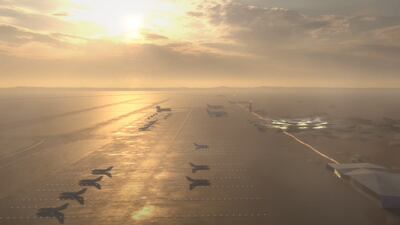
A rendering of the design for Amaala airport in Saudi Arabia, which will cater to the luxury traveller and should be completed by 2023. Supplied -
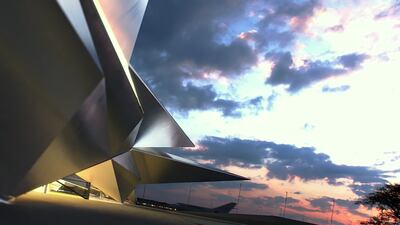
A rendering of the design for Amaala airport in Saudi Arabia, which will cater to the luxury traveller and should be completed by 2023. Supplied -

A rendering of the design for Amaala airport in Saudi Arabia, which will cater to the luxury traveller and should be completed by 2023. Supplied -

A rendering of the design for Amaala airport in Saudi Arabia, which will cater to the luxury traveller and should be completed by 2023. Supplied -

A rendering of the design for Amaala airport in Saudi Arabia, which will cater to the luxury traveller and should be completed by 2023. Supplied -

A rendering of the design for Amaala airport in Saudi Arabia, which will cater to the luxury traveller and should be completed by 2023. Supplied -

A rendering of the design for Amaala airport in Saudi Arabia, which will cater to the luxury traveller and should be completed by 2023. Supplied -
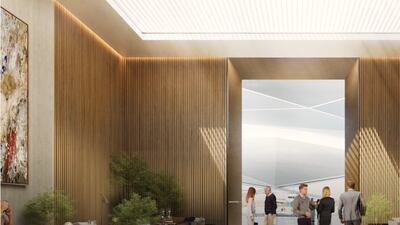
A rendering of the design for Amaala airport in Saudi Arabia, which will cater to the luxury traveller and should be completed by 2023. Supplied -
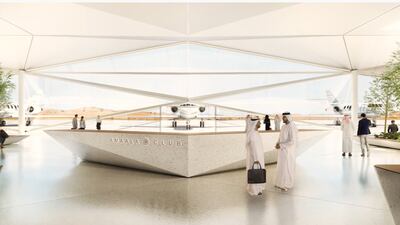
A rendering of the design for Amaala airport in Saudi Arabia, which will cater to the luxury traveller and should be completed by 2023. Supplied -
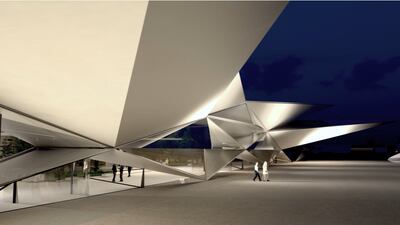
A rendering of the design for Amaala airport in Saudi Arabia, which will cater to the luxury traveller and should be completed by 2023. Supplied -

A rendering of the design for Amaala airport in Saudi Arabia, which will cater to the luxury traveller and should be completed by 2023. Supplied


Amaala
Amaala is a year-round ultra-luxury coastal destination planned for the north-western Tabuk province.
It will have its own airport and target luxury travellers seeking “transformative personal journeys” inspired by wellness, arts, culture and the “purity of the Red Sea”. It borders the city of Neom and the Red Sea Project within the Prince Mohammed bin Salman Natural Reserve.
Amaala will offer 3,000 hotel rooms in 25 hotels, and 900 private residential villas, along with a retail area with 200 outlets.

