
Live updates: follow the latest news on Covid-19 variant Omicron
Police in Italy have arrested a nurse on charges that he faked giving coronavirus vaccinations to at least 45 people so they could fraudulently obtain a health pass.
The nurse is accused of ditching vaccines in a bin and even putting bandages on his “patients” so no one would suspect the scam.
Police in Ancona, on Italy’s eastern coast, placed four other people under house arrest, accusing them of finding anti-vaccine customers who were willing to pay for a health pass rather than get the shots.
Forty-five people who allegedly received the passes as part of the scam are under investigation. They are required to check in daily with police and prevented from leaving their cities.
Police filmed the nurse working at the huge vaccine centre in Ancona, apparently squirting the needle’s contents into the medical waste bin before pretending to inject the patients' arms, then putting on Band-Aids.
The suspects are accused of corruption, falsifying information and embezzlement, although police said the fake vaccination scheme also wasted a “fundamental public resource.”
Italy has cracked down increasingly hard on the unvaccinated, requiring proof of inoculation or recent recovery from Covid-19 to enter a host of leisure venues and services such as public transport.
-
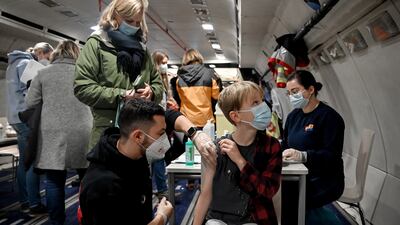
Jannik, 9, gets vaccinated in an airplane at Cologne Bonn Airport in Germany. The city is hosting a special vaccination event for children aged 5 to 11 in a decommissioned Airbus A300 Zero G. EPA -
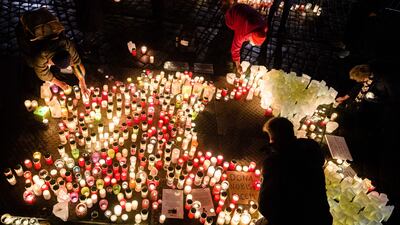
People place candles in Neumarkt Square, Dresden to commemorate the 1,400 lives lost to the coronavirus in the German city. AFP -
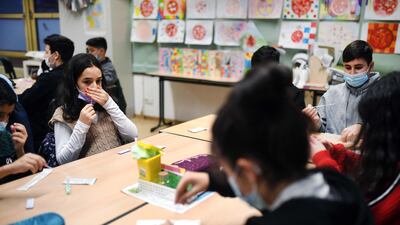
Pupils take a sample for a rapid test during the first lesson after Christmas holidays at the Freiherr-vom-Stein secondary school in Bonn, western Germany. AFP -

Protesters demonstrate against Covid-19 measures and compulsory vaccination in Frankfurt, Germany. AP -
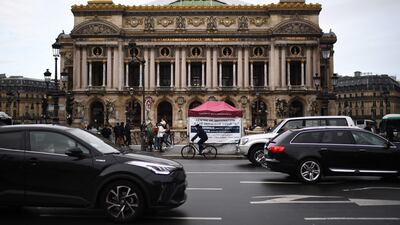
A cyclist rides past a tent where patients are undergoing coronavirus tests, at the Opera square in Paris. AFP -
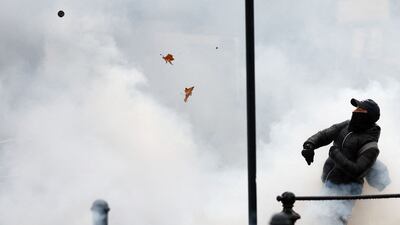
A protestor in Nantes, France throws a tear gas canister during a demonstration against a bill that would transform the country's current coronavirus health pass into a 'vaccine pass'. Reuters -

A group of young students wearing masks disinfect their hands before entering the Luis Amigo school after the Christmas holidays, in Pamplona, northern Spain. AP -
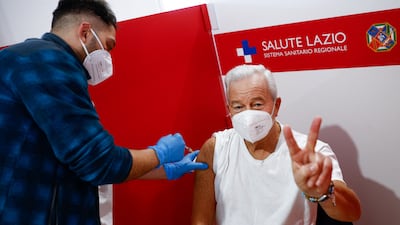
A man receives a dose of a Covid-19 vaccine at a Red Cross centre in Rome. Reuters -
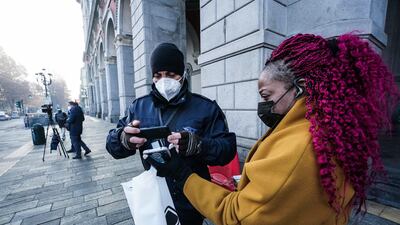
Traffic police check the green pass of public transport passengers in Turin, Italy. EPA -
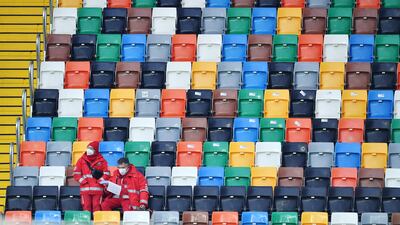
Empty seats inside the stadium before a football match between Udinese and Atalanta, as coronavirus restrictions limit the capacity to 50 percent in Udine, Italy. Reuters -

People sit in a waiting area in case of an immediate reaction after receiving booster shots at a Covid-19 vaccination centre set up in Schiphol Airport in Amsterdam. AFP -
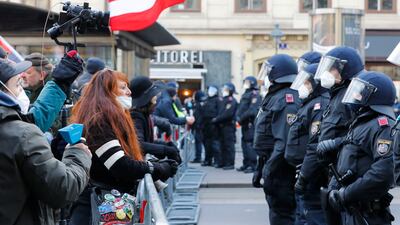
People in Vienna scream at police as officers stop a demonstration against Austria's coronavirus restrictions. AP
Italy, where the outbreak first erupted in Europe in February 2020, has inoculated 86 per cent of its population aged over 12 and has administered boosters to about 60 per cent of those eligible.
There have been several cases of police investigations into fake health passes, and one headline-grabbing case of a dentist who went into get his injection with a silicone fake arm.
After his stunt landed him under criminal investigation, the dentist announced he had been vaccinated and was merely protesting against the government’s vaccine mandates for healthcare workers.

Mobile phone packages comparison
MATCH INFO
Uefa Champions League last-16, second leg:
Real Madrid 1 (Asensio 70'), Ajax 4 (Ziyech 7', Neres 18', Tadic 62', Schone 72')
Ajax win 5-3 on aggregate
Ten tax points to be aware of in 2026
1. Domestic VAT refund amendments: request your refund within five years
If a business does not apply for the refund on time, they lose their credit.
2. E-invoicing in the UAE
Businesses should continue preparing for the implementation of e-invoicing in the UAE, with 2026 a preparation and transition period ahead of phased mandatory adoption.
3. More tax audits
Tax authorities are increasingly using data already available across multiple filings to identify audit risks.
4. More beneficial VAT and excise tax penalty regime
Tax disputes are expected to become more frequent and more structured, with clearer administrative objection and appeal processes. The UAE has adopted a new penalty regime for VAT and excise disputes, which now mirrors the penalty regime for corporate tax.
5. Greater emphasis on statutory audit
There is a greater need for the accuracy of financial statements. The International Financial Reporting Standards standards need to be strictly adhered to and, as a result, the quality of the audits will need to increase.
6. Further transfer pricing enforcement
Transfer pricing enforcement, which refers to the practice of establishing prices for internal transactions between related entities, is expected to broaden in scope. The UAE will shortly open the possibility to negotiate advance pricing agreements, or essentially rulings for transfer pricing purposes.
7. Limited time periods for audits
Recent amendments also introduce a default five-year limitation period for tax audits and assessments, subject to specific statutory exceptions. While the standard audit and assessment period is five years, this may be extended to up to 15 years in cases involving fraud or tax evasion.
8. Pillar 2 implementation
Many multinational groups will begin to feel the practical effect of the Domestic Minimum Top-Up Tax (DMTT), the UAE's implementation of the OECD’s global minimum tax under Pillar 2. While the rules apply for financial years starting on or after January 1, 2025, it is 2026 that marks the transition to an operational phase.
9. Reduced compliance obligations for imported goods and services
Businesses that apply the reverse-charge mechanism for VAT purposes in the UAE may benefit from reduced compliance obligations.
10. Substance and CbC reporting focus
Tax authorities are expected to continue strengthening the enforcement of economic substance and Country-by-Country (CbC) reporting frameworks. In the UAE, these regimes are increasingly being used as risk-assessment tools, providing tax authorities with a comprehensive view of multinational groups’ global footprints and enabling them to assess whether profits are aligned with real economic activity.
Contributed by Thomas Vanhee and Hend Rashwan, Aurifer
Company%20profile
Company%20profile%20
Mercer, the investment consulting arm of US services company Marsh & McLennan, expects its wealth division to at least double its assets under management (AUM) in the Middle East as wealth in the region continues to grow despite economic headwinds, a company official said.
Mercer Wealth, which globally has $160 billion in AUM, plans to boost its AUM in the region to $2-$3bn in the next 2-3 years from the present $1bn, said Yasir AbuShaban, a Dubai-based principal with Mercer Wealth.
“Within the next two to three years, we are looking at reaching $2 to $3 billion as a conservative estimate and we do see an opportunity to do so,” said Mr AbuShaban.
Mercer does not directly make investments, but allocates clients’ money they have discretion to, to professional asset managers. They also provide advice to clients.
“We have buying power. We can negotiate on their (client’s) behalf with asset managers to provide them lower fees than they otherwise would have to get on their own,” he added.
Mercer Wealth’s clients include sovereign wealth funds, family offices, and insurance companies among others.
From its office in Dubai, Mercer also looks after Africa, India and Turkey, where they also see opportunity for growth.
Wealth creation in Middle East and Africa (MEA) grew 8.5 per cent to $8.1 trillion last year from $7.5tn in 2015, higher than last year’s global average of 6 per cent and the second-highest growth in a region after Asia-Pacific which grew 9.9 per cent, according to consultancy Boston Consulting Group (BCG). In the region, where wealth grew just 1.9 per cent in 2015 compared with 2014, a pickup in oil prices has helped in wealth generation.
BCG is forecasting MEA wealth will rise to $12tn by 2021, growing at an annual average of 8 per cent.
Drivers of wealth generation in the region will be split evenly between new wealth creation and growth of performance of existing assets, according to BCG.
Another general trend in the region is clients’ looking for a comprehensive approach to investing, according to Mr AbuShaban.
“Institutional investors or some of the families are seeing a slowdown in the available capital they have to invest and in that sense they are looking at optimizing the way they manage their portfolios and making sure they are not investing haphazardly and different parts of their investment are working together,” said Mr AbuShaban.
Some clients also have a higher appetite for risk, given the low interest-rate environment that does not provide enough yield for some institutional investors. These clients are keen to invest in illiquid assets, such as private equity and infrastructure.
“What we have seen is a desire for higher returns in what has been a low-return environment specifically in various fixed income or bonds,” he said.
“In this environment, we have seen a de facto increase in the risk that clients are taking in things like illiquid investments, private equity investments, infrastructure and private debt, those kind of investments were higher illiquidity results in incrementally higher returns.”
The Abu Dhabi Investment Authority, one of the largest sovereign wealth funds, said in its 2016 report that has gradually increased its exposure in direct private equity and private credit transactions, mainly in Asian markets and especially in China and India. The authority’s private equity department focused on structured equities owing to “their defensive characteristics.”
How to help
Send “thenational” to the following numbers or call the hotline on: 0502955999
2289 – Dh10
2252 – Dh 50
6025 – Dh20
6027 – Dh 100
6026 – Dh 200
England World Cup squad
Eoin Morgan (capt), Moeen Ali, Jofra Archer, Jonny Bairstow, Jos Buttler (wkt), Tom Curran, Liam Dawson, Liam Plunkett, Adil Rashid, Joe Root, Jason Roy, Ben Stokes, James Vince, Chris Woakes, Mark Wood
While you're here
National Editorial: Donald Trump has left his mark on the Middle East
Con Coughlin: The thorn in the side of Biden's foreign policy team
James Reinl: Biden’s Yemen U-turn gets thumbs-up overseas
Raghida Dergham: Will Biden's 'maximum diplomacy' with Iran work?
The smuggler
Eldarir had arrived at JFK in January 2020 with three suitcases, containing goods he valued at $300, when he was directed to a search area.
Officers found 41 gold artefacts among the bags, including amulets from a funerary set which prepared the deceased for the afterlife.
Also found was a cartouche of a Ptolemaic king on a relief that was originally part of a royal building or temple.
The largest single group of items found in Eldarir’s cases were 400 shabtis, or figurines.
Khouli conviction
Khouli smuggled items into the US by making false declarations to customs about the country of origin and value of the items.
According to Immigration and Customs Enforcement, he provided “false provenances which stated that [two] Egyptian antiquities were part of a collection assembled by Khouli's father in Israel in the 1960s” when in fact “Khouli acquired the Egyptian antiquities from other dealers”.
He was sentenced to one year of probation, six months of home confinement and 200 hours of community service in 2012 after admitting buying and smuggling Egyptian antiquities, including coffins, funerary boats and limestone figures.
For sale
A number of other items said to come from the collection of Ezeldeen Taha Eldarir are currently or recently for sale.
Their provenance is described in near identical terms as the British Museum shabti: bought from Salahaddin Sirmali, "authenticated and appraised" by Hossen Rashed, then imported to the US in 1948.
- An Egyptian Mummy mask dating from 700BC-30BC, is on offer for £11,807 ($15,275) online by a seller in Mexico
- A coffin lid dating back to 664BC-332BC was offered for sale by a Colorado-based art dealer, with a starting price of $65,000
- A shabti that was on sale through a Chicago-based coin dealer, dating from 1567BC-1085BC, is up for $1,950


