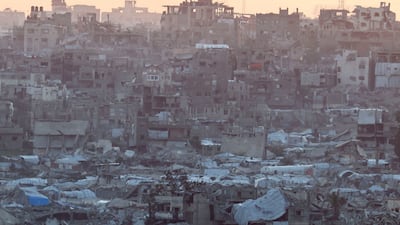

Israel’s war on Gaza has caused the potential environmental contamination of more than 99 per cent of the territory, threatening human survival, a report by Oxfam has found.
It said the extensive use of explosive and incendiary weapons has made air, soil and water in the strip dangerous for decades to come.
Israel had “wreaked havoc” on environmental systems, “dismantling the basic conditions necessary for life”, Oxfam said.

The charity group's research found the scale and intensity of the Israeli military’s onslaught has affected about 78 per cent of Gaza’s land area, with potential contamination across more than 99 per cent of the territory.
It said: “In this wasteland, the very conditions of civilian survival have been systematically degraded, raising grave concerns of human rights violations and breaches of international law.”
“Since October 2023, Israel’s military has subjected Gaza to a sustained military assault of extraordinary scale and intensity, inflicting a humanitarian and environmental catastrophe through the excessive use of explosive weapons in one of the most densely populated areas in the world.
“Hazardous contaminants have been released into the soil, water and air from munitions, destroyed buildings and infrastructure, [causing] fires, damaged industrial facilities and collapsed environmental systems. These contaminants will have profound and lasting consequences for the health of the entire population and the environmental resources upon which their lives depend.”

Its report, in collaboration with the Conflict and Environment Observatory, was compiled using satellite data, remote sensing analysis and geolocated conflict incidents to map contamination risks across Gaza, and unearth the potential health consequences and legal implications of environmental harm.
It found explosions and fires, together with the destruction and burning of buildings and infrastructure, have released airborne contaminants that settle on to rubble, soil and other surfaces, and are repeatedly redistributed by wind, vehicle movement and the clearance of damaged buildings and debris. The Palestinian enclave's highest concentration of air contaminants was found in Gaza city, Jabalia and the North Gaza governorate.
The charity said environmental recovery must not be overlooked when planning Gaza’s reconstruction. It said the evidence was sufficient to conclude that contamination was widespread, severe and consequential, and raised concerns under international laws.
Oxfam called for a “full, independent, field-based” post-conflict environmental assessment to “establish what contaminants are present, where they are found and at what concentrations; determine the risks they pose to people and the environment; and identify what needs to be done to address them”.
It also called for Israel to allow unrestricted access for aid, environmental assessment and essential equipment into Gaza.