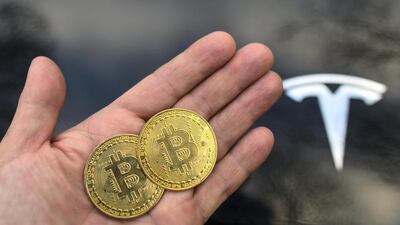
Bitcoin slid after a tweet from Tesla’s billionaire chief executive Elon Musk apparently hinting at a potential split with the largest cryptocurrency.
The world's biggest cryptocurrency dropped as much as 5.4 per cent and was trading at about $36,980 a coin on Friday.
The decline dented this week’s stabilisation in the crypto sector after a rout in May.
Mr Musk has roiled Bitcoin and other digital tokens with a string of social media posts. Most notably, the tycoon last month reversed a decision to allow purchases of Tesla electric vehicles with Bitcoin, citing the environmental fallout of the energy required by the servers underpinning the cryptocurrency.
In his latest tweet, Mr Musk wrote "#Bitcoin" with a broken heart emoji and a reference to a lyric from the popular song In the End by Linkin Park.
Bitcoin is about $28,000 down from its mid-April record of almost $65,000. The biggest believers in crypto argue the token is consolidating before a run higher to new highs.
But Mr Musk’s spotlight on environmental risks - and the way his tweets drive swings in prices - have hurt the narrative that the virtual currency is bound to win more mainstream adoption over time.
After suspending Bitcoin payments to Tesla, Mr Musk later said that the company had not sold any of its holdings of the digital token, clarifying another of his tweets that raised questions about whether Tesla might have done so.
The repeated posts have fuelled speculation over just why the electric car pioneer is issuing crypto missives.
Tesla in February disclosed a $1.5 billion Bitcoin investment. In April, the firm’s earnings report showed it had sold 10 per cent of its Bitcoin holdings.
Despite May’s retreat, Bitcoin is up about 280 per cent over the past year, while the second-ranked cryptocurrency Ether is up 1,000 per cent.

WHAT%20MACRO%20FACTORS%20ARE%20IMPACTING%20META%20TECH%20MARKETS%3F
%3Cp%3E%E2%80%A2%20Looming%20global%20slowdown%20and%20recession%20in%20key%20economies%3C%2Fp%3E%0A%3Cp%3E%E2%80%A2%20Russia-Ukraine%20war%3C%2Fp%3E%0A%3Cp%3E%E2%80%A2%20Interest%20rate%20hikes%20and%20the%20rising%20cost%20of%20debt%20servicing%3C%2Fp%3E%0A%3Cp%3E%E2%80%A2%20Oil%20price%20volatility%3C%2Fp%3E%0A%3Cp%3E%E2%80%A2%20Persisting%20inflationary%20pressures%3C%2Fp%3E%0A%3Cp%3E%E2%80%A2%20Exchange%20rate%20fluctuations%3C%2Fp%3E%0A%3Cp%3E%E2%80%A2%20Shortage%20of%20labour%2Fskills%3C%2Fp%3E%0A%3Cp%3E%E2%80%A2%20A%20resurgence%20of%20Covid%3F%3C%2Fp%3E%0A
MEDIEVIL%20(1998)
%3Cp%3E%3Cstrong%3EDeveloper%3A%3C%2Fstrong%3E%20SCE%20Studio%20Cambridge%3Cbr%3E%3Cstrong%3EPublisher%3A%3C%2Fstrong%3E%20Sony%20Computer%20Entertainment%3Cbr%3E%3Cstrong%3EConsole%3A%3C%2Fstrong%3E%20PlayStation%2C%20PlayStation%204%20and%205%3Cbr%3E%3Cstrong%3ERating%3A%3C%2Fstrong%3E%203.5%2F5%3C%2Fp%3E%0A
RESULT
RS Leipzig 3
Marcel Sabitzer 10', 21'
Emil Forsberg 87'
Tottenham 0
Types of bank fraud
1) Phishing
Fraudsters send an unsolicited email that appears to be from a financial institution or online retailer. The hoax email requests that you provide sensitive information, often by clicking on to a link leading to a fake website.
2) Smishing
The SMS equivalent of phishing. Fraudsters falsify the telephone number through “text spoofing,” so that it appears to be a genuine text from the bank.
3) Vishing
The telephone equivalent of phishing and smishing. Fraudsters may pose as bank staff, police or government officials. They may persuade the consumer to transfer money or divulge personal information.
4) SIM swap
Fraudsters duplicate the SIM of your mobile number without your knowledge or authorisation, allowing them to conduct financial transactions with your bank.
5) Identity theft
Someone illegally obtains your confidential information, through various ways, such as theft of your wallet, bank and utility bill statements, computer intrusion and social networks.
6) Prize scams
Fraudsters claiming to be authorised representatives from well-known organisations (such as Etisalat, du, Dubai Shopping Festival, Expo2020, Lulu Hypermarket etc) contact victims to tell them they have won a cash prize and request them to share confidential banking details to transfer the prize money.
Book%20Details
%3Cp%3E%3Cem%3EThree%20Centuries%20of%20Travel%20Writing%20by%20Muslim%20Women%3C%2Fem%3E%3Cbr%3E%3Cstrong%3EEditors%3A%20%3C%2Fstrong%3ESiobhan%20Lambert-Hurley%2C%20Daniel%20Majchrowicz%2C%20Sunil%20Sharma%3Cbr%3E%3Cstrong%3EPublisher%3A%20%3C%2Fstrong%3EIndiana%20University%20Press%3B%20532%20pages%3Cbr%3E%3C%2Fp%3E%0A
More on Palestine-Israeli relations
