

Live updates: follow the latest news on Russia-Ukraine
Russian President Vladimir Putin’s military offensive in Ukraine has cast a dark cloud over stock markets but it is not the only threat investors are worrying about right now.
Inflation has been the number one concern for months, as prices rise steeply in the wake of the pandemic to hit a 40-year high.
Now, it seems as if we are plunging back to the darker days of the 20th century, with a war in Europe and resurgent inflation. Except now we are getting both at the same time.
Last week, we looked at how war affects stock markets and found that history suggests that while sentiment and shares collapse at the start of the conflict, both can quickly recover.
Inflation can be a much tougher beast to control. As well as squeezing businesses and consumers, this year’s inflationary surge has shaken people’s faith in central banks, in particular the US Federal Reserve, which spent most of 2021 saying inflation would be “transient” even as the menace grew.
It used this to justify holding interest rates low, maintaining bond purchases and flooding the global economy with trillions of dollars’ worth of stimulus.
With US consumer price inflation hitting 7.5 per cent in the year to January, the Fed’s complacency has been exposed.
There is a danger now that inflation could explode out of control, exacerbated by increasing oil and gas prices, as the West seeks to isolate Russia after imposing a raft of sanctions at the weekend, including disconnecting certain Russian banks from the global Swifts payments network.
Many analysts now expect the Fed to start atoning for last year’s errors by increasing interest rates in March, possibly by half a per cent.
The Fed may even raise rates at each of its next nine meetings, JP Morgan Chase chief economist Bruce Kasman says.
Yet, some analysts fear the cure could be worse than the disease and may not even be necessary at all.
They suspect inflation will prove temporary after all. By raising interest rates and tapering bond purchases today, central bankers could end up tipping the global economy into a needless recession. There are risks on both sides, so who is right?
There are certainly good reasons to see inflation as a serious threat right now, one that demands swift and ruthless policy action.
Prices are not only rising steeply in the US. In the UK, consumer price inflation hit 5.5 per cent in the year to January and the Bank of England predicts it will hit 7.25 per cent by April.
Measured by another yardstick, retail price inflation, price growth is already near 8 per cent and will stay there all year, according to NatWest.
The BoE has been quicker to respond, increasing base rates twice, in December and February, to 0.5 per cent. Another increase is expected in March, possibly lifting them to 1 per cent.
In the eurozone, inflation hit 5.1 per cent in January but the European Central Bank is reluctant to impose higher borrowing costs on indebted countries such as Greece and Italy, says Shane O’Neill, head of interest rate trading at Validus Risk Management.
market analyst at Think Markets
“This will have crippling effects on these economies and, most worryingly, could re-spark calls to leave the EU altogether,” he says.
Yet, the ECB may have no choice. Germany’s decision to block approval of the Nord Stream 2 gas pipeline could put paid to that by driving Europe’s oil and gas bills to new highs, Alex Livingstone, head of trading at Titan Asset Management, says.
“This should give ECB hawks further ammunition to hike rates,” Mr Livingstone says.
As Russia bombards Kiev, Kharkiv and Odessa, energy prices are set to go higher, with Brent crude trading just below $100 a barrel after breaching $105 last week, Fawad Razaqzada, market analyst at Think Markets, says. “This will hurt the economic recovery and raise concerns about a possible recession.”
The problem is that increasing interest rates will pile even more pressure on consumers and businesses by driving up borrowing costs, while doing nothing to address the causes of inflation.
Higher interest rates will not mend broken supply chains or magically deliver cheaper supplies of energy. What they will do is drive up the cost of servicing all those massive debts governments ran up during Covid-19 lockdowns.
Borrowing to the hilt looked affordable, with interest rates at record lows, but not now. Take the UK as an example. In January, inflation pushed up debt interest payments to a record £6.1 billion ($8.19bn), up about fourfold from £1.6bn in the same month last year, says Laith Khalaf, head of investment analysis at AJ Bell.
“As inflation rises, the government has to shell out more to service the £500bn of index-linked gilts it used to fund its spending,” he adds.
-
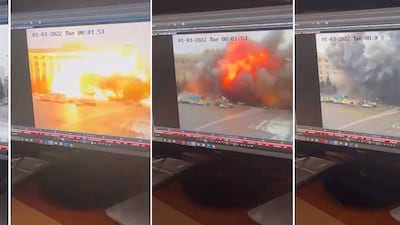
A monitor displays a projectile striking the regional state administration building in Kharkiv, as the Russian invasion continues. Reuters -
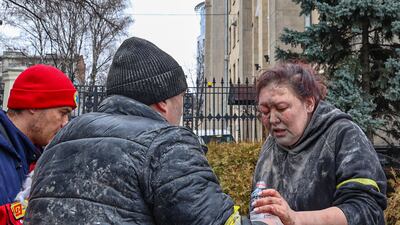
People help a wounded woman in the aftermath of Russian shelling in Kharkiv. EPA -

Ukrainian emergency service personnel carry the body of a victim following shelling in Kharkiv. AP -
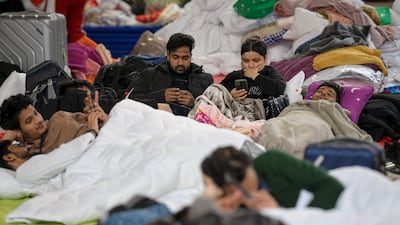
Students who fled the conflict rest in a refugee camp in Voluntari, Romania. AP -
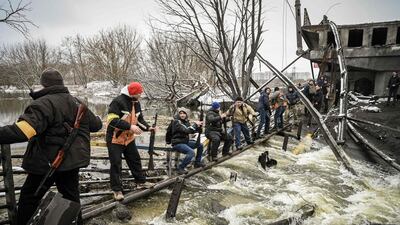
Members of an Ukrainian civil defence unit pass new assault rifles to the opposite side of a blown-up bridge on Kiev’s northern front. AFP -
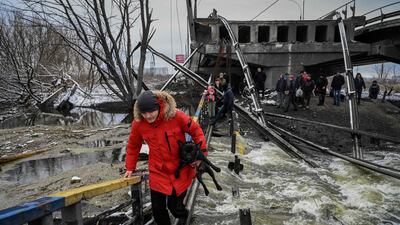
Civilians cross a river on Kiev's northern front. AFP -
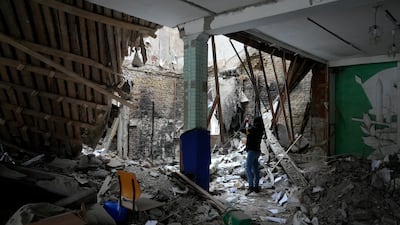
A woman takes photos of a destroyed accommodation building near a checkpoint in Brovary, outside Kiev. AP -
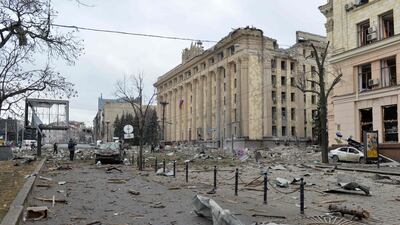
The city hall of Kharkiv, damaged by Russian shelling. AFP -
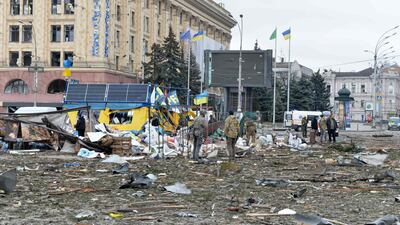
Debris litters the square outside the damaged Kharkiv city hall. AFP -

A Ukrainian woman sleeps on the floor of the railway station in Zahonyi close to the Hungary/Ukraine border. AFP -

A medical worker attends to wounded man at a hospital in Brovary, outside Kiev. AP -
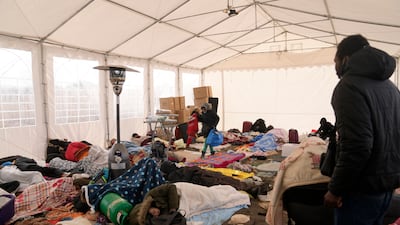
Refugees from Ukraine in a tent at the Medyka border crossing, Poland. AP -
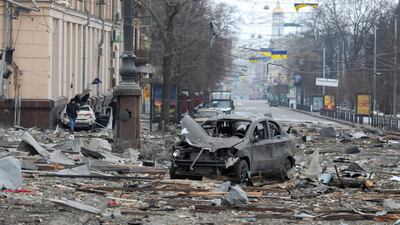
Debris outside the regional administration building, which city officials said was hit by a missile, in Kharkiv. Reuters -

A student evacuated from Ukraine is embraced by her family after arriving at Tunis-Carthage International Airport in Tunisia. AFP -
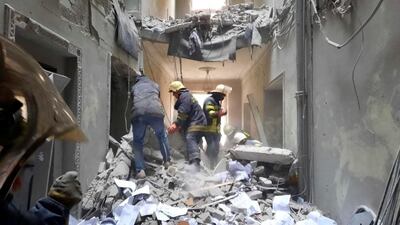
Rescuers in a building damaged by a missile in central Kharkiv. Reuters -
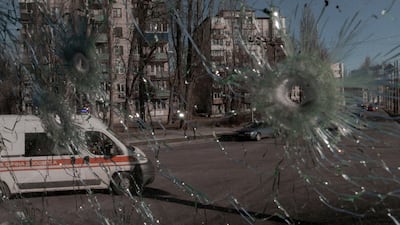
An ambulance is visible through the damaged window of a vehicle hit by bullets in Kiev, Ukraine. Reuters -

Territorial defence members prepare to head out on patrol in Kiev. EPA -
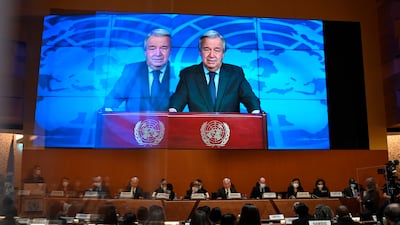
UN Secretary General Antonio Guterres delivers a speech on screen during the opening of the 49th session of the UN Human Rights Council in Geneva, Switzerland. AP -
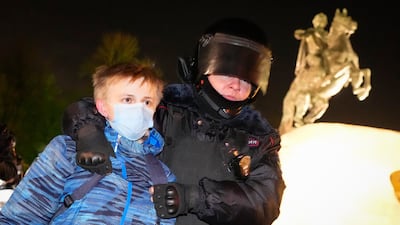
A policeman detains a young demonstrator during a protest against Russia's attack on Ukraine in St Petersburg, Russia. AP -
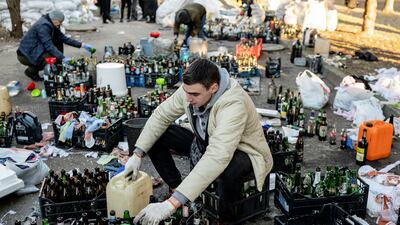
Local residents in Zhytomyr, Ukraine, prepare Molotov cocktails. Reuters -

Residents clean a bomb shelter under an out-of-service cinema in central Zhytomyr. Reuters -
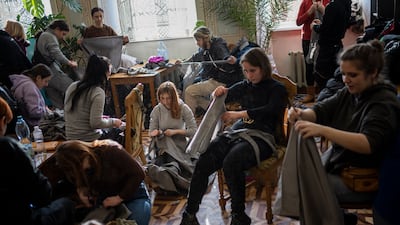
Ukrainian volunteers tear cloth into strips to make camouflage nets in Lviv, western Ukraine. AP -
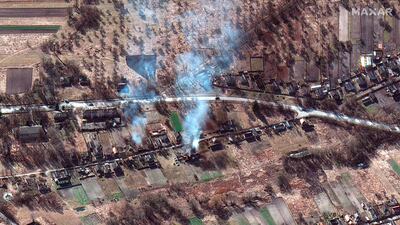
Part of the military convoy north-west of Invankiv, Ukraine. AP -

Mark Goncharuk, a young boy from Kiev, leaves his father behind as he travels with the rest of his family towards the border. Reuters -

People hold an anti-war protest outside the Russian Embassy in Mexico City, Mexico. Reuters -
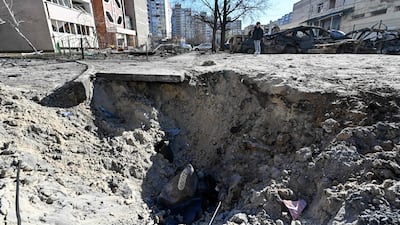
A crater caused by shelling on the outskirts of Kiev. AFP -
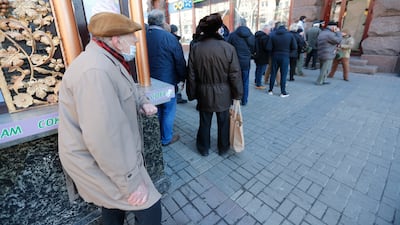
People queue outside a grocery store in the Ukrainian capital. EPA -

Ukrainian soldiers stand at Maidan Nezalezhnosti, or Independence Square, in Kiev. EPA -
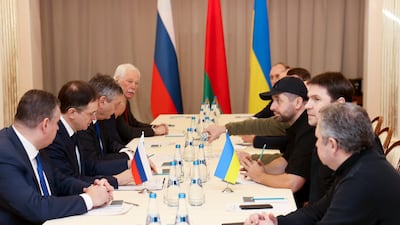
Vladimir Medinsky, the head of the Russian delegation, second left, and Davyd Arakhamia, faction leader of the Servant of the People party in the Ukrainian Parliament, third right, attend the peace talks in the Gomel region of Belarus. AP -

People who have fled the Russian invasion in Ukraine, clamour to board a bus bound for a refugee centre established in Przemysl, Poland. Reuters -
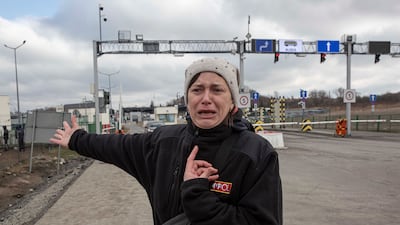
Hanna Pavlovna Lukasz, from Mirhord, Ukraine, said her sons, aged 12 and 8, and her 66-year-old mother had been waiting on the Ukrainian side of the border crossing with Medyka, Poland, for four days. AP -

A volunteer from Kiev prepares a rear post with trenches in the city. AFP -

Police officers check occupants of a suspicious car in Kiev, as Russia's invasion of Ukraine continues. Reuters -
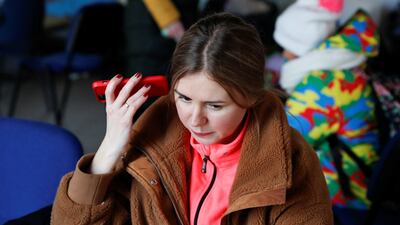
A woman from Ukraine uses a phone to listen to a speech by President Volodymyr Zelenskyy at a refugee shelter in Beregsurany, Hungary. Reuters -

Shelves empty of bread after a curfew was lifted as Russia's invasion of Ukraine continues, in Kiev. Reuters -

Ukrainian Defence Minister Oleksii Reznikov, left, and President Zelenskyy. AFP -
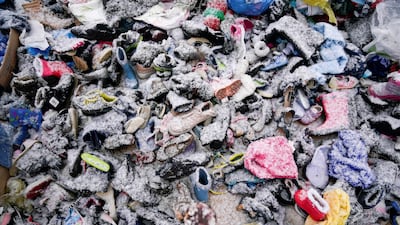
Snow-covered shoes donated for those fleeing the Russian invasion of Ukraine at the border crossing in Medyka, Poland. Reuters -
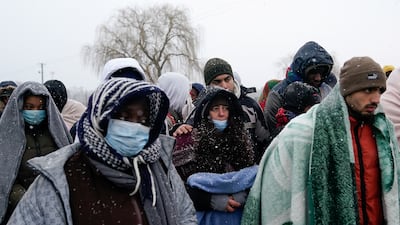
People who have fled Ukraine wait for a bus to transport them away from the border crossing in Medyka. Reuters -
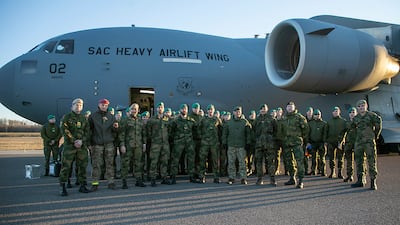
Norwegian soldiers of the Nato-enhanced forward presence battalion pose at a military plane as they arrive at an airport in Kaunas, Lithuania. AP -

A person fleeing Ukraine sits during snowfall at a temporary camp in Przemysl, Poland. Reuters -
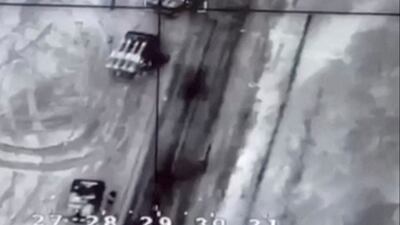
Footage reportedly of Russian Buk missile system vehicles on a road before a drone strike near Malyn, Ukraine. Reuters -

An explosion after what are said to be Russian Buk missile system vehicles on a road are struck by a drone. Reuters -
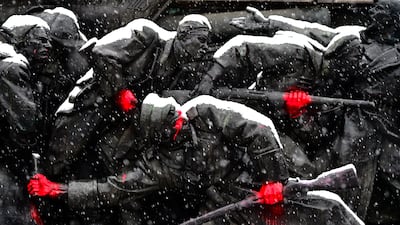
The monument to Russian troops from the Second World War, after the figures’ hands were painted red, at the Red Army memorial in Sofia, Bulgaria. EPA -
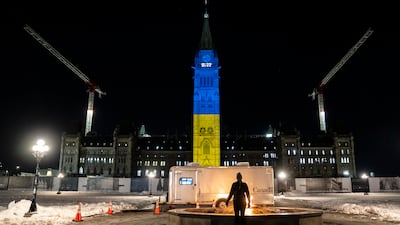
The Peace Tower on Parliament Hill in Ottawa, Canada, is lit up with the colours of Ukraine’s national flag in a show of support. AP -
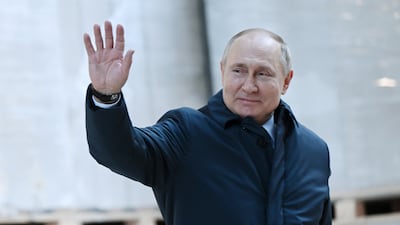
Russian President Vladimir Putin visits the construction site of the National Space Agency on the premises of the Khrunichev State Research and Production Space Centre, in Moscow. EPA -

A man looks out from a train, at the railway station in Lviv, Ukraine. The UN has estimated the conflict could produce as many as four million refugees. AP -
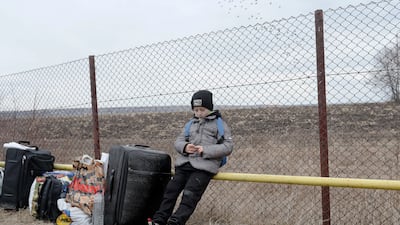
A Ukrainian boy waits for his mother after passing the border crossing point in Siret, northern Romania. EPA -

Russian policemen detain a demonstrator in St Petersburg, during a protest against the country's military actions in Ukraine. EPA -
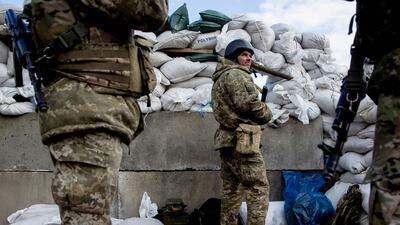
Ukrainian soldiers at a check point in the city of Zhytomyr. Reuters -
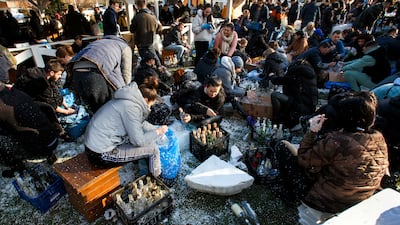
Residents prepare petrol bombs to defend the city, in Uzhhorod, Ukraine. Reuters -
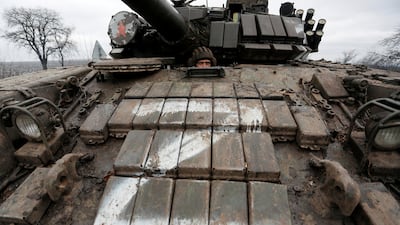
A pro-Russian fighter sits inside a tank in the separatist self-proclaimed Luhansk People's Republic, in the Luhansk region, Ukraine. Reuters -
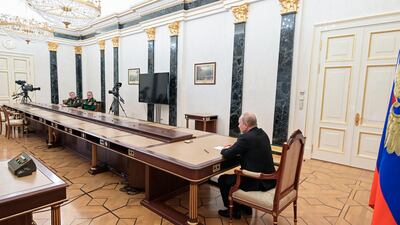
Russian President Vladimir Putin, right, speaks to Defence Minister Sergei Shoigu, second left, and Head of the General Staff of the Armed Forces and First Deputy Defence Minister Valery Gerasimov, left, during their meeting in Moscow. AP -
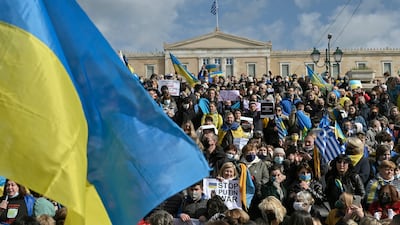
Ukrainians and supporters gather during a demonstration in front of the Greek Parliament in Athens against the Russian military's operation in Ukraine. AFP -
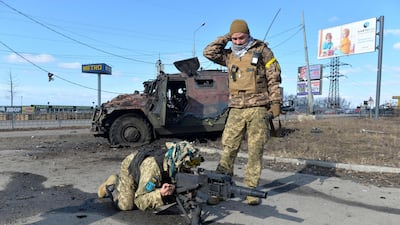
Ukrainian Territorial Defence fighters test an automatic grenade launcher taken from a destroyed Russian infantry mobility vehicla after a battle in Kharkiv. AFP


Mr Khalaf is concerned. “It could leave the government facing a cost-of-borrowing crisis if inflation persists at high levels.”
Hope is a rare commodity in these bleak times, but there is a tiny flicker on the horizon, provided central bankers heed it.
Inflation may surprise us by receding quicker than expected, Stephen Jones, global chief investment officer at Aegon Asset Management, says.
“Many of the pressures that allowed inflation to rise sharply could ease in the coming quarters,” Mr Jones adds.
Olivier Marciot, senior portfolio manager at fund manager Unigestion, agrees. He says expectations of monetary policy tightening have gone “too far, too fast”.
“Inflation is likely to cool this year as the combination of massive liquidity injections and fiscal stimulus begin to fade,” Mr Marciot says.
Inflation has been driven by record demand and supply-chain disruptions, at the same time that “the unprecedented combination of massive liquidity injections and fiscal stimulus post Covid” drove up demand.
Unigestion research suggests these factors are now fading. “Our US Inflation Nowcaster has been at elevated levels over the last six months, but has now stabilised,” Mr Marciot says.
Growth is slowing after a year of record consumption and investment, he says. “Demand destruction could already be under way as higher prices eat away at corporate margins and consumer spending power.”
This is where the Fed and others must tread carefully. If they raise rates but growth is already slowing, things could get ugly.
“It would increase the risk of a major monetary policy mistake and asset prices could adjust violently,” Mr Marciot says.
The Fed is aware of the danger and may have reached “peak hawkishness”. “Rates may not rise as far as expected,” Mr Marciot says.
We may already have seen the worst of this year’s stock market dip, “as long as real growth remains positive and central banks manage to avoid a major mistake”, Mr Marciot says.
The Ukraine conflict will partly determine where inflation heads next, Susannah Streeter, senior investment and markets analyst at Hargreaves Lansdown, says.
“Oil prices are hovering near seven-year highs and gas prices could rise sharply if aggression intensifies,” she says.
If a full-blown conflict breaks out, there is also expected to be significant disruption to ship movements around the Black Sea.
“This could fuel higher food inflation, given that Ukraine, Russia, Kazakhstan and Romania all ship grain from ports in the area,” Ms Streeter says.
Pity the poor Fed, which has to weigh up all these competing factors. A policy mistake now could be costly, Patrick Reid, currency expert and co-funder of Adamis Principle, says.
“If the Fed hikes too quickly, we could get something that strikes a cold sweat for policy setters — stagflation, with lower growth, higher unemployment and even higher consumer price inflation,” he says.
Right now, the world is watching Ukraine. On March 15 and 16, it will turn its attention to the US Federal Reserve.

