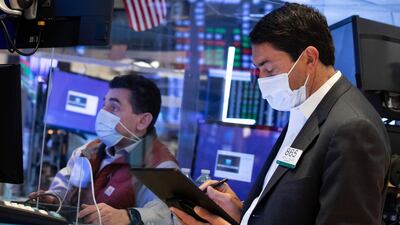
Global equities languished close to two-week lows on Thursday while the dollar traded near a four-month high against the euro, as investors worried that Europe's Covid-19 response was falling behind that in the United States.
European markets were under pressure, with the STOXX index of 600 European shares down 0.8 per cent and Britain's FTSE index down 1.1 per cent. The mood was not helped by data showing the biggest rise since January 9 in new confirmed coronavirus cases in Germany. The number of people with Covid-19 in French intensive care, meanwhile, set a high for 2021.
Extended lockdowns and worries about the pace of vaccinations across Europe hobbled the euro, which was down 0.1 per cent against the dollar, at $1.1807.
The dollar index had hit its highest since November 2020 overnight, at 92.697, breaking its 200-day moving average.
"The dollar is absolutely critical," said James Athey, investment director at Aberdeen Standard Investments.
"While the 'reflation trade' has been largely driven by US fiscal stimulus and thus growth and inflation expectations, it has also been driven by rising input prices coming from higher commodity prices.
"If the dollar starts rallying, that becomes a problem. It means commodity weakness and emerging-market weakness and it starts to provide a disinflationary countervailing narrative."
MSCI's gauge of world stocks was 0.2 per cent lower, down for a second day and at its lowest level in more than two weeks.
Its broadest index of Asia-Pacific shares outside Japan fell 0.2 per cent, bringing it closer to wiping out all the gains it has posted so far this year.
Weighing on sentiment was a sell-off in Chinese technology shares amid concern they will be delisted from US exchanges and worries about a semiconductor shortage.
In Hong Kong, companies with US listings led declines. JD.com lost 3.57 per cent and Alibaba fell 3.91 per cent.
China's blue-chip CSI300 index edged 0.05 per cent lower to its lowest close since December 11, weighed down by jitters about policy tightening and rising tensions between China and western countries over human rights allegations in Xinjiang.
The US securities regulator is introducing measures that would kick foreign companies off stock exchanges if they do not comply with US auditing standards, and require them to disclose any government affiliations – measures widely expected to hit Chinese companies.
As well as concerns about extended economic lockdowns in Europe, disruptions to the distribution of Covid-19 vaccinations and potential US tax hikes also dimmed investor sentiment.
"Rising interest rates, uncertainty of tax policy, concern over inflation all remain top-of-mind for investors. However, none of these themes speak to rising appetite for risk," said Peter Kenny of Kenny's Commentary and Strategic Board Solutions in Denver.
US crude fell 2.9 per cent to $59.41 per barrel, and Brent fell 2.7 per cent to $62.67 a barrel, giving back some gains made the previous day after one of the world's largest container ships ran aground in the Suez Canal, blocking the vital shipping lane.
Benchmark 10-year US Treasury yields eased to 1.6015 per cent. Investors have focused on the 10-year Treasury yield, pondering whether there is room for long-term interest rates to run, said David Kelly, chief global strategist at JPMorgan Asset Management.
"We know that the economy is primed to begin to really accelerate in the second quarter," Mr Kelly said. "But we haven't seen that acceleration yet, so that's what we're waiting for."

How to join and use Abu Dhabi’s public libraries
• There are six libraries in Abu Dhabi emirate run by the Department of Culture and Tourism, including one in Al Ain and Al Dhafra.
• Libraries are free to visit and visitors can consult books, use online resources and study there. Most are open from 8am to 8pm on weekdays, closed on Fridays and have variable hours on Saturdays, except for Qasr Al Watan which is open from 10am to 8pm every day.
• In order to borrow books, visitors must join the service by providing a passport photograph, Emirates ID and a refundable deposit of Dh400. Members can borrow five books for three weeks, all of which are renewable up to two times online.
• If users do not wish to pay the fee, they can still use the library’s electronic resources for free by simply registering on the website. Once registered, a username and password is provided, allowing remote access.
• For more information visit the library network's website.
How to protect yourself when air quality drops
Install an air filter in your home.
Close your windows and turn on the AC.
Shower or bath after being outside.
Wear a face mask.
Stay indoors when conditions are particularly poor.
If driving, turn your engine off when stationary.
THE%20STRANGERS'%20CASE
%3Cp%3E%3Cstrong%3EDirector%3C%2Fstrong%3E%3A%20Brandt%20Andersen%3Cbr%3E%3Cstrong%3EStarring%3A%20%3C%2Fstrong%3EOmar%20Sy%2C%20Jason%20Beghe%2C%20Angeliki%20Papoulia%3Cbr%3E%3Cstrong%3ERating%3A%3C%2Fstrong%3E%204%2F5%3C%2Fp%3E%0A
Where to Find Me by Alba Arikha
Alma Books
The President's Cake
Director: Hasan Hadi
Starring: Baneen Ahmad Nayyef, Waheed Thabet Khreibat, Sajad Mohamad Qasem
Rating: 4/5
Sholto Byrnes on Myanmar politics
The specs: 2018 Nissan Altima
Price, base / as tested: Dh78,000 / Dh97,650
Engine: 2.5-litre in-line four-cylinder
Power: 182hp @ 6,000rpm
Torque: 244Nm @ 4,000rpm
Transmission: Continuously variable tranmission
Fuel consumption, combined: 7.6L / 100km
UAE currency: the story behind the money in your pockets
%20Ramez%20Gab%20Min%20El%20Akher
%3Cp%3E%3Cstrong%3ECreator%3A%3C%2Fstrong%3E%20Ramez%20Galal%3C%2Fp%3E%0A%3Cp%3E%3Cstrong%3EStarring%3A%3C%2Fstrong%3E%20Ramez%20Galal%3C%2Fp%3E%0A%3Cp%3E%3Cstrong%3EStreaming%20on%3A%20%3C%2Fstrong%3EMBC%20Shahid%3C%2Fp%3E%0A%3Cp%3E%3Cstrong%3ERating%3A%20%3C%2Fstrong%3E2.5%2F5%3C%2Fp%3E%0A
More from Rashmee Roshan Lall
States of Passion by Nihad Sirees,
Pushkin Press
Harry%20%26%20Meghan
%3Cp%3E%3Cstrong%3EDirector%3A%20%3C%2Fstrong%3ELiz%20Garbus%26nbsp%3B%3C%2Fp%3E%0A%3Cp%3E%3Cstrong%3EStars%3A%3C%2Fstrong%3E%20Duke%20and%20Duchess%20of%20Sussex%0D%3Cbr%3E%0D%3Cbr%3E%3Cstrong%3ERating%3A%20%3C%2Fstrong%3E3%2F5%3C%2Fp%3E%0A
Mercer, the investment consulting arm of US services company Marsh & McLennan, expects its wealth division to at least double its assets under management (AUM) in the Middle East as wealth in the region continues to grow despite economic headwinds, a company official said.
Mercer Wealth, which globally has $160 billion in AUM, plans to boost its AUM in the region to $2-$3bn in the next 2-3 years from the present $1bn, said Yasir AbuShaban, a Dubai-based principal with Mercer Wealth.
“Within the next two to three years, we are looking at reaching $2 to $3 billion as a conservative estimate and we do see an opportunity to do so,” said Mr AbuShaban.
Mercer does not directly make investments, but allocates clients’ money they have discretion to, to professional asset managers. They also provide advice to clients.
“We have buying power. We can negotiate on their (client’s) behalf with asset managers to provide them lower fees than they otherwise would have to get on their own,” he added.
Mercer Wealth’s clients include sovereign wealth funds, family offices, and insurance companies among others.
From its office in Dubai, Mercer also looks after Africa, India and Turkey, where they also see opportunity for growth.
Wealth creation in Middle East and Africa (MEA) grew 8.5 per cent to $8.1 trillion last year from $7.5tn in 2015, higher than last year’s global average of 6 per cent and the second-highest growth in a region after Asia-Pacific which grew 9.9 per cent, according to consultancy Boston Consulting Group (BCG). In the region, where wealth grew just 1.9 per cent in 2015 compared with 2014, a pickup in oil prices has helped in wealth generation.
BCG is forecasting MEA wealth will rise to $12tn by 2021, growing at an annual average of 8 per cent.
Drivers of wealth generation in the region will be split evenly between new wealth creation and growth of performance of existing assets, according to BCG.
Another general trend in the region is clients’ looking for a comprehensive approach to investing, according to Mr AbuShaban.
“Institutional investors or some of the families are seeing a slowdown in the available capital they have to invest and in that sense they are looking at optimizing the way they manage their portfolios and making sure they are not investing haphazardly and different parts of their investment are working together,” said Mr AbuShaban.
Some clients also have a higher appetite for risk, given the low interest-rate environment that does not provide enough yield for some institutional investors. These clients are keen to invest in illiquid assets, such as private equity and infrastructure.
“What we have seen is a desire for higher returns in what has been a low-return environment specifically in various fixed income or bonds,” he said.
“In this environment, we have seen a de facto increase in the risk that clients are taking in things like illiquid investments, private equity investments, infrastructure and private debt, those kind of investments were higher illiquidity results in incrementally higher returns.”
The Abu Dhabi Investment Authority, one of the largest sovereign wealth funds, said in its 2016 report that has gradually increased its exposure in direct private equity and private credit transactions, mainly in Asian markets and especially in China and India. The authority’s private equity department focused on structured equities owing to “their defensive characteristics.”
FFP EXPLAINED
What is Financial Fair Play?
Introduced in 2011 by Uefa, European football’s governing body, it demands that clubs live within their means. Chiefly, spend within their income and not make substantial losses.
What the rules dictate?
The second phase of its implementation limits losses to €30 million (Dh136m) over three seasons. Extra expenditure is permitted for investment in sustainable areas (youth academies, stadium development, etc). Money provided by owners is not viewed as income. Revenue from “related parties” to those owners is assessed by Uefa's “financial control body” to be sure it is a fair value, or in line with market prices.
What are the penalties?
There are a number of punishments, including fines, a loss of prize money or having to reduce squad size for European competition – as happened to PSG in 2014. There is even the threat of a competition ban, which could in theory lead to PSG’s suspension from the Uefa Champions League.
South Africa World Cup squad
South Africa: Faf du Plessis (c), Hashim Amla, Quinton de Kock (w), JP Duminy, Imran Tahir, Aiden Markram, David Miller, Lungi Ngidi, Anrich Nortje, Andile Phehlukwayo, Dwaine Pretorius, Kagiso Rabada, Tabraiz Shamsi, Dale Steyn, Rassie van der Dussen.
The specs
Price: From Dh529,000
Engine: 5-litre V8
Transmission: Eight-speed auto
Power: 520hp
Torque: 625Nm
Fuel economy, combined: 12.8L/100km
COMPANY%20PROFILE%20
%3Cp%3EName%3A%20DarDoc%3Cbr%3EBased%3A%20Abu%20Dhabi%3Cbr%3EFounders%3A%20Samer%20Masri%2C%20Keswin%20Suresh%3Cbr%3ESector%3A%20HealthTech%3Cbr%3ETotal%20funding%3A%20%24800%2C000%3Cbr%3EInvestors%3A%20Flat6Labs%2C%20angel%20investors%20%2B%20Incubated%20by%20Hub71%2C%20Abu%20Dhabi's%20Department%20of%20Health%3Cbr%3ENumber%20of%20employees%3A%2010%3C%2Fp%3E%0A
