
“Worthy Canadian initiative” is a common joke for the world’s most boring headline. But, threatened by the US, Canada is launching initiatives that could be more world-shaping than worthy. The UAE and the EU have become two vertices of the triangle including this northern resource giant.
The Canada-EU summit concluded in Montreal, one of the most European cities in North America, on Friday. Though Prime Minister Mark Carney’s hopes of “associate membership” may not be granted in so many words, a much closer relationship is on the cards.
And on Tuesday, the UAE signed a comprehensive economic partnership with Ottawa. The UAE committed $50 billion of investment in the country last year. This has a strong energy component: Abu Dhabi’s renewable energy champion Masdar concluded a co-operation agreement with federal agency Natural Resources Canada.
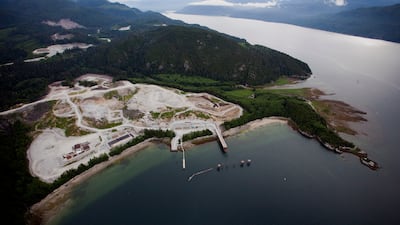
Simultaneously, Dubai’s DP World is discussing developing the northern port of Churchill, on Hudson Bay, with access to the Arctic and Atlantic oceans. Rail connects it to the Pacific. Canada’s official Latin motto translates as “From Sea to Sea”, and some have proposed amending it to “From Sea to Sea to Sea” to respect the northern ocean.
Churchill’s operator suggests it could be part of an Asia-Europe trade corridor that would be as fast and more secure than traditional routes through the Red Sea. The fast-warming Arctic, itself a warning of dangerous climate change, is opening up new shipping routes through previously ice-choked straits.
These moves span four global trends. First, the need for other great and middle powers to build alliances and lessen dependence on an increasingly erratic US, a revanchist Russia and a potentially overbearing China. Second, the creation of alternative transport routes as maritime security comes under threat. Third, the construction of new trade architecture while other countries try to demolish it. Fourth, the search for reliable providers of critical resources.
Resource superpowers
The UAE and Canada may not have much in common geographically, but they are resource superpowers. While the UAE’s bounty concentrates mostly on hydrocarbons, the northern nation has those, plus many others.
At nearly 6.2 million barrels per day, it is the fourth-biggest oil producer in the world and, depending on your view of Venezuela, the second or third-largest reserves owner. It is fifth in gas output, and its shale resources ensure plenty of room to grow production.
The Shell-led LNG Canada in British Columbia began exporting liquefied natural gas (LNG) last June, with an ideal geography to supply Asia. LNG Canada is set to double capacity by the early 2030s, and two other projects are due to start in 2027 and 2028. Bloomberg last month suggested that Adnoc’s international unit XRG was interested in taking a stake in LNG Canada. The company already bought Calgary's Nova Chemicals in a $13.4 billion deal last March.
Canada is first in the world in extracting potash, a crucial fertiliser, second in uranium mining, and fourth in gold, platinum and nickel mining and aluminium smelting. And it is an agricultural hothouse, with huge exports of wheat, oilseed, livestock, wood and other crops.
For the new strategic minerals, as well as nickel for batteries, it is a growing producer of lithium and natural graphite. It has important deposits of titanium and vanadium, crucial metals for aerospace and defence technology. In the famous and geopolitically sensitive rare earths, it has no commercial mines today, but holds large resources, and several projects are being developed.
-
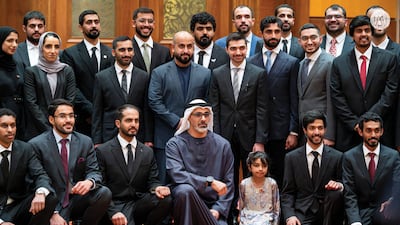
Sheikh Khaled bin Mohamed, Crown Prince of Abu Dhabi, with Emirati students studying in Canada during his official visit to the country. All photos: Abu Dhabi Media Office -
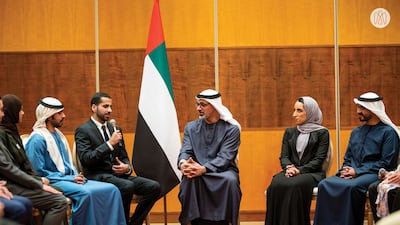
Sheikh Khaled speaks with the students -
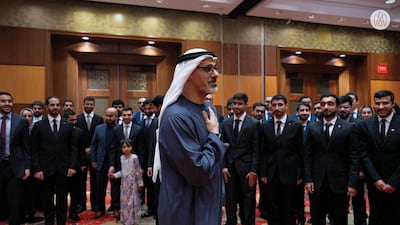
Sheikh Khaled and the students -
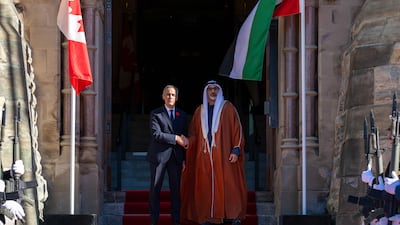
Sheikh Khaled and Canadian Prime Minister Mark Carney held official talks earlier on Wednesday -
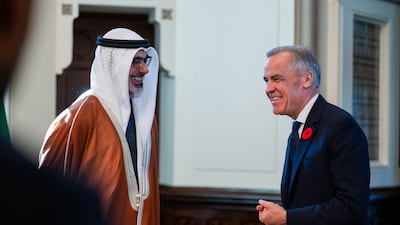
Sheikh Khaled shares a joke with Mr Carney -
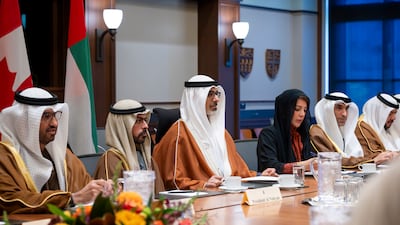
Sheikh Khaled with the UAE delegation, which included Dr Sultan Al Jaber, Minister of Industry and Advanced Technology; Reem Al Hashimy, Minister of State for International Co-operation; Dr Thani Al Zeyoudi, Minister of Foreign Trade; and Mohamed Alsuwaidi, Minister of Investment. -
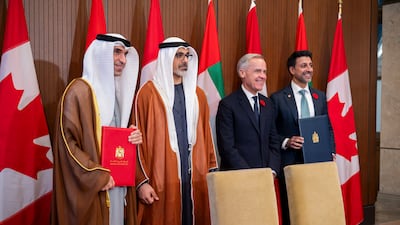
Sheikh Khaled and Mr Carney witness the signing of Canada-UAE comprehensive economic partnership agreement by Dr Al Zeyoudi and Maninder Sidhu, Canada’s Minister of International Trade -
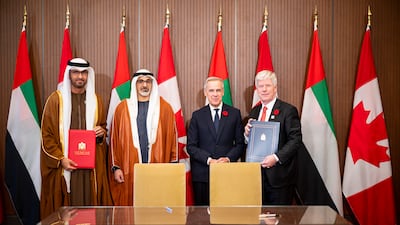
Sheikh Khaled and Mr Carney with Dr Al Jaber and Tim Hodgson, Canada’s Minister of Energy and Natural Resources -
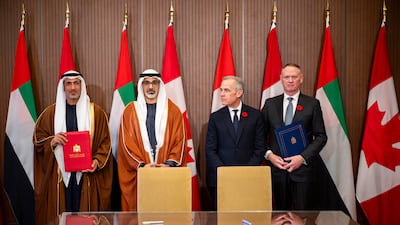
Sheikh Khaled and Mr Carney with Mohammed Al Mazrouei, Minister of State for Defence Affairs, and David McGuinty, Canada's Minister of National Defence -
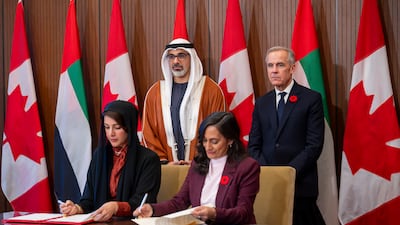
Sheikh Khaled and Mr Carney with Ms Al Hashimy and Anita Anand, Canada's Minister of Foreign Affairs. -
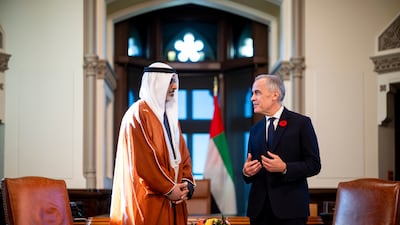
Sheikh Khaled's visit comes weeks after President Sheikh Mohamed spoke by phone with Mr Carney to explore efforts to deepen partnerships, with a focus on the economy, investment and advanced technology -
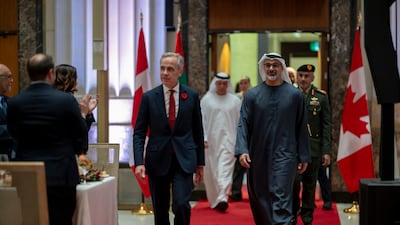
Sheikh Khaled attended an official dinner banquet hosted by Mr Carney -
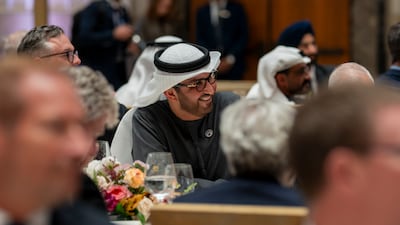
Dr Al Jaber at the banquet -
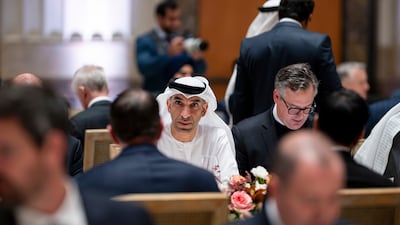
Dr Al Zeyoudi was also there -
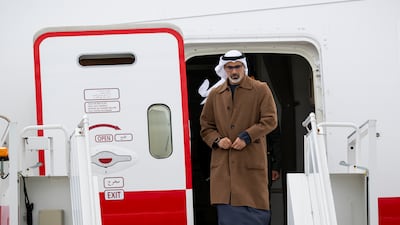
Sheikh Khaled arrives in Ottawa


Finally, its cool climate, open land and abundance of cheap, zero-carbon hydropower – where it is the third-biggest generator in the world – make it a good site for data centres.
This commodity wealth makes it tremendously attractive as a partner to the EU: a stable, Western, free-market democracy, and closer than the similarly advantaged Australia. It is further from the UAE, but many of the same attractions apply.
In turn, Canada needs good friends. Seventy-six per cent of its exports go to its overbearing southern neighbour. The EU, China and the UK are each of similar weight, with about 4 per cent to 5 per cent each. This dependence makes Canada vulnerable to the US's arm-twisting with tariffs. While Canada will no doubt expand trade with China, that brings its own political exposure.
A recent preliminary referendum on independence for the hydrocarbon heartland province of Alberta, backed by right-wing voices in the US, was heavily defeated. But Canadians are not amused by “51st state” taunts. They saw how their Arctic neighbour, Greenland, was intimidated by the White House, which eyes enviously its rare earths and possible oil.
New routes, new partnerships
Transport barriers mean Canada does not earn full value for its resources. American natural gas producers might complain about low prices, currently $2.86 per million British thermal units. Europeans’ wallets are emptied, and their energy-intensive industries hollowed out by paying around $30, as they suffer from the cut-off of LNG from the Gulf. But the wholesale price in Alberta, Canada’s main producing region, is just $1.40 per MMBtu.
It is a similar story for oil. With only one pipeline to the Pacific, Albertan producers are hostage to the US market. Western Canadian crude usually sells at about a $12 per barrel discount to the US’s West Texas Intermediate. That differential has now widened to $31 per barrel.
Mr Carney has sought to promote new pipelines, to integrate the national electricity grid, and in general to recharge the Canadian economy by diversifying exports and slashing inter-provincial trading barriers. Broadening its transport infrastructure is a crucial element and needs deep-pocketed investors with a long time horizon. Full development of the Churchill port and rail corridor alone will cost $57 billion. It will not replace Suez or Panama, but the current war in the Gulf shows how valuable back-up plans can become.
Like Western countries in general, Canada also struggles less with mining critical minerals and more with processing them. Investors are deterred by high costs, lack of access to proprietary technologies, and the tendency of China to undercut competitors. This may be a fruitful area for triangular UAE-EU-Canada co-operation, whether investing in metals refineries in Canada or in the Gulf, as part of an integrated supply chain.
Diversification – of allies, trading partners, transport routes and commodity providers – seems like a good policy today. Although technically hydrocarbon competitors, the UAE and Canada have much to complement with Europe. A new geography mingles the warm waters of the Gulf with the chilly north.

