
“America has no permanent friends or enemies, only interests.” The observation, widely attributed to Henry Kissinger but originating with the British statesman Lord Palmerston, has long captured the logic of international relations. Nearly two centuries later, it may offer the clearest explanation of the new world order taking shape.
For much of the past century, international relations were organised around relatively permanent alliances, geographical blocs and established institutions. Countries joined international organisations, aligned themselves with major powers and accepted long-term commitments that extended beyond their immediate interests. Today, that architecture is being supplemented by something more fluid: temporary, purpose-driven coalitions that I would call “pop-up alliances”.
The emerging geopolitical advantage may no longer be choosing the right side, but retaining the ability to work with several sides.
India illustrates this new geopolitical a la carte menu. It participates in the Quad alongside the US, Japan and Australia, maintains defence relationships with Russia, belongs to Brics and deepens economic ties with Europe and the Gulf. The UAE similarly combines Brics membership with extensive western security partnerships and growing commercial relationships through more than 30 Comprehensive Economic Partnership Agreements across Europe, Asia and Africa.
These arrangements are not necessarily contradictory. They reflect a world in which countries increasingly choose their partners according to the issue rather than their permanent geopolitical affiliation.
Canadian Prime Minister Mark Carney gave this thinking a powerful expression at Davos earlier this year, arguing that middle powers must co-operate more deliberately because, as he put it, “if you are not at the table, you are on the menu”. His proposed approach of “variable geometry”, involving different coalitions for different issues, captures an important shift in how international influence is exercised.
Traditionally, great powers built alliances while smaller countries joined them. Increasingly, middle powers are becoming coalition entrepreneurs, bringing together countries around shared capabilities and interests. Influence depends not simply on military strength or economic size, but on the ability to mobilise capital, technology, energy, natural resources and market access.
For countries such as the UAE, Saudi Arabia, Canada, India and Indonesia, this creates opportunities to shape international co-operation rather than merely participate in structures designed elsewhere.
The logic also challenges the geographical foundations of traditional alliances. The EU, GCC and the Association of South-East Asian Nations were largely built around regional proximity, whereas emerging partnerships increasingly reflect strategic interdependence. Semiconductor supply chains connect Taiwan, South Korea, Japan, the Netherlands and the US, while critical minerals, artificial intelligence and cybersecurity create overlapping interests across continents.
The next geopolitical map may therefore be drawn less around borders and more around the supply chains, technologies and resources that countries cannot afford to lose.
Britain’s evolving relationship with Europe offers another revealing example. Brexit represented a decisive departure from institutional integration, yet the subsequent rebuilding of economic and security co-operation demonstrates that geography and mutual dependence cannot simply be legislated away. The debate over closer relations, including possible eventual re-entry, reflects a broader movement towards more selective forms of international co-operation.
-
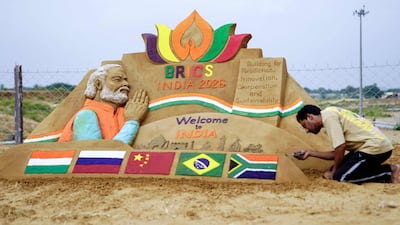
Artist Ajay Rawat creates a sand sculpture in the desert of Pushkar, India while the 18th Brics Summit was being held 460km away in New Delhi. AFP -
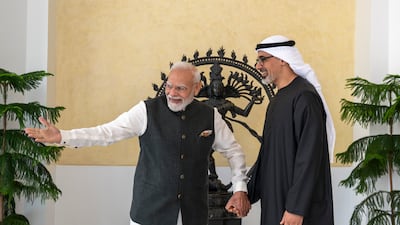
Sheikh Khaled bin Mohamed, Crown Prince of Abu Dhabi, meets Narendra Modi, Prime Minister of India, in New Delhi, where they discussed bilateral national friendship and co-operation. Photo: Abu Dhabi Media Office -
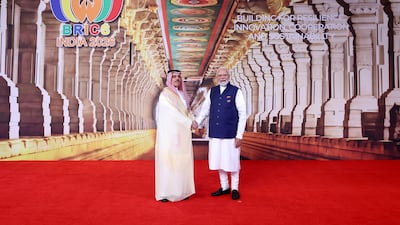
Saudi Foreign Minister Prince Faisal bin Farhan with Mr Modi on the final day of the Brics Summit in India's capital city. EPA -

Mr Modi shares a moment with Malaysia's Prime Minister Anwar Ibrahim as Russian President Vladimir Putin and Ethiopia's Prime Minister Abiy Ahmed look on. Reuters -

Saeed Al Hajeri, Minister of State; Brazil’s Foreign Minister Mauro Vieira; Russia's President Vladimir Putin; China's President Xi Jinping; India's Prime Minister Narendra Modi; Indonesia's President Prabowo Subianto; Egyptian President Abdel Fattah El Sisi; South Africa's President Cyril Ramaphosa; Iranian President Masoud Pezeshkian; and Ethiopia's Prime Minister Abiy Ahmed pose for a family in New Delhi. Reuters -

Mr Modi shares a moment with Mr Putin as Mr Xi looks on. Reuters -
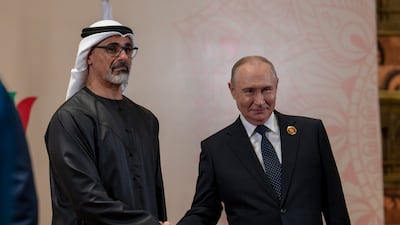
Sheikh Khaled bin Mohamed, Crown Prince of Abu Dhabi, with Mr Putin. The pair discussed the strong strategic relations between the UAE and Russia, on the sidelines of the summit. Photo: Abu Dhabi Media Office -
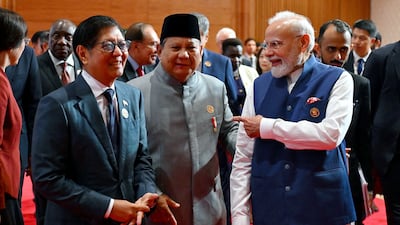
From left, Philippines' President Ferdinand Marcos, Mr Subianto and Mr Modi. AFP -
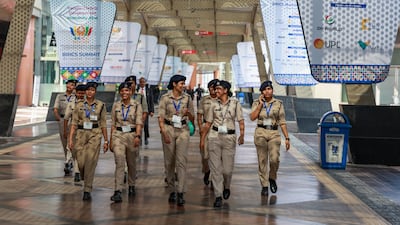
Indian women security personnel walk through the venue for the summit. EPA -
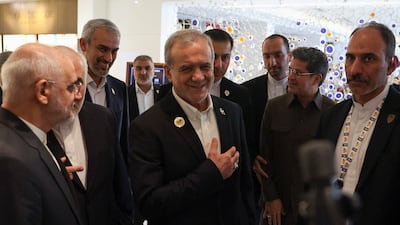
Mr Pezeshkian is greeted at a hotel during his visit to India. Reuters -
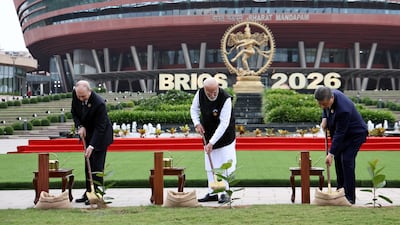
From left, Mr Putin, Mr Modi and Mr Xi at a joint banyan tree-planting ceremony. EPA -
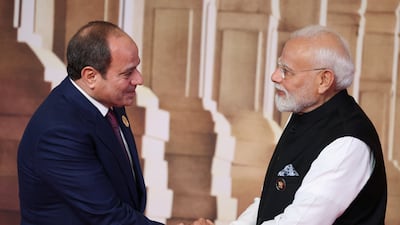
Mr Modi welcomes Mr El Sisi. Reuters -
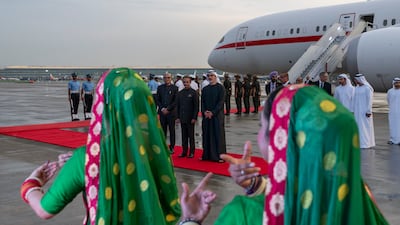
Sheikh Khaled leading the UAE delegation on behalf of President Sheikh Mohamed. Photo: Abu Dhabi Media Office


This is not necessarily the end of globalisation, but rather its rewiring. Countries are reconsidering whom they depend on, for what purposes and under which conditions. Strategic resilience increasingly means maintaining options rather than placing every national interest within a single alliance. In the future of international relations, every country will be permanently looking for new and better friends.
This is an emerging model that can be described as “pop-up governance”: flexible partnerships formed around specific challenges, designed to achieve defined outcomes and time-bound and designed to potentially dissolve when their purpose was fulfilled. Traditional institutions such as the UN, EU, GCC and Asean will remain, although some may lose influence as governments seek faster and more targeted arrangements. Alongside them, we are likely to see a growing layer of pop-up alliances, organised around shared interests rather than geography, with clear objectives and sometimes explicit time limits.
Some will address defence, geopolitical tensions or economic security. Others will be more forward-looking, bringing together countries to develop water technologies, secure critical raw materials, co-ordinate specialised manufacturing capabilities or accelerate industrial innovation. A coalition formed to develop water desalination technologies, for example, might unite Gulf countries, Singapore, Australia and technology providers without requiring a broader political alliance.
Such flexibility carries risks. Temporary coalitions can weaken accountability, exclude smaller economies and undermine established international rules. Their effectiveness will depend on whether they complement permanent institutions rather than simply bypass them. Nevertheless, the direction of change is becoming clearer. The emerging international system may resemble a network of overlapping partnerships, some permanent and others temporary, in which countries co-operate where interests converge while accepting differences elsewhere.
Kissinger’s famous principle remains relevant, but its application is changing. National interests may be enduring, yet the alliances through which countries pursue them need not be. The next measure of diplomatic influence may be less about which alliances a country belongs to, and more about which alliances it has the capacity to create.

