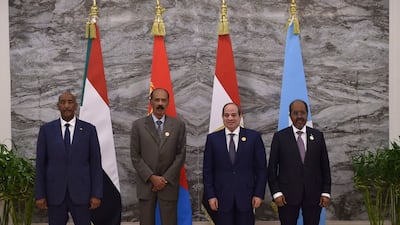

The leaders of Egypt, Eritrea, Sudan and Somalia have signalled the emergence of their countries as an alliance to influence the geopolitical landscape of the Horn of Africa and ensure its security.
Egypt's President Abdel Fattah El Sisi, head of the Sudanese Armed Forces and de facto leader Gen Abdel Fattah Al Burhan, Somalia's President Hassan Sheikh Mohamud and President Isaias Afwerki of Eritrea met on Sunday in the Egyptian city of Alamein.
The first such meeting came as the four countries grapple with formidable challenges. Egypt is in dispute with Ethiopia over the former's share of Nile water, while Sudan and Ethiopia are torn by civil wars. Somalia is struggling to defeat a long-running insurgency by Al Qaeda-linked extremists.

A joint statement issued late on Sunday made no mention of Ethiopia, which accuses three of the four nations – Egypt, Sudan and Eritrea – of aiding an anti-government rebellion. Nor did it mention Israel, which last year became the first country to recognise the breakaway region of Somaliland.
But the statement appeared to signal the creation of a four-nation alliance, albeit a loose one, whose actions could alter the geopolitics of a strategic area with a porous Red Sea coastline and ample natural resources.

It said the four leaders had agreed to support Sudan's territorial unity and the rejection of any “parallel identities” and support for “mercenaries” by foreign players – an allusion to the paramilitary Rapid Support Forces that have been fighting the SAF since 2023.
On Somalia, the leaders said they rejected recognition or support for “the so-called Somaliland”. They also agreed that the freedom of navigation and “governance” of the Red Sea is the exclusive responsibility of littoral nations, a reference to landlocked Ethiopia's attempts to gain a permanent foothold on the Red Sea against the opposition of Egypt and its allies.
On Egypt's water dispute with Ethiopia, the statement said the four leaders emphasised the importance of respecting international laws governing transnational rivers, including the Nile.
“They completely reject unilateral actions that harm the existing water usage by the two downstream nations [Egypt and Sudan],” it said.

Ethiopia has accused Eritrea, Sudan and Egypt of supporting an opposition alliance led by the Tigray People's Liberation Front that has been battling troops loyal to the federal government since last month. The three nations deny the charge.
Last week, Egypt and Ethiopia expelled diplomats in a retaliatory row that saw a senior member of each country's embassy ordered to leave.
The expulsions came a day after Ethiopia ordered the closure of its embassy in Eritrea and declared 10 Eritrean diplomats persona non grata. That prompted Eritrea to sever diplomatic ties with its neighbour.
Egypt, the most populous of the four nations with an army considered the largest in the Middle East, has been forging close military relations with Eritrea, Somalia and Sudan. It has an estimated 15,000-strong military contingent in Somalia serving in an African Union peacekeeping force as well as a large mission supporting the Mogadishu government and its military.

Egypt's military also has naval and army sites in Eritrea and is reportedly backing the SAF against the RSF. It has naval facilities in Djibouti, also a neighbour of Ethiopia.
Its military footprint in Eritrea and Somalia is chiefly designed to isolate and put pressure on Ethiopia to show flexibility in the water dispute, which is rooted in Ethiopia's construction of a large Nile dam that Cairo insists could reduce its vital share of the river's water.
While Egypt has been locked in that quarrel with Ethiopia, it has been spearheading an intense campaign to prevent efforts by landlocked Ethiopia to secure a permanent foothold on the Red Sea, including in Somaliland.
Eritrea has been at odds with Addis Ababa for most of the 30-plus years since it seceded from Ethiopia. The Sudanese Armed Forces accuse Ethiopia of aiding its civil war adversary, the RSF.
Sudan, Eritrea and Somalia all neighbour Ethiopia and, together with Egypt, have an uninterrupted Red Sea coastline that stretches from the northern tip of the Gulf of Suez in Egypt to Somalia in the Horn of Africa.
Commenting on the internal strife in Ethiopia, prominent Egyptian analyst Abdalla Senawy said that while Cairo insisted it played no part in the conflict, it had benefited from the “weakening” of Prime Minister Abiy Ahmed's government.
“It accorded its political narrative strength and credibility that it has been missing throughout a time of warnings and hints at red lines but without doing anything to deter [Ethiopia],” he said.
Ethiopia, Egypt and Sudan held years of negotiations on the dispute but failed to reach an agreement. Cairo and Khartoum demand that they be included in the running of the dam, but Addis Ababa rejects that as a violation of its sovereignty.
Egypt, one of the world's driest countries, is especially alarmed that it will not get enough water in the case of a persistent drought. It has said it will not stand idly by if Addis Ababa went ahead and built more dams on the Blue Nile, the river's main tributary that accounts for more than 80 per cent of the water reaching Egypt.

