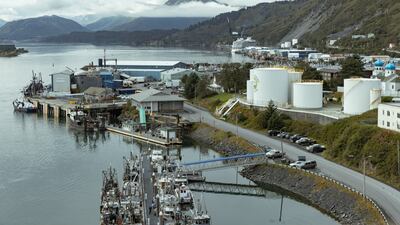

A massive liquefied natural gas project in Alaska has emerged as an unlikely focal point in purported foreign investment, as Asian buyers rush to diversify their supply imports amid disruptions from the Iran war.
On Tuesday in Wasilla, a town 70km north of Anchorage, US President Donald Trump said Taiwan had agreed to buy 30 per cent of the LNG from the long-planned Alaska LNG project. Commerce Secretary Howard Lutnick said Taiwan had committed to investing $4.4 billion to develop the pipeline. The terms of the deal were not immediately clear.
Last week, Mr Trump announced a $54 billion South Korea investment in Alaska LNG as part of a $200 billion energy package and $350 billion trade deal the two sides struck last year to lower tariffs on Korean imports. South Korea has rejected the claim, saying it has given no firm commitment on the project.

“There's no investors other than the US government, and there are no buyers who have committed to signing any sales and purchase agreements,” said Ira Joseph, a global fellow at the Centre on Global Energy Policy at Columbia University.
The project hopes to make a final investment decision on the pipeline this year, with a separate one on the export terminal in 2027.
One of the dominant factors in the publicly promoted claims are the November 3 midterm elections. Alaska has become a battleground state for control of the US Senate. Mr Trump’s appearance in Wasilla on Tuesday underscored the race’s importance as he seeks to promote energy exports and foreign investment.
At the same time, the Alaska LNG project holds big promises, as South-East Asian buyers are seeking to diversify their energy supplies as the Iran war cut off shipments from the region.
If Alaska LNG becomes operational, it would drastically reduce the time for delivery of LNG shipments. The journey from Alaska to Japan is more than 9,600km shorter than from the US Gulf Coast, the project's developer said in a 2023 report.
Theory v practicality
For all the promise that Alaska LNG holds, it remains a far-off venture. Development is expected to begin in phases, with targets for the first exports in 2031.
Glenfarne Group estimates the project will cost between $44.5 billion and $54.5 billion. That means about $2.2 billion to $2.7 billion a tonne a year of capacity, according to a Reuters analysis.
“This is an expensive project that's going to take at best a lot of years to sort of come to fruition,” said Rachel Ziemba, founder of risk advisory firm Ziemba Insights.
Another possible sticking point is the about 106cm-diameter pipeline that would stretch 1,300km from Alaska’s North Slope to Nikiski, south of Anchorage, running parallel to the existing Trans Alaska Pipeline System for oil. LNG sites in Nikiski would produce 20 million tonnes a year for export and hold a daily capacity of 3.3 billion cubic feet.

The pipeline itself – Phase One – is likely to cost between $13.2 billion and $16.9 billion, according to company estimates.
“If the gas is sitting right next to the LNG facility, this thing would have been built 40 or 50 years ago, but it's not, and … that's the difference maker in this project,” Mr Joseph said.
Investors remain cautious. As of January this year, only six non-binding offtake agreements have been signed totalling 13 million tonnes a year.
Another point of friction is competition, with LNG projects in Canada and in America's Gulf Coast also attracting attention.
Major players in the Middle East have continued to increase their interest in LNG, but through the Gulf Coast. This summer, Adnoc's XRG boosted its stake in NextDecade's LNG site in Rio Grande, Texas. QatarEnergy began LNG exports from its joint venture with Exxon at the Golden Pass project in March.
“It is notable to me that at a time where you know Trump is looking for all the finance he can for this project, that he's not turning to these sources of capital,” Ms Ziemba said.

