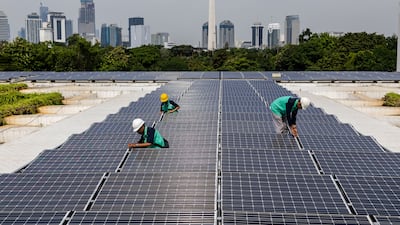

The liquefied natural gas shock caused by the Iran war is pushing South-East Asia towards solar and wind power, but the region has lined up less than a third of the energy storage it needs by 2030, a report has found.
South-East Asia's current pipeline of utility-scale storage projects of about 7GW, expected to be operational by 2030, covers less than a third of the 23 to 26GW needed to support its renewable energy targets, energy think tank Ember said in the report published on Wednesday.
On its current growth rate, the region would fall even further behind by 2045, Ember said.
“The financing bottleneck in Asean's [Association of South-east Asian Nations'] energy transition has shifted from raising capital to creating bankable assets,” said Alnie Demoral, an energy analyst at Ember.
The findings highlight the challenge for economies trying to cut their exposure to imported fuel after the Iran war disrupted shipments through the Strait of Hormuz. The waterway carried almost a fifth of global LNG before the conflict began in late February.
South-East Asia sourced about a third of its gas imports from the Middle East before the war, according to the Global Energy Monitor. Asian spot LNG prices averaged $17.50 per million British thermal units in the second quarter, 45 per cent higher than a year earlier, GEM said.
In the South-East Asia region, the Philippines, which declared a national energy emergency in March, gas-fired power capacity in development had fallen from 19.7GW in January to 13.8GW by August, GEM data shows. In Vietnam, Vingroup has sought to replace a planned 4.8GW LNG power plant with solar, wind and battery storage.
Large solar farms are increasingly able to attract commercial financing, Ember found, but battery storage, smaller renewable installations and transmission lines remain less attractive to investors. Under the same tariff and financing assumptions, a half-megawatt solar project returns 2.6 per cent to equity, against 13.1 per cent for a 20MW plant.
Investment will increasingly depend on cutting transaction costs and allowing storage and grids to earn returns that reflect their value to the power system, Ms Demoral said.
Current investment falls short of the $281 billion a year the region needs by 2035 to complete its energy transition, Ember said. Electricity demand in South-East Asia is forecast to increase about 5.4 per cent a year through 2030, the International Energy Agency says.
Expensive gas is also reviving coal, with the IEA expecting global coal demand to rise 1.2 per cent to a record 8.94 billion tonnes this year, as high LNG prices push utilities in Europe, Japan, South Korea and China to burn more.
The financing models that supported large renewable projects have yet to extend to the storage and grids needed to integrate intermittent power, Ember said.