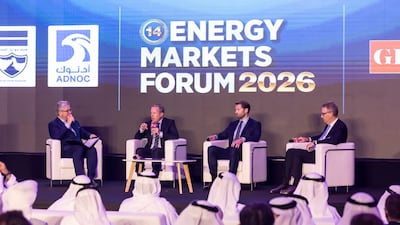

The Iran war is creating “huge” arbitrage opportunities across global energy markets as disrupted trade flows stretch tanker fleets to capacity and send oil on longer journeys, according to Vitol Group, the world’s largest independent oil trader.
“There’s huge arbitrage opportunities going on,” Tom Baker, managing director for Vitol in Bahrain, said at an industry forum in Fujairah on Wednesday.
The disruption has also pushed the global tanker fleet to full utilisation. “When you see the shipping fleet at 100 per cent utilisation”, shipping becomes “very interesting”, Mr Baker said.
Tanker rates have surged as restrictions on the Strait of Hormuz and Bab Al Mandeb strait force vessels on longer journeys and increase ship-to-ship transfers. Average spot earnings for very large crude carriers approached $642,000 a day globally in late September, according to Clarksons Research.
The upheaval has also changed where Vitol sends its barrels. “It’s been fascinating to see that barrels from our Western or European refineries have found their way around to the east under these conditions,” Mr Baker said.
Refining recovery
Refining has been another source of market dislocation, although Mr Baker said Middle East capacity is now recovering rapidly from outages caused by the conflict.
About two million barrels a day of refining capacity has been knocked out in Russia, while the Middle East suffered similar outages and capacity in China has also been down, he said.
“We had similar [refinery outages] in the Middle East, but it’s recovering very rapidly now,” Mr Baker said.
Middle East refinery runs were forecast last month to average about eight million barrels per day this year, 1.6 million bpd below 2025 levels, according to S&P Global Energy, as outages tightened supplies of petrol, diesel and jet fuel.
Infrastructure opportunities
The turmoil is also changing how Vitol assesses energy infrastructure investments, with the trader generally backing assets that can generate returns immediately over projects that take years to develop.
“Today, you can buy a ship and make an immediate return on it,” Mr Baker said. A pipeline that will not be ready for another two or three years has to be assessed against the possibility of further “black swan events”.
Some projects may also be driven by “national strategic reasons” rather than the returns sought by private investors, he said.
“We’ve gone from being more of a trader of a third-party barrel to really seeing the need to be part of the infrastructure chain,” Mr Baker said.
Africa links
Vitol views the Middle East and East Africa as an increasingly connected energy market, with the Gulf’s surplus fuel supply and short shipping distances making it a natural source for countries short of products, Mr Baker said.
During the crisis, Vitol helped landlocked Uganda diversify fuel imports beyond Kenya’s pipeline system, routing supplies through Tanzania’s port of Tanga.
Uganda is also expected to begin exporting about 230,000 bpd of crude through its heated export pipeline to Tanga “at some point next year”, Mr Baker said. Those barrels “will easily get bought” in Europe, the Middle East or Asia.