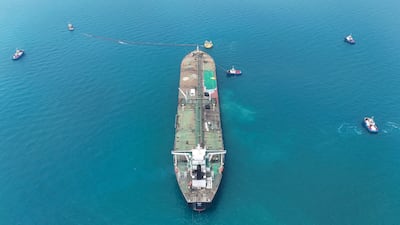

The cost of hauling crude through the world’s key oil routes has surged to record levels, with supertanker earnings approaching $650,000 a day as Middle East disruption ties up vessels and squeezes available shipping capacity.
Average spot earnings for Very Large Crude Carriers, or VLCCs, have jumped 40 per cent in the past week to almost $642,000 a day globally, according to Clarksons Research.
Restrictions at the Strait of Hormuz and Bab Al Mandeb have forced tankers into longer journeys and complex ship-to-ship transfers.
Rising diesel prices and war risk premiums for shipping firms willing to run the gauntlet have further hiked prices.
The squeeze is even more extreme on some routes. Gross earnings for tankers sailing from Oman to South Korea have climbed to about $845,000 a day, while freight from the US Gulf to China has reached about $50 million per voyage, equivalent to $25 a barrel.
The surge comes even as crude flows from the Arabian Gulf recover, underscoring how the disruption has shifted from simply keeping oil off the market to tying up the ships needed to move it.
These prices have led to high-stakes bets on futures funds related to the tanker industry. One such fund is Breakwave, where projections on the price of shipping have seen a spike in share prices of more than 3,600 per cent.
Tanker traffic through the Strait of Hormuz, the chokepoint between the Gulf and global markets, has been severely constrained since the US-Israeli war on Iran began in late February.
Clarksons estimates that at least nine million barrels per day of crude passed through the Strait of Hormuz over the past week. That remains about six million bpd below pre-conflict levels, but flows have been increasing as the shipping industry adapts to the disruption.
A significant amount of oil is being moved through so-called “shuttling”, where tankers transport crude out of the Arabian Gulf, sometimes with their AIS tracking systems switched off, before transferring the cargo to other vessels.
But this process is creating its own bottlenecks. Longer waits for receiving vessels in the Gulf of Oman are tying up a growing share of the world's tanker fleet. About 15 per cent of the global VLCC fleet is now in the Gulf of Oman, according to Clarksons, compared with 10 per cent at the beginning of July.
That effectively reduces the number of tankers available elsewhere, helping push rates higher even while oil continues to reach the market.
The disruption is also spreading beyond crude oil. Clarksons says shuttling activity involving LPG carriers has increased, while reports have emerged of liquefied natural gas carriers conducting ship-to-ship transfers.
With Hormuz restricted, Saudi Arabia has relied on its East-West pipeline to shift crude oil exports away from the Gulf. That route came under direct attack on September 10 when drones launched from Iran targeted the pipeline in the Riyadh and Madinah regions, causing fires and damage. Since then, the Red Sea routes have also come under threat. On July 20, Houthi military spokesman Yahya Saree declared an immediate naval blockade on Saudi Arabia. Within 48 hours, five vessels turned around to avoid crossing the Bab Al Mandeb strait, according to maritime intelligence firm Windward.
Meanwhile, Saudi Arabia has stepped up crude loadings from within the Arabian Gulf after a disruption to the East-West pipeline, which carries oil across the kingdom to the Red Sea port of Yanbu. The pipeline is expected to return to about 50 per cent capacity in the coming days, although Clarksons says it may not be fully operational until November.
Despite the disruption, energy markets have so far proved relatively resilient. Brent crude fell below $100 a barrel on Tuesday as flows from the Arabian Gulf increased, and expectations grew that the East-West pipeline would return faster than previously thought.
But for the ships carrying that oil, the impact has been very different. As vessels spend longer completing journeys and a significant share of the fleet gets caught up in Arabian Gulf logistics, tanker capacity has become increasingly scarce, sending freight rates to unprecedented levels.

