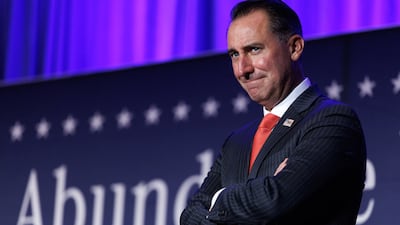

Almost seven months into a war that has redrawn the global energy map, the man overseeing US President Donald Trump's energy agenda says the fight over Middle East oil is no longer only about supply – it's about the routes that carry it.
“We need to de-emphasise the strait [Hormuz],” says the head of America’s Energy Dominance Council, Jarrod Agen. “When Europe had to get off Russian gas, we looked at different corridors to get US LNG into Europe to replace the Russian gas. We want to do a similar system in the Gulf.”
Speaking to On The Record with Hadley Gamble at the UN General Assembly, Mr Agen said the goal was redundancy: routes that cannot all be knocked out at once.
That means “several routes, different corridors, either east-west, either bypassing the strait or getting up Turkey or into the Mediterranean”, he said, with the UAE and Saudi Arabia working as key partners with the US.
“How do we make alternative routes beyond the bypass route so that no one route can be attacked and shut down the progress?” Mr Agen said. “The only person that can quarterback that is President Trump. He's the one that can get everybody around the table and get everyone to agree.”

Since the Iran war erupted in February, Brent crude has swung from about $72 a barrel to a peak near $120, dipped below $70 by midsummer, and by mid-September was trading back above $104 as renewed attacks on shipping and energy infrastructure reversed earlier gains.
Traffic through the Strait of Hormuz – the corridor that once carried more than 20 per cent of the world's oil trade – has collapsed by about 95 per cent, from more than 100 vessels a day to as few as five. War-risk insurance for tankers attempting the transit has surged into the millions of dollars a voyage. American motorists, meanwhile, have watched pump prices climb to their highest levels since 2023.
Asked to set the scene, Mr Agen did not start with barrels – he started with bottlenecks. “The most important one globally is refining,” he said. “Refining capacity here in the United States is at 100 per cent. We are tapped out.” He noted the imbalance across the globe. “Russia is down 30 per cent to 40 per cent refining. China has still some room to do more refining, more export,” he added.
But the deeper shift, Mr Agen said, was strategic rather than technical, with the Middle East energy map permanently redrawn.
“If you don't have your own energy supply that you can rely on, then it affects everything. It's not just your economy, it's your national security. And it's your whole foreign policy as well,” Mr Agen said.
Pressed on cost, Mr Agen did not dispute that the numbers are large. “I mean, yes, the infrastructure commitment is going to be in the billions,” he said. “But look at the long-term benefits of it.”
Asked to put a number to this new energy security premium, Mr Agen reframed what producers are buying. “It's almost incalculable, because energy security is national security,” he said.
That calculus lands on top of an industry-wide investment gap that predates the war. Analysts at the International Energy Forum and S&P Global have put the annual upstream spending required until 2030 at between $400 billion and $640 billion. The figure is up sharply from the $483 billion peak reached in 2019, just to offset accelerating decline rates in existing fields – before a single dollar goes towards new bypass pipelines, storage or alternative Gulf export corridors.
Mr Agen's framing suggests the war has added a security premium on top of that baseline: infrastructure spending Gulf states will now shoulder not to grow supply, but to insure it against the next disruption.
Venezuela centre of the ‘energy universe’
Mr Agen was most emphatic when describing what he called the administration's core strategic bet: that the Western Hemisphere, not the Gulf, should anchor global energy security.
“The President has made the Western Hemisphere the centre of the energy universe,” he said. “It is not in the Middle East. It is not in the East. It's the Western Hemisphere, Alaska, all the way down to Argentina. We are unleashing American energy. We are unleashing Venezuelan energy.”
He said a new arrangement with Caracas was the clearest evidence. “This amazing deal that the President struck with Venezuela, where we're now opening 17 more prime fields – the US is now in partnership with Venezuela on this,” Mr Agen said. “This is the biggest oil deal in the history of the US. That sends a message to the world.”
Asked whether that diminishes Opec’s relevance, he said: “What it means is we've become more important.”
No sympathy for a slower transition
On Europe's energy politics, Mr Agen credited a recent G20 energy ministerial meeting in Houston with a tonal shift away from climate targets and towards reliability.
“There wasn't a lot of talk about net zero,” he said. “It was more about energy security; affordability, reliable energy.” He singled out Poland and Italy for investing in LNG import and storage capacity, but dismissed the broader premise of a shift away from fossil fuels entirely.
“This whole talk of energy transition – that's nonsense. It's energy addition,” he said. “Natural gas is secure. Nuclear is going to be secure. These are the things they should be investing in, not windmills and solar projects.”
Relief for refiners
Asked directly about prices at the pump, Mt Agen turned to domestic policy, contrasting the administration's approach with predecessors he accused of constraining supply. “In the past, California, Gavin Newsom, Joe Biden – they have all been trying to shut down refineries in the US, and this is what happens when you try to shut down refineries,” he said.
“We're doing the opposite. We're bringing them in. We're asking them what they need.” He said the administration was examining use of the Defence Production Act to fast-track refinery funding. “This is weeks and months of getting more refining capacity online” – paired, he said, with regulatory relief modelled on rolling back California-style restrictions. “If we get more refined products on the market, that will drive down prices.”
Whether that timeline holds may determine how much of the “security premium” American consumers ultimately absorb – and how long Gulf capitals are willing to bankroll a rerouted energy map before the war that made it necessary comes to an end.

