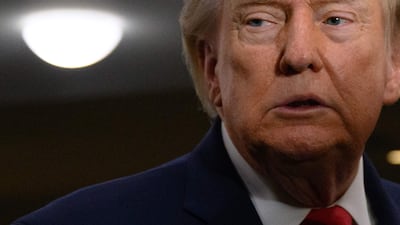

Donald Trump is in an advantageous position in dealings with Iran, a State Department official told The National on Tuesday, after the US President announced new negotiations had taken place.
Mr Trump's remarks that his son-in-law Jared Kushner and special envoy Steve Witkoff had negotiated with the Iranian delegation at the UN took many by surprise, as no talks are known to have happened since July, when an interim deal that was supposed to be a road map to peace broke down.
State Department spokesman Tommy Pigott said the Trump administration is compounding pressure on Iran through the Treasury Department's Economic Outcast campaign and the US military's efforts to block Iranian oil shipments.
"The President holds all of the cards here, and is continuing to ramp up the pressure," he said. "We're seeing [the Trump administration's policies] have real impacts here. So the choice of the Iranian regime is very clear," he added.
Mr Trump had earlier threatened to "annihilate" Iran if it did not make a deal, which he suggested might happen after the US midterm elections on November 3. He said the US and Iranian delegations had spoken for three hours.
Mr Trump has "always preferred a diplomatic approach, but he's going to see this fundamental objective that they can't have a nuclear weapon be fulfilled, one way or another," Mr Pigott said.
Mr Witkoff later said talks with the Iranian delegation had been held through mediators.
"They successfully completed a round of discussions that we hope will prove constructive and promising. The mediators will continue their work," he said.
Apart from the blockade of Iranian oil shipments, the US military has also reopened the Strait of Hormuz to a significant extent, chipping away at Iran's main point of influence in the conflict. Before the war, about 20 million barrels of oil would flow through the waterway daily.
"We're looking at approximately 60 to 70 per cent of where oil was before this began," he said.
When Mr Trump launched the war alongside Israel on February 28, he predicted it would only last a few weeks. It has now lasted nearly seven months and remains deeply unpopular in the US, where food and fuel prices have risen, largely because of disruptions in the Strait of Hormuz.
Tuesday's new discussions come as the conflict is at risk of becoming more complex, after the Iran-backed Houthis in Yemen seized large areas including Mokha and Perim Island in a lightning offensive that could allow them to threaten shipping in a separate waterway, the Bab Al Mandeb strait.
The State Department has warned that the situation could "escalate rapidly". The Houthis have attacked Riyadh with missiles, and Crown Prince Mohammed bin Salman has pressed Mr Trump for direct US action, but Washington has so far declined.
Mr Pigott said the US is having "constant conversations with our Saudi partners" and was co-operating closely with Gulf allies.
"We have been living up to our commitments and we will live up to our commitments to our Saudi Arabian partners," he said.

Board of Peace
During his speech to the UN General Assembly on Tuesday, Mr Trump spoke about the situation in Gaza and how his Board of Peace had been able to stop the killing.
"Hundreds of thousands of lives have been saved because of that peace plan," Mr Pigott said. "We've seen the movement of assistance into Gaza."
But French President Emmanuel Macron, during his final speech to the General Assembly before he leaves office next year, said not one humanitarian corridor had been reopened into Gaza, despite the proclaimed peace.
The Board of Peace is due to meet in New York on Wednesday as it tries to push for full implementation of the Gaza peace plan.
"All parties must fulfil their commitments and refrain from actions that could undermine the ceasefire or return Gaza to conflict," the board, of which Mr Trump is chairman, said in a statement. "International partners must turn political support into practical commitments."
Britain this month announced it would impose sanctions on businesses linked to illegal Israeli settlements in the occupied West Bank. The Trump administration has said relatively little about the measures.
Mr Pigott said the Trump administration opposes "criminal activity" and "violent activity" in the West Bank and does not support actions that lead to "destabilisation".
"We oppose criminal activity. We oppose violent activity, and that's something that we have said repeatedly from this administration," he said, referring to violent Israeli settlers.

