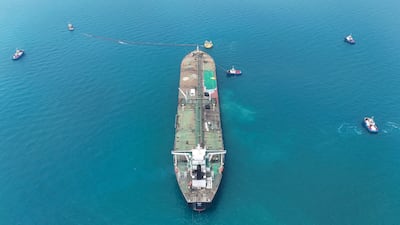

Iraq's state oil company has transported its own crude beyond the Strait of Hormuz for the first time in decades as the Iran war threatens its export route.
The state-run Iraqi Oil Tankers Company shipped two million barrels of crude on a Very Large Crude Carrier (VLCC) to outside the strait, its director general Ali Qais told the Iraqi News Agency (INA).
The task was assigned to the company for the first time in decades, shifting part of Iraqi oil sales from the previous free on board (FOB) Basra port model to deliver outside the strait, Mr Qais added.
The company held talks with specialised firms and secured the VLCC, allowing the State Oil Marketing Organisation (Somo) to take advantage of better sales and pricing opportunities, he said.
The Oil Tankers Company is now in talks to purchase and own specialised crude tankers "as soon as possible and to compete with regional peers", he added. He didn't give further details.
The move comes as Iraq faces one of its worst economic and security squeezes since the Iran war broke out in February.

Iraq, Opec's second-largest producer, depends on oil for at least 90 per cent of state revenue. Most of its exports, roughly 3.3 million barrels per day before the war, went from its southern Basra terminals through the Strait of Hormuz. The narrow waterway has been effectively closed by Iran during the war, with shipping disrupted by missile and drone attacks, insurance spikes, and naval confrontations.
Since the war began, Iraq has been caught in the middle. Iranian-aligned factions launched drones toward Gulf states from Iraqi territory, prompting Saudi Arabia, the UAE, Qatar, Kuwait, Bahrain and Jordan to hold Baghdad responsible. Meanwhile, Iraqi waters near Hormuz have seen heightened risks, forcing Somo to offer discounts for Basra loading and causing buyers to demand delivery outside the strait.
The government has been scrambling to revive alternative routes — including talks to reopen the Iraq-Turkey pipeline via Ceyhan and trucking crude to Syria — but those handle only a fraction of volumes.
Iraq has been able to export three million barrels of oil per day since the beginning of September, the state news agency quoted oil minister Bassim Khudair as saying last month.
“The government plans to increase export capacity to five million barrels per day after the completion of the strategic pipelines extending to Fishkhabour and Baniyas, in addition to the export terminals in the Strait of Hormuz," he said at the time.
The VLCC operation appears to signal a new strategy: Iraq will carry oil past the Strait of Hormuz to guarantee delivery and secure better prices, rather than leaving buyers to shoulder the war risk premium.
The tanker company, once a major fleet operator in the 1980s that was largely destroyed during successive wars and sanctions, has been trying to rebuild itself. Owning its own VLCCs would give Baghdad more control over its main source of income.

