About 14 per cent of those polled in the UAE said they recently bought a petrol car but wished they had purchased a hybrid or EV instead, according to a survey by Audi Abu Dhabi. Photo: The National

Half of all UAE residents consider switching to electric vehicles, survey finds


Deepthi Nair
  • English
  • Arabic

About 52 per cent of UAE residents are considering a switch to hybrid or electric motoring as the increase in fuel prices comes to bear on the way consumers think about transport, according to a survey by Audi Abu Dhabi.

Twenty-five per cent of people surveyed are waiting for more EV options to be launched before buying, the research, which polled 1,000 residents in the UAE, found.

“Interest in EVs has continued to grow organically over time. However, increasing petrol prices have certainly accelerated the shift in consumers’ attitude towards EV adoption,” said Mark Austin, Audi Abu Dhabi general manager.

“When considering energy efficiency across the full life cycle of producing, transporting and using fuel — typically referred to as “well to wheel” — electric vehicles offer high efficiency and the lowest carbon emissions per mile.”

There is a global move towards the use of EVs that are charged from the electric grid as more consumers choose transport powered by clean energy.

While petrol prices in the UAE declined slightly in May, they rose by more than 10 per cent in February, 10 per cent in March and 16 per cent in April, as global oil prices surged beyond $100 a barrel.

The prices announced by the UAE Fuel Price Committee in April were the highest they have been since they were deregulated in 2015 to allow them to move in line with the market.

In 2020, prices were frozen by the Fuel Price Committee at the onset of the coronavirus pandemic. The controls were removed in March 2021 to reflect the movement of the market.

Industry analysts expect crude supply to be tight as the EU considers a ban on Russian oil imports and expectations of higher demand in the US, the world's largest economy, increase as the summer season looms.

The easing of the coronavirus pandemic restrictions in China, the world’s largest importer of oil, is also supporting crude prices.

About 14 per cent of those polled in the UAE said they recently bought a petrol car but would have preferred a hybrid or EV, according to the survey.

“Depending on the type of car you drive, the average cost of filling a fuel tank can be upwards of Dh270 versus Dh8.25 to fully charge an EV battery with a 110 kWh charger. With EVs, owners also save on operating expenses,” Mr Austin said.

EV owners spend 60 per cent less on fuel than owners of internal combustion engine vehicles, according to a 2020 Consumer Reports study. Owning an EV will save the typical driver $6,000 to $10,000 over the life of the vehicle, compared with owning a comparable petrol-powered vehicle, the study found.

Residents in the UAE are now planning their car journeys more carefully, with about 25 per cent saying they use public transport a lot more now, while 14 per cent of drivers have purchased an electric scooter or bike to use over short distances, the Audi Abu Dhabi survey revealed.

Remote and flexible working options are also helping people in the UAE to mitigate rising fuel costs, with 19 per cent saving more on fuel expenses by working from home, the research found.

Best fuel-efficient cars — in pictures

  • SUZUKI DZIRE: It may not be the prettiest vehicle but the Dzire is one of the cheapest to fill up at the pumps. You should get 24 kilometres per litre (km/l), with a new model costing only Dh36,900 ($10,045). Getty Images
    SUZUKI DZIRE: It may not be the prettiest vehicle but the Dzire is one of the cheapest to fill up at the pumps. You should get 24 kilometres per litre (km/l), with a new model costing only Dh36,900 ($10,045). Getty Images
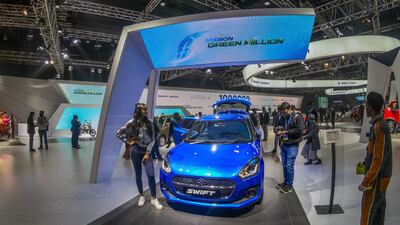
  • SUZUKI SWIFT: A bit snazzier than the Dzire, the Swift comes with a punchy 1.4 litre turbocharged engine but can still get 23.75km/l, says Drive Ninja, a UAE comparison site. A new model starts at slightly less than Dh49,000 ($13,340). Prashanth Vishwanathan / Bloomberg
    SUZUKI SWIFT: A bit snazzier than the Dzire, the Swift comes with a punchy 1.4 litre turbocharged engine but can still get 23.75km/l, says Drive Ninja, a UAE comparison site. A new model starts at slightly less than Dh49,000 ($13,340). Prashanth Vishwanathan / Bloomberg
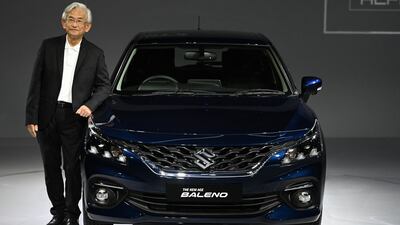
  • SUZUKI BALENO: The slightly larger Baleno comes with 1.2 or 1.4-litre engines and should get you 22.35km/l. You should expect to pay in the region of Dh45,900 ($10,905). AFP
    SUZUKI BALENO: The slightly larger Baleno comes with 1.2 or 1.4-litre engines and should get you 22.35km/l. You should expect to pay in the region of Dh45,900 ($10,905). AFP
  • TOYOTA YARIS: The Yaris did not become one of the world's most popular cars for nothing. With a fuel efficiency of 22km/l, a new one should set you back about Dh60,000 ($16,335). Another Dh10,000 would get you a Corolla saloon, the world's number one selling car. Reuters
    TOYOTA YARIS: The Yaris did not become one of the world's most popular cars for nothing. With a fuel efficiency of 22km/l, a new one should set you back about Dh60,000 ($16,335). Another Dh10,000 would get you a Corolla saloon, the world's number one selling car. Reuters
  • TOYOTA RAIZE: The only compact SUV on our list gets our vote for forecourt price and fuel efficiency. It should get you 19km/l and prices start at around Dh57,000 ($15,518). Its small 1-litre engine model is turbocharged, giving you about 100 horsepower. Akio Kon / Bloomberg
    TOYOTA RAIZE: The only compact SUV on our list gets our vote for forecourt price and fuel efficiency. It should get you 19km/l and prices start at around Dh57,000 ($15,518). Its small 1-litre engine model is turbocharged, giving you about 100 horsepower. Akio Kon / Bloomberg

Abu Dhabi released regulatory policy for electric vehicle charging infrastructure in the emirate this week.

The policy, released by the emirate’s Department of Energy, sets out the requirements and standards for establishing a network of electric vehicle charging stations across Abu Dhabi.

It includes the principles governing ownership, installation and management of electric vehicle supply equipment, power supply to the charging installations and the pricing mechanism for end customers.

The policy anticipated a progressive increase in the use of electric vehicles on Abu Dhabi’s roads in the coming years, department chairman Awaidha Al Marar said.


Should late investors consider cryptocurrencies?

Wealth managers recommend late investors to have a balanced portfolio that typically includes traditional assets such as cash, government and corporate bonds, equities, commodities and commercial property.

They do not usually recommend investing in Bitcoin or other cryptocurrencies due to the risk and volatility associated with them.

“It has produced eye-watering returns for some, whereas others have lost substantially as this has all depended purely on timing and when the buy-in was. If someone still has about 20 to 25 years until retirement, there isn’t any need to take such risks,” Rupert Connor of Abacus Financial Consultant says.

He adds that if a person is interested in owning a business or growing a property portfolio to increase their retirement income, this can be encouraged provided they keep in mind the overall risk profile of these assets.

Ten tax points to be aware of in 2026

1. Domestic VAT refund amendments: request your refund within five years

If a business does not apply for the refund on time, they lose their credit.

2. E-invoicing in the UAE

Businesses should continue preparing for the implementation of e-invoicing in the UAE, with 2026 a preparation and transition period ahead of phased mandatory adoption. 

3. More tax audits

Tax authorities are increasingly using data already available across multiple filings to identify audit risks. 

4. More beneficial VAT and excise tax penalty regime

Tax disputes are expected to become more frequent and more structured, with clearer administrative objection and appeal processes. The UAE has adopted a new penalty regime for VAT and excise disputes, which now mirrors the penalty regime for corporate tax.

5. Greater emphasis on statutory audit

There is a greater need for the accuracy of financial statements. The International Financial Reporting Standards standards need to be strictly adhered to and, as a result, the quality of the audits will need to increase.

6. Further transfer pricing enforcement

Transfer pricing enforcement, which refers to the practice of establishing prices for internal transactions between related entities, is expected to broaden in scope. The UAE will shortly open the possibility to negotiate advance pricing agreements, or essentially rulings for transfer pricing purposes. 

7. Limited time periods for audits

Recent amendments also introduce a default five-year limitation period for tax audits and assessments, subject to specific statutory exceptions. While the standard audit and assessment period is five years, this may be extended to up to 15 years in cases involving fraud or tax evasion. 

8. Pillar 2 implementation 

Many multinational groups will begin to feel the practical effect of the Domestic Minimum Top-Up Tax (DMTT), the UAE's implementation of the OECD’s global minimum tax under Pillar 2. While the rules apply for financial years starting on or after January 1, 2025, it is 2026 that marks the transition to an operational phase.

9. Reduced compliance obligations for imported goods and services

Businesses that apply the reverse-charge mechanism for VAT purposes in the UAE may benefit from reduced compliance obligations. 

10. Substance and CbC reporting focus

Tax authorities are expected to continue strengthening the enforcement of economic substance and Country-by-Country (CbC) reporting frameworks. In the UAE, these regimes are increasingly being used as risk-assessment tools, providing tax authorities with a comprehensive view of multinational groups’ global footprints and enabling them to assess whether profits are aligned with real economic activity. 

Contributed by Thomas Vanhee and Hend Rashwan, Aurifer

How to help

Call the hotline on 0502955999 or send "thenational" to the following numbers:

2289 - Dh10

2252 - Dh50

6025 - Dh20

6027 - Dh100

6026 - Dh200


Rock in a Hard Place: Music and Mayhem in the Middle East
Orlando Crowcroft
Zed Books

How to donate

Send “thenational” to the following numbers or call the hotline on: 0502955999
2289 – Dh10
2252 – Dh 50
6025 – Dh20
6027 – Dh 100
6026 – Dh 200

10 tips for entry-level job seekers
  • Have an up-to-date, professional LinkedIn profile. If you don’t have a LinkedIn account, set one up today. Avoid poor-quality profile pictures with distracting backgrounds. Include a professional summary and begin to grow your network.
  • Keep track of the job trends in your sector through the news. Apply for job alerts at your dream organisations and the types of jobs you want – LinkedIn uses AI to share similar relevant jobs based on your selections.
  • Double check that you’ve highlighted relevant skills on your resume and LinkedIn profile.
  • For most entry-level jobs, your resume will first be filtered by an applicant tracking system for keywords. Look closely at the description of the job you are applying for and mirror the language as much as possible (while being honest and accurate about your skills and experience).
  • Keep your CV professional and in a simple format – make sure you tailor your cover letter and application to the company and role.
  • Go online and look for details on job specifications for your target position. Make a list of skills required and set yourself some learning goals to tick off all the necessary skills one by one.
  • Don’t be afraid to reach outside your immediate friends and family to other acquaintances and let them know you are looking for new opportunities.
  • Make sure you’ve set your LinkedIn profile to signal that you are “open to opportunities”. Also be sure to use LinkedIn to search for people who are still actively hiring by searching for those that have the headline “I’m hiring” or “We’re hiring” in their profile.
  • Prepare for online interviews using mock interview tools. Even before landing interviews, it can be useful to start practising.
  • Be professional and patient. Always be professional with whoever you are interacting with throughout your search process, this will be remembered. You need to be patient, dedicated and not give up on your search. Candidates need to make sure they are following up appropriately for roles they have applied.

Arda Atalay, head of Mena private sector at LinkedIn Talent Solutions, Rudy Bier, managing partner of Kinetic Business Solutions and Ben Kinerman Daltrey, co-founder of KinFitz

FIGHT CARD

Sara El Bakkali v Anisha Kadka (Lightweight, female)
Mohammed Adil Al Debi v Moaz Abdelgawad (Bantamweight)
Amir Boureslan v Mahmoud Zanouny (Welterweight)
Abrorbek Madaminbekov v Mohammed Al Katheeri (Featherweight)
Ibrahem Bilal v Emad Arafa (Super featherweight)
Ahmed Abdolaziz v Imad Essassi (Middleweight)
Milena Martinou v Ilham Bourakkadi (Bantamweight, female)
Noureddine El Agouti v Mohamed Mardi (Welterweight)
Nabil Ouach v Ymad Atrous (Middleweight)
Nouredin Samir v Zainalabid Dadachev (Lightweight)
Marlon Ribeiro v Mehdi Oubahammou (Welterweight)
Brad Stanton v Mohamed El Boukhari (Super welterweight

Updated: May 29, 2022, 9:11 AM