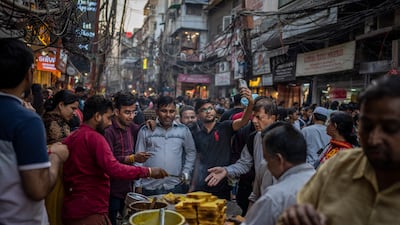
This photo taken on October 10, 2022 shows people walking down Takeshita Street in the Harajuku area of Tokyo. - The global population will breach the symbolic level of 8 billion on November 15, according to the UN. The milestone comes as questions are increasingly being raised about the measures needed to adapt to global warming, as well as about how humanity consumes Earth’s resources. (Photo by Richard A. Brooks / AFP)
This photo taken on October 10, 2022 shows people walking down Takeshita Street in the Harajuku area of Tokyo. - The global population will breach the symbolic level of 8 billion on November 15, accor

How sensible climate policies will support a growing world population


Robin Mills
  • English
  • Arabic

“In the human fugue there are eighteen hundred million parts,” wrote Aldous Huxley, author of Brave New World. “The resultant noise means something perhaps to the statistician.”

Huxley published his novel Point Counter Point just 94 years ago; on November 15, UN statisticians estimated that the global population had passed eight billion.

It is not only people; we keep 19 billion chickens, 1.5 billion cows, 1 billion sheep, 1 billion pigs and 1.1 billion domestic cats and dogs. Wild animals — not just lions and pandas, but the innumerable hordes of mice, rats and bats — account for just 4 per cent of the biomass of all mammals.

In fact, like 2022, 1928 was a landmark population year: the number of humans crossed 2 billion, according to modern estimates. This is despite the ravages of the First World War and Spanish flu pandemic that killed 70 million people between them.

World population hits 8 billion — in pictures

Demographics have a tremendous momentum: the rising population was hardly slowed by the 75 million people who died as a result of the Second World War, about 3 per cent of people then alive.

The late 1950s also experienced one of the fastest global population increases in history.

These trends caught the attention of the rising environmentalist movement in the 1960s.

In 1968, the influential book The Population Bomb, by Stanford University academics Anne Ehrlich and Paul Ehrlich, wrote: “The battle to feed all of humanity is over. In the 1970s hundreds of millions of people will starve to death in spite of any crash programs embarked upon now.”

In the same year, the Club of Rome was founded and, in 1972, it warned in The Limits of Growth of the exhaustion of oil, metals and food.

We have not starved or run out of minerals, but today, the major concern is climate change.

An ever-growing number of people who need air-conditioning, nitrogenous fertilisers and homes made from steel, concrete and glass, seems to mean unstoppable greenhouse gas emissions.

So does the rising population forebode a hot, hungry and crowded planet? And surely we cannot feed, power and move this seemingly relentlessly swelling horde of humanity and other animals, and preserve a liveable environment, without reducing our numbers?

Such alarmist predictions are wrong in four ways.

First, the population is not growing that much any more. The UN thinks we will reach a maximum of about 10.4 billion during the 2080s. Two thirds of people now live in a country with fewer than 2.1 births per woman, below the long-term replacement level.

Barring a truly cataclysmic war, plague, societal collapse, asteroid strike or robot takeover on the one hand, or an unexpected resurgence in fertility or huge extension in lifespan on the other, these forecasts are near-inevitable.

Watch: Why are rich nations paying for climate 'loss and damage'?

Second, warnings about overpopulation usually concentrate on East and South Asia and Africa. Indeed, the population in Europe and Japan is set to fall, and the problem will be to attract sufficient immigration to sustain the economy and look after a growing elderly cohort.

But China’s working-age population also peaked in 2014 and its overall population may drop after this year.

Bangladesh, the most densely populated country in the world after small islands and city-states, had a birth rate of almost seven children per woman in the early 1970s; now it is less than two, below the replacement level. Alarms of “third-world” overpopulation are often thinly veiled racism.

Third, the climate problem is not driven by the absolute number of people, but by their lifestyle.

The average American emits nearly 200 times as much carbon dioxide as the average citizen of the Democratic Republic of the Congo. Little Luxembourg pollutes nearly four times as much per person as neighbouring France. A few thousand ultra-wealthy with their private jets and super-yachts outweigh millions of Africans.

Fourth, we use resources ever more efficiently. Land use for food per person has halved since 1960. As agricultural hectarage has declined slightly since 2000, we may have passed “peak land”, a point at which our farming footprint would gradually diminish.

The all-time peak for oil use per person was in the late 1970s, after which it dropped sharply, then flattened out. The rising use of electric cars will probably bring a further downwards trend in the next few years. Carbon dioxide emissions from energy use reached a high in 2013 and have gradually dropped since then.

Energy use per person, though, continues to grow gradually, with the spread of middle-class lifestyles around the planet.

Scenarios such as those of the International Energy Agency show sharp drops in overall energy consumption as we move towards a “net-zero” carbon world by the mid-century.

This comes largely from a shift to intrinsically more efficient technologies — renewables and electric cars that do not shed more than half their energy input as waste heat.

Such forecasts are probably wrong — energy use will continue to rise as new technologies and desires emerge.

The all-time peak for oil use per person was in the late 1970s, after which it dropped sharply, then flattened out
Robin Mills

But with sensible policies, we will decarbonise. And whether policies are good or bad, the now slow rate of population growth — less than 1 per cent per year — is not the decisive factor in achieving the annual falls of more than 5 per cent in greenhouse gas emissions required for net zero by mid-century.

Families, and especially women, should certainly be given the rights and means to manage their fertility and plan the number of children they want.

But we should not instrumentalise this in service of an agenda of population control: it is a matter of human dignity and well-being.

It is a reason not for despair but for celebration that we can sustain eight billion people, their creations and aspirations and, for most of them, in tolerable peace and prosperity.

Human beings are not simply machines for emitting carbon dioxide: as last week’s breakthrough in fusion energy reminds us, each baby is a potential great scientist, political leader, communicator, entrepreneur or environmentalist.

Nor is it necessary to be famous: as novelist George Eliot wrote: “The growing good of the world is partly dependent on unhistoric acts; and that things are not so ill with you and me as they might have been, is half owing to the number who lived faithfully a hidden life.”

Robin M. Mills is chief executive of Qamar Energy, and author of The Myth of the Oil Crisis

The language of diplomacy in 1853

Treaty of Peace in Perpetuity Agreed Upon by the Chiefs of the Arabian Coast on Behalf of Themselves, Their Heirs and Successors Under the Mediation of the Resident of the Persian Gulf, 1853
(This treaty gave the region the name “Trucial States”.)


We, whose seals are hereunto affixed, Sheikh Sultan bin Suggar, Chief of Rassool-Kheimah, Sheikh Saeed bin Tahnoon, Chief of Aboo Dhebbee, Sheikh Saeed bin Buyte, Chief of Debay, Sheikh Hamid bin Rashed, Chief of Ejman, Sheikh Abdoola bin Rashed, Chief of Umm-ool-Keiweyn, having experienced for a series of years the benefits and advantages resulting from a maritime truce contracted amongst ourselves under the mediation of the Resident in the Persian Gulf and renewed from time to time up to the present period, and being fully impressed, therefore, with a sense of evil consequence formerly arising, from the prosecution of our feuds at sea, whereby our subjects and dependants were prevented from carrying on the pearl fishery in security, and were exposed to interruption and molestation when passing on their lawful occasions, accordingly, we, as aforesaid have determined, for ourselves, our heirs and successors, to conclude together a lasting and inviolable peace from this time forth in perpetuity.

Taken from Britain and Saudi Arabia, 1925-1939: the Imperial Oasis, by Clive Leatherdale

Pots for the Asian Qualifiers

Pot 1: Iran, Japan, South Korea, Australia, Qatar, United Arab Emirates, Saudi Arabia, China
Pot 2: Iraq, Uzbekistan, Syria, Oman, Lebanon, Kyrgyz Republic, Vietnam, Jordan
Pot 3: Palestine, India, Bahrain, Thailand, Tajikistan, North Korea, Chinese Taipei, Philippines
Pot 4: Turkmenistan, Myanmar, Hong Kong, Yemen, Afghanistan, Maldives, Kuwait, Malaysia
Pot 5: Indonesia, Singapore, Nepal, Cambodia, Bangladesh, Mongolia, Guam, Macau/Sri Lanka

PROFILE OF SWVL

Started: April 2017

Founders: Mostafa Kandil, Ahmed Sabbah and Mahmoud Nouh

Based: Cairo, Egypt

Sector: transport

Size: 450 employees

Investment: approximately $80 million

Investors include: Dubai’s Beco Capital, US’s Endeavor Catalyst, China’s MSA, Egypt’s Sawari Ventures, Sweden’s Vostok New Ventures, Property Finder CEO Michael Lahyani

Nayanthara: Beyond The Fairy Tale

Starring: Nayanthara, Vignesh Shivan, Radhika Sarathkumar, Nagarjuna Akkineni

Director: Amith Krishnan

Rating: 3.5/5

The President's Cake

Director: Hasan Hadi

Starring: Baneen Ahmad Nayyef, Waheed Thabet Khreibat, Sajad Mohamad Qasem 

Rating: 4/5

Du Football Champions

The fourth season of du Football Champions was launched at Gitex on Wednesday alongside the Middle East’s first sports-tech scouting platform.“du Talents”, which enables aspiring footballers to upload their profiles and highlights reels and communicate directly with coaches, is designed to extend the reach of the programme, which has already attracted more than 21,500 players in its first three years.

The team

Videographer: Jear Velasquez 

Photography: Romeo Perez 

Fashion director: Sarah Maisey 

Make-up: Gulum Erzincan at Art Factory 

Models: Meti and Clinton at MMG 

Video assistant: Zanong Maget 

Social media: Fatima Al Mahmoud  

Elvis
%3Cp%3E%3Cstrong%3EDirector%3A%3C%2Fstrong%3E%20Baz%20Luhrmann%3C%2Fp%3E%0A%3Cp%3E%3Cstrong%3EStars%3A%3C%2Fstrong%3E%20Austin%20Butler%2C%20Tom%20Hanks%2C%20Olivia%20DeJonge%3C%2Fp%3E%0A%3Cp%3E%3Cstrong%3ERating%3A%3C%2Fstrong%3E%204%2F5%3C%2Fp%3E%0A
RedCrow Intelligence Company Profile

Started: 2016

Founders: Hussein Nasser Eddin, Laila Akel, Tayeb Akel 

Based: Ramallah, Palestine

Sector: Technology, Security

# of staff: 13

Investment: $745,000

Investors: Palestine’s Ibtikar Fund, Abu Dhabi’s Gothams and angel investors

Dengue%20fever%20symptoms
%3Cul%3E%0A%3Cli%3EHigh%20fever%3C%2Fli%3E%0A%3Cli%3EIntense%20pain%20behind%20your%20eyes%3C%2Fli%3E%0A%3Cli%3ESevere%20headache%3C%2Fli%3E%0A%3Cli%3EMuscle%20and%20joint%20pains%3C%2Fli%3E%0A%3Cli%3ENausea%3C%2Fli%3E%0A%3Cli%3EVomiting%3C%2Fli%3E%0A%3Cli%3ESwollen%20glands%3C%2Fli%3E%0A%3Cli%3ERash%3C%2Fli%3E%0A%3C%2Ful%3E%0A%3Cp%3EIf%20symptoms%20occur%2C%20they%20usually%20last%20for%20two-seven%20days%3C%2Fp%3E%0A
When Umm Kulthum performed in Abu Dhabi


Known as The Lady of Arabic Song, Umm Kulthum performed in Abu Dhabi on November 28, 1971, as part of celebrations for the fifth anniversary of the accession of Sheikh Zayed bin Sultan Al Nahyan as Ruler of Abu Dhabi. A concert hall was constructed for the event on land that is now Al Nahyan Stadium, behind Al Wahda Mall. The audience were treated to many of Kulthum's most well-known songs as part of the sold-out show, including Aghadan Alqak and Enta Omri.


North Pole stats

Distance covered: 160km

Temperature: -40°C

Weight of equipment: 45kg

Altitude (metres above sea level): 0

Terrain: Ice rock

South Pole stats

Distance covered: 130km

Temperature: -50°C

Weight of equipment: 50kg

Altitude (metres above sea level): 3,300

Terrain: Flat ice
 

Profile Periscope Media

Founder: Smeetha Ghosh, one co-founder (anonymous)

Launch year: 2020

Employees: four – plans to add another 10 by July 2021

Financing stage: $250,000 bootstrap funding, approaching VC firms this year

Investors: Co-founders

LILO & STITCH

Starring: Sydney Elizebeth Agudong, Maia Kealoha, Chris Sanders

Director: Dean Fleischer Camp

Rating: 4.5/5

Company%20Profile
%3Cp%3E%3Cstrong%3EName%3A%20%3C%2Fstrong%3EDirect%20Debit%20System%3Cbr%3E%3Cstrong%3EStarted%3A%3C%2Fstrong%3E%20Sept%202017%3Cbr%3E%3Cstrong%3EBased%3A%3C%2Fstrong%3E%20UAE%20with%20a%20subsidiary%20in%20the%20UK%3Cbr%3E%3Cstrong%3EIndustry%3A%3C%2Fstrong%3E%20FinTech%3Cbr%3E%3Cstrong%3EFunding%3A%3C%2Fstrong%3E%20Undisclosed%3Cbr%3E%3Cstrong%3EInvestors%3A%3C%2Fstrong%3E%20Elaine%20Jones%3Cbr%3E%3Cstrong%3ENumber%20of%20employees%3A%3C%2Fstrong%3E%208%3Cbr%3E%3C%2Fp%3E%0A
Barbie
%3Cp%3E%3Cstrong%3EDirector%3A%3C%2Fstrong%3E%20Greta%20Gerwig%3Cbr%3E%3Cstrong%3EStars%3A%3C%2Fstrong%3E%20Margot%20Robbie%2C%20Ryan%20Gosling%2C%20Will%20Ferrell%2C%20America%20Ferrera%3Cbr%3E%3Cstrong%3ERating%3A%3C%2Fstrong%3E%204%2F5%3Cbr%3E%3C%2Fp%3E%0A
Gifts exchanged
  • King Charles - replica of President Eisenhower Sword
  • Queen Camilla -  Tiffany & Co vintage 18-carat gold, diamond and ruby flower brooch
  • Donald Trump - hand-bound leather book with Declaration of Independence
  • Melania Trump - personalised Anya Hindmarch handbag
Key findings
  • Over a period of seven years, a team of scientists analysed dietary data from 50,000 North American adults.
  • Eating one or two meals a day was associated with a relative decrease in BMI, compared with three meals. Snacks count as a meal. Likewise, participants who ate more than three meals a day experienced an increase in BMI: the more meals a day, the greater the increase. 
  • People who ate breakfast experienced a relative decrease in their BMI compared with “breakfast-skippers”. 
  • Those who turned the eating day on its head to make breakfast the biggest meal of the day, did even better. 
  • But scrapping dinner altogether gave the best results. The study found that the BMI of subjects who had a long overnight fast (of 18 hours or more) decreased when compared even with those who had a medium overnight fast, of between 12 and 17 hours.
ALRAWABI%20SCHOOL%20FOR%20GIRLS
%3Cp%3ECreator%3A%20Tima%20Shomali%3C%2Fp%3E%0A%3Cp%3EStarring%3A%C2%A0Tara%20Abboud%2C%C2%A0Kira%20Yaghnam%2C%20Tara%20Atalla%3C%2Fp%3E%0A%3Cp%3ERating%3A%204%2F5%3C%2Fp%3E%0A
List of alleged parties


May 12, 2020: PM and his wife Carrie attend 'work meeting' with at least 17 staff 

May 20, 2020: They attend 'bring your own booze party'

Nov 27, 2020: PM gives speech at leaving party for his staff 

Dec 10, 2020: Staff party held by then-education secretary Gavin Williamson 

Dec 13, 2020: PM and his wife throw a party

Dec 14, 2020: London mayoral candidate Shaun Bailey holds staff event at Conservative Party headquarters 

Dec 15, 2020: PM takes part in a staff quiz 

Dec 18, 2020: Downing Street Christmas party 

The%20new%20Turing%20Test
%3Cp%3EThe%20Coffee%20Test%3C%2Fp%3E%0A%3Cp%3E%3Cem%3EA%20machine%20is%20required%20to%20enter%20an%20average%20American%20home%20and%20figure%20out%20how%20to%20make%20coffee%3A%20find%20the%20coffee%20machine%2C%20find%20the%20coffee%2C%20add%20water%2C%20find%20a%20mug%20and%20brew%20the%20coffee%20by%20pushing%20the%20proper%20buttons.%3C%2Fem%3E%3C%2Fp%3E%0A%3Cp%3EProposed%20by%20Steve%20Wozniak%2C%20Apple%20co-founder%3C%2Fp%3E%0A
COMPANY%20PROFILE%20
%3Cp%3E%3Cstrong%3EName%3A%3C%2Fstrong%3E%20Dooda%20Solutions%0D%3Cbr%3E%3Cstrong%3EBased%3A%3C%2Fstrong%3E%20Lebanon%0D%3Cbr%3E%3Cstrong%3EFounder%3A%20%3C%2Fstrong%3ENada%20Ghanem%0D%3Cbr%3E%3Cstrong%3ESector%3A%3C%2Fstrong%3E%20AgriTech%0D%3Cbr%3E%3Cstrong%3ETotal%20funding%3A%20%3C%2Fstrong%3E%24300%2C000%20in%20equity-free%20funding%0D%3Cbr%3E%3Cstrong%3ENumber%20of%20employees%3A%3C%2Fstrong%3E%2011%3C%2Fp%3E%0A
'My Son'

Director: Christian Carion

Starring: James McAvoy, Claire Foy, Tom Cullen, Gary Lewis

Rating: 2/5

UAE currency: the story behind the money in your pockets
RESULTS

Bantamweight title:
Vinicius de Oliveira (BRA) bt Xavier Alaoui (MAR)
(KO round 2)
Catchweight 68kg:
Sean Soriano (USA) bt Noad Lahat (ISR)
(TKO round 1)
Middleweight:
Denis Tiuliulin (RUS) bt Juscelino Ferreira (BRA)
(TKO round 1)
Lightweight:
Anas Siraj Mounir (MAR) bt Joachim Tollefsen (DEN)
(Unanimous decision)
Catchweight 68kg:
Austin Arnett (USA) bt Daniel Vega (MEX)
(TKO round 3)
Lightweight:
Carrington Banks (USA) bt Marcio Andrade (BRA)
(Unanimous decision)
Catchweight 58kg:
Corinne Laframboise (CAN) bt Malin Hermansson (SWE)
(Submission round 2)
Bantamweight:
Jalal Al Daaja (CAN) bt Juares Dea (CMR)
(Split decision)
Middleweight:
Mohamad Osseili (LEB) bt Ivan Slynko (UKR)
(TKO round 1)
Featherweight:
Tarun Grigoryan (ARM) bt Islam Makhamadjanov (UZB)
(Unanimous decision)
Catchweight 54kg:
Mariagiovanna Vai (ITA) bt Daniella Shutov (ISR)
(Submission round 1)
Middleweight:
Joan Arastey (ESP) bt Omran Chaaban (LEB)
(Unanimous decision)
Welterweight:
Bruno Carvalho (POR) bt Souhil Tahiri (ALG)
(TKO)

The%C2%A0specs%20
%3Cp%3E%3Cstrong%3EEngine%3A%3C%2Fstrong%3E%204-cylinder%202-litre%3Cbr%3E%3Cstrong%3ETransmission%3A%20%3C%2Fstrong%3E9-speed%20automatic%3Cbr%3E%3Cstrong%3EPower%3A%20%3C%2Fstrong%3E252%20brake%20horsepower%3Cbr%3E%3Cstrong%3ETorque%3A%20%3C%2Fstrong%3E352Nm%3Cbr%3E%3Cstrong%3EPrice%3A%20%3C%2Fstrong%3Efrom%20Dh146%2C700%3Cbr%3E%3Cstrong%3EOn%20sale%3A%20%3C%2Fstrong%3Enow%3C%2Fp%3E%0A
Updated: December 19, 2022, 3:30 AM