
Related: Five critical questions we need to answer to fight Covid-19
When news began to spread in January of a new virus ripping through China with the potential to become the next pandemic, Jaime Breitnauer was not in the least bit surprised.
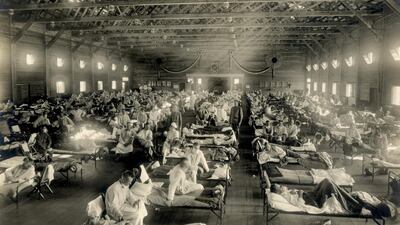
The historian had just released a book on Spanish flu, the worst infectious disease outbreak in modern history.
She knew it was just a matter of time before the next ‘big one’ emerged.
The Spanish Flu Epidemic and Its Influence on History charts the origins of the flu, through to the affect it had across the globe, which was still in the midst of the Great War.
“Pandemics aren’t new,” said Ms Breitnauer, who previously lived in Dubai, but now splits her time between the UK and New Zealand.
“We all know about the black death or the plague. That was just another type of pandemic. If you look through history, there are a lot of pandemics that aren’t really talked about. You had several pandemics in Britain and across Europe leading through to more modern times.”
Despite the 100-year gap between the emergence of the pathogens, the Spanish flu holds a number of important lessons for the governments fighting the latest pandemic, said Ms Breitnauer.
The mass movement of troops, in relation to the war, played a central important role in its virulent spread, she said.
“People hadn’t moved in that way before. As a result of that, H1N1 reached some of the most remote places of the world and left no one untouched,” she said.
This pattern was an indication to scientists today of what could have happened in the current pandemic, had countries not closed their borders to air travel as they did.
“We have air travel today which gave us [before restrictions were placed] similar movements on a daily or at least a weekly basis as they probably did throughout several months of the Great War.”
Levels of hygiene were not as good back in 1918, which also resulted in more cases.
“In the Great War, people were less likely to wash their hands, clean their clothes regularly, and they lived in very close quarters in poor conditions. We had men on boats for months in close quarters with each other, and men in trenches for years. We don’t have that any more.
-
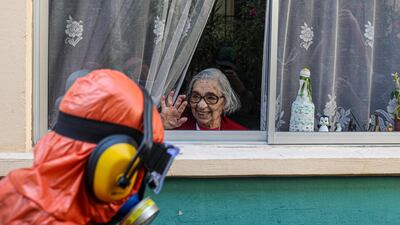
A woman waves to a city worker dressed in a hazmat suit as he disinfects the streets in her neighborhood as a precaution against the spread of the new coronavirus, in Santiago, Chile. AP Photo -

Medical staff take care of a Covid-19 patient in an intensive care unit at the University hospital of Aachen, western Germany during the novel coronavirus COVID-19 pandemic. AFP -
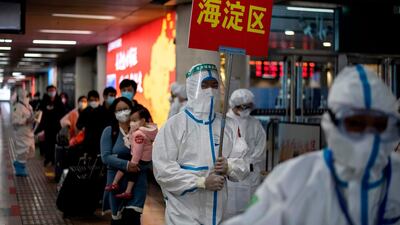
Transport personnel wearing hazmat suits guide travellers arriving from Wuhan to buses, which will take them to their quarantine locations, at Beijing West Railway Station. AFP -

An employee stands in front of coffins stacked at the Yago Gonzalez coffin-making factory in Pinor, northwestern Spain. AFP -
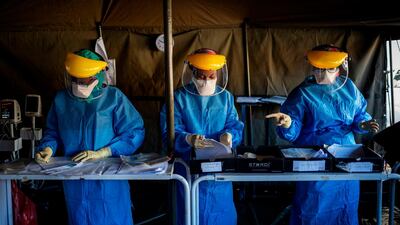
Health workers fill out documents before performing tests for COVID-19 coronavirus on other health workers at the screening and testing tents set up at the Charlotte Maxeke Hospital in Johannesburg. AFP -
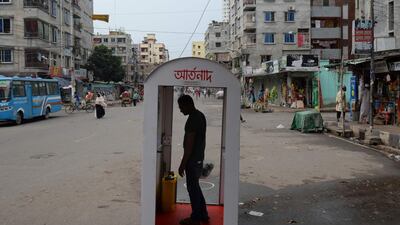
A man goes through a disinfecting tunnel set up by vonlunteers in a street as preventative measure against the COVID-19 coronavirus, in Dhaka. AFP -
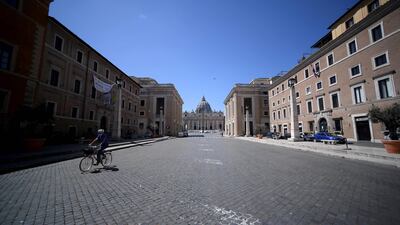
A woman wearing a face mask cycles in the empty Via della Conciliazione, as the Vatican's Saint Peter's Basilica is seen in the background, in Rome. AFP -

A New York City Fire Department (FDNY) Emergency Medical Technician (EMT) wearing personal protective equipment assist a woman who was having difficulty breathing during ongoing outbreak of the coronavirus disease (COVID19) in New York, U.S. REUTERS -
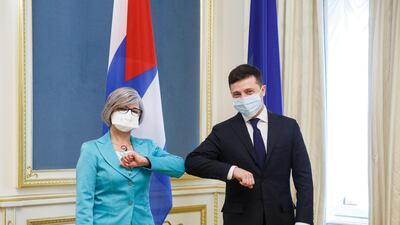
Ukraine's President Volodymyr Zelenskiy and Cuba's Ambassador Natacha Diaz Aguilera pose for a picture while greeting each other with an elbow bump instead of a traditional handshake during a ceremony to receive diplomatic credentials amid the coronavirus disease (COVID-19) outbreak in Kiev, Ukraine. REUTERS -

Health workers gesture as citizens show their support from their balconies and windows, amid the spread of the coronavirus disease (COVID-19), in Barcelona, Spain. REUTERS -
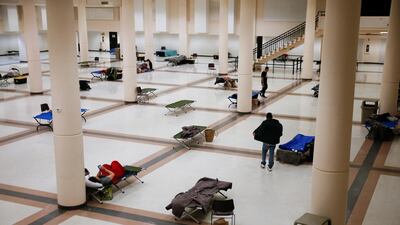
People walk around their living quarters at a temporary men's shelter run by the Downtown Emergency Service Center (DESC) at the Seattle Center Exhibition Hall, currently with 75 beds spaced at least six feet apart, during the coronavirus disease (COVID-19) outbreak in Seattle, Washington, U.S. REUTERS -

Health and Human Services Secretary Dr. David Scrase gives an update on the COVID-19 outbreak in the state as New Mexico Gov. Michelle Lujan Grisham, left, listens during a news conference in the state Capitol in Santa Fe, N.M.. AP -
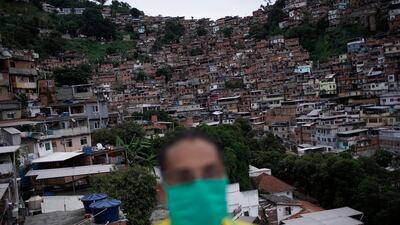
A member of a cultural center wears a mask to protect himself against the spread of the new coronavirus, as he donates food for poor families in Turano favela, Rio de Janeiro, Brazil. AP Photo -
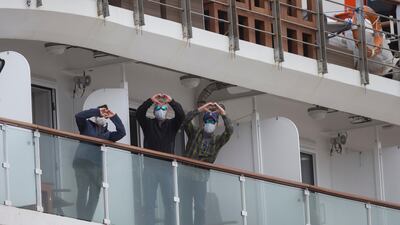
Passengers on the Australian cruise ship name Greg Mortimer gesture heart signs as they arrive to port on their way to the international airport in Montevideo, Uruguay. AP Photo -
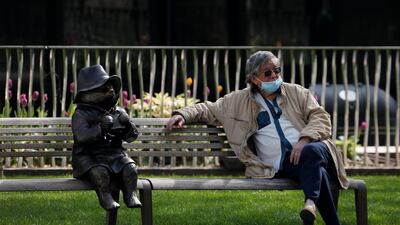
A man relaxes on a bench in London, next to a sculpture of Paddington Bear, as the country is in lockdown to help curb the spread of the coronavirus. AP Photo


“We have unprecedented movement today, but we also have unprecedented level of health and hygiene.”
Scientists still do not know where the flu strain originated, but it received its name from the fact that Spain was neutral during the war, so the press there reported on the outbreak more extensively, leading many to believe it was “ground zero”.
News of the flu was suppressed in countries fighting the war to avoid adversely affecting morale, so many had caught the infectious disease before they even knew it existed.
“A lot of people today said the media today were scaremongering, but in 1918 there was media suppression,” she said.
“You had people who caught the flu, spread it around their friends and family and died of it without even knowing what it was. So I think more information is definitely better than less.”
Those factors added up to a deadly combination.
“In 1918 there was no restriction of movement, a lack of information and, in some places, people were told to just get on with it because there was a war going on. The result was an increase in cases.”
Spanish flu ultimately burnt itself out after populations across the globe achieved herd immunity, meaning there were not enough people left to infect to let it spread effectively – but only after it infected an estimated 500 million people, a third of the world's population, and killed at least 50m.
The advent of vaccines means there is now a different way to achieve that goal, meaning like Spanish flu, the coronavirus will one day no longer cast the dark shadow it currently does.
“Whether this goes on for a few more months or even years, it will eventually burn itself out,” said Ms Breitnauer.
“Viruses change and they move on.”

