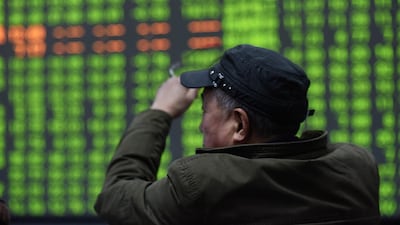
Capital flows to emerging market securities reached $13.8 billion in May, a more than three-fold rise from a year earlier, supported by purchases of debt instruments, according to the Institute of International Finance.
The flows last month jumped from $4.1bn recorded in May 2020 at the peak of pandemic lockdowns. On a monthly basis, they declined from $45.5bn in April.
"The EM complex finds itself in a process of slow recovery," Jonathan Fortun, an IIF economist said in a report on Tuesday. "While many countries see renewed hope with partial opening of their activities, some new lockdowns are limiting a wide and lasting snapback."
The capital flows dynamic of emerging markets in May was mainly supported by investments into debt securities, accounting for $9.8bn of the total capital minus China, which suffered outflows of $1bn. A supportive environment for risk assets is fuelling the rebound in emerging market local debt and helping total returns to recover, according to the IIF.
Investments into emerging markets equities suffered outflows during May as uncertainty grew around the outlook for inflation. Emerging market equity investments excluding China fell by $7.3bn, but Chinese equities recorded a positive inflow of $11.3bn last month.
“The build-up of inflationary pressures across the market have hurt the outlook – especially on equities – and [have] put the focus on the response of policymakers,” Mr Fortun said.
Capital flows to emerging markets portfolios are slowly recovering after a sharp drop last year, as investments waned amid the coronavirus pandemic. Flows to emerging market portfolios declined 13 per cent year-on-year in 2020 to $313bn.
Persistent fiscal scarring amid the pandemic has contributed to an increase in the debt burden across emerging markets, widening fiscal deficits and presenting further challenges, according to the IIF.
Global debt declined for the first time in 10 quarters by $1.7 trillion to $289tn in the first three months of 2021. However, it rose by $600bn to a record high of more than $86tn in emerging markets, the IIF said in a May report.
The risk of “idiosyncratic events” and a “taper-tantrum” – the panic in global markets that triggered a spike in US Treasury yields in 2013 after investors learned of the Federal Reserve’s plans to slow its quantitative easing programme – are also weighing on the outlook for emerging markets, the IIF said on Tuesday.
“Nevertheless, initial conditions for most EMs are more favourable than ahead of the 2013 taper tantrum,” Mr Fortun said.
The importance of policy credibility will be “paramount in the months ahead”, especially given rising interest rates, he added.
In terms of regional flows, the IIF's data showed mixed results. Latin American markets received the greatest inflows of $6.2bn and $1.7bn for equity and debt, respectively. Emerging markets in Europe, Africa and Middle East accounted for $6.5bn of inflows, whereas emerging Asian markets suffered net outflows of $500 million.

UAE currency: the story behind the money in your pockets
Mercer, the investment consulting arm of US services company Marsh & McLennan, expects its wealth division to at least double its assets under management (AUM) in the Middle East as wealth in the region continues to grow despite economic headwinds, a company official said.
Mercer Wealth, which globally has $160 billion in AUM, plans to boost its AUM in the region to $2-$3bn in the next 2-3 years from the present $1bn, said Yasir AbuShaban, a Dubai-based principal with Mercer Wealth.
“Within the next two to three years, we are looking at reaching $2 to $3 billion as a conservative estimate and we do see an opportunity to do so,” said Mr AbuShaban.
Mercer does not directly make investments, but allocates clients’ money they have discretion to, to professional asset managers. They also provide advice to clients.
“We have buying power. We can negotiate on their (client’s) behalf with asset managers to provide them lower fees than they otherwise would have to get on their own,” he added.
Mercer Wealth’s clients include sovereign wealth funds, family offices, and insurance companies among others.
From its office in Dubai, Mercer also looks after Africa, India and Turkey, where they also see opportunity for growth.
Wealth creation in Middle East and Africa (MEA) grew 8.5 per cent to $8.1 trillion last year from $7.5tn in 2015, higher than last year’s global average of 6 per cent and the second-highest growth in a region after Asia-Pacific which grew 9.9 per cent, according to consultancy Boston Consulting Group (BCG). In the region, where wealth grew just 1.9 per cent in 2015 compared with 2014, a pickup in oil prices has helped in wealth generation.
BCG is forecasting MEA wealth will rise to $12tn by 2021, growing at an annual average of 8 per cent.
Drivers of wealth generation in the region will be split evenly between new wealth creation and growth of performance of existing assets, according to BCG.
Another general trend in the region is clients’ looking for a comprehensive approach to investing, according to Mr AbuShaban.
“Institutional investors or some of the families are seeing a slowdown in the available capital they have to invest and in that sense they are looking at optimizing the way they manage their portfolios and making sure they are not investing haphazardly and different parts of their investment are working together,” said Mr AbuShaban.
Some clients also have a higher appetite for risk, given the low interest-rate environment that does not provide enough yield for some institutional investors. These clients are keen to invest in illiquid assets, such as private equity and infrastructure.
“What we have seen is a desire for higher returns in what has been a low-return environment specifically in various fixed income or bonds,” he said.
“In this environment, we have seen a de facto increase in the risk that clients are taking in things like illiquid investments, private equity investments, infrastructure and private debt, those kind of investments were higher illiquidity results in incrementally higher returns.”
The Abu Dhabi Investment Authority, one of the largest sovereign wealth funds, said in its 2016 report that has gradually increased its exposure in direct private equity and private credit transactions, mainly in Asian markets and especially in China and India. The authority’s private equity department focused on structured equities owing to “their defensive characteristics.”
Electric scooters: some rules to remember
- Riders must be 14-years-old or over
- Wear a protective helmet
- Park the electric scooter in designated parking lots (if any)
- Do not leave electric scooter in locations that obstruct traffic or pedestrians
- Solo riders only, no passengers allowed
- Do not drive outside designated lanes
WOMAN AND CHILD
Director: Saeed Roustaee
Starring: Parinaz Izadyar, Payman Maadi
Rating: 4/5
THE BIO
Age: 33
Favourite quote: “If you’re going through hell, keep going” Winston Churchill
Favourite breed of dog: All of them. I can’t possibly pick a favourite.
Favourite place in the UAE: The Stray Dogs Centre in Umm Al Quwain. It sounds predictable, but it honestly is my favourite place to spend time. Surrounded by hundreds of dogs that love you - what could possibly be better than that?
Favourite colour: All the colours that dogs come in
Groom and Two Brides
Director: Elie Semaan
Starring: Abdullah Boushehri, Laila Abdallah, Lulwa Almulla
Rating: 3/5
The President's Cake
Director: Hasan Hadi
Starring: Baneen Ahmad Nayyef, Waheed Thabet Khreibat, Sajad Mohamad Qasem
Rating: 4/5
Living in...
This article is part of a guide on where to live in the UAE. Our reporters will profile some of the country’s most desirable districts, provide an estimate of rental prices and introduce you to some of the residents who call each area home.
Trump v Khan
2016: Feud begins after Khan criticised Trump’s proposed Muslim travel ban to US
2017: Trump criticises Khan’s ‘no reason to be alarmed’ response to London Bridge terror attacks
2019: Trump calls Khan a “stone cold loser” before first state visit
2019: Trump tweets about “Khan’s Londonistan”, calling him “a national disgrace”
2022: Khan’s office attributes rise in Islamophobic abuse against the major to hostility stoked during Trump’s presidency
July 2025 During a golfing trip to Scotland, Trump calls Khan “a nasty person”
Sept 2025 Trump blames Khan for London’s “stabbings and the dirt and the filth”.
Dec 2025 Trump suggests migrants got Khan elected, calls him a “horrible, vicious, disgusting mayor”
Wicked: For Good
Director: Jon M Chu
Starring: Ariana Grande, Cynthia Erivo, Jonathan Bailey, Jeff Goldblum, Michelle Yeoh, Ethan Slater
Rating: 4/5
The%20specs
%3Cp%3E%3Cstrong%3EEngine%3A%20%3C%2Fstrong%3E4.0-litre%2C%20flat%20six-cylinder%3Cbr%3E%3Cstrong%3ETransmission%3A%20%3C%2Fstrong%3Eseven-speed%20PDK%3Cbr%3E%3Cstrong%3EPower%3A%20%3C%2Fstrong%3E510hp%3Cbr%3E%3Cstrong%3ETorque%3A%20%3C%2Fstrong%3E470Nm%3Cbr%3E%3Cstrong%3EPrice%3A%20%3C%2Fstrong%3Efrom%20Dh634%2C200%3Cbr%3E%3Cstrong%3EOn%20sale%3A%20%3C%2Fstrong%3Enow%3C%2Fp%3E%0A
