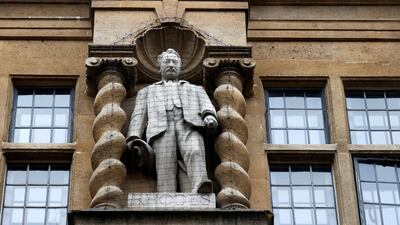
In Europe, the Americas and beyond, hundreds of thousands have been gathering to demonstrate about racism past and present. A greater awareness of structural racism is certainly necessary, and if many are unaware of the brutality and exploitation carried out by the European colonial empires that is indeed shameful. It is right that curricula be amended.
We should debate historical figures such as Cecil Rhodes – although given that South Africa’s Nelson Mandela was willing to form the Mandela Rhodes Foundation in association with a trust named after a rapacious Victorian imperialist, we might perhaps do so with a little more nuance than the statue-topplers employ.
“What’s past is prologue,” as Shakespeare wrote. It is correct that we connect the dots between past wrongs and present day injustices. What is worrying, however, is that in all this discussion there appears to be a near complete disconnect from a danger that is not just figuratively at the gates but in many cases already within the citadel – and that is the rise and normalisation of the far-right.
We are used to hearing about Trump “mini-mes” like Brazil’s Jair Bolsonaro, although there is a tendency in that case to dismiss him as the product of volatile Brazilian politics. But consider the situation in Europe. Leave aside parties that might generously be described as conservative nationalist that are in government, such as Hungary’s Fidesz and Poland’s Law and Justice, and the unambiguously far-right can still be seen to be riding higher than at any time since the 1930s.
In France, the National Rally (the renamed National Front) topped the polls in last year’s European parliament elections. The Alternative for Germany (AfD) is now the leading opposition party in the country’s Bundestag and beat Angela Merkel’s Christian Democrats in a state election in Thuringia last October. Far-right parties are in the governing coalition in Estonia, almost won the last general election in Finland, and came third in Spain’s last year.
The debate about statues often pits two groups of the broadly liberal-minded against each other
The significance of these and other results is frequently underplayed. The BBC is far from alone in describing the then National Front leader Marine Le Pen as having been “comprehensively defeated by Emmanuel Macron” when she ran for the French presidency in 2017.
It’s a comforting but terribly complacent narrative. Far wiser, I believe, to be shocked that over one in three – a staggering proportion – who went to the polls voted for a far-right candidate in the final round of the election.
But I am in a minority putting forward that proposition. Perhaps it is the years of assured media performances by extremist politicians like the Netherlands’ Geert Wilders, but the instinctive recoil that used to be near-universally felt when the far right did well seems to have disappeared.
Contrast, for instance, the reaction when Austria’s Freedom Party first entered government as part of a coalition in 2000 to its later return to high office in 2017. In 2000 there was an international furore, and the European Union imposed sanctions on the country. In 2017, there were protests on the streets of Vienna, but the diplomatic response was widely described as being “muted”.
Why? It may be partly that populism, of both the left and the right, has become commonplace. The range of worry one could acceptably express about immigration has hugely expanded. After all, if a figure as respected as the then British prime minister Gordon Brown could talk about “British jobs for British workers” in 2009 – an atypical low for Mr Brown, who must have known the dogwhistle many heard in his words – was it really too far a leap for the Ukip leader Nigel Farage to say he’d be concerned if a group of Romanians moved in next door to him?
Conservative commentators and far-right activists may have distinguished themselves from each other, but many played on the same fears and smears of Islam. And far-right politicians have made an attempt to smarten up, are more careful in what they say, and have ditched a few dinosaurs, such as when the National Front expelled its founder, Ms Le Pen’s father, Jean-Marie, in 2015. Far-right parties are sure to distance themselves from embarrassing pasts – Nazi or neo-Nazi connections and so on – but is this all an attempt to make themselves more palatable? Have they really changed at all?
I suspect not. The anti-immigrant and Islamophobic messaging is still clear, however it is couched. And occasionally, the curtain parts. In a 2018 documentary, The Patriot Game, the former UK MP George Galloway interviewed Martin Webster, once a leading figure in the far-right National Front. Webster talked of the British people not allowing themselves to "be mongrelised out of existence".
“Why have we got to submit to being exterminated by race mixing?” he asked. These may be sentiments that most far-right politicians would be cautious not to state too explicitly today. But does anyone doubt that most, if not all, would privately agree with them?
Would that Webster’s words be heard more widely, for the stark, unapologetic bigotry has a chilling clarity. The debate about statues often pits two groups of the broadly liberal-minded against each other. Neither side, for instance, is suggesting putting up new statues of imperialists or American Confederate generals.
But preoccupied as they are with the latest battle in the culture wars, they appear to be overlooking a much greater and more insidious enemy. The far-right was once beyond the pale. They have now dismantled that barrier and are posing as the true representatives of the common people, and even – grotesquely – as statesmen.
Leftists, liberals and decent conservatives of all stripes should ask themselves how they have allowed this to happen – and focus much harder on what they are going to do about it.
Sholto Byrnes is a commentator and consultant in Kuala Lumpur and a corresponding fellow of the Erasmus Forum

Sweet%20Tooth
%3Cp%3E%3Cstrong%3ECreator%3A%20%3C%2Fstrong%3EJim%20Mickle%3Cbr%3E%3Cstrong%3EStarring%3A%20%3C%2Fstrong%3EChristian%20Convery%2C%20Nonso%20Anozie%2C%20Adeel%20Akhtar%2C%20Stefania%20LaVie%20Owen%3Cbr%3E%3Cstrong%3ERating%3A%20%3C%2Fstrong%3E2.5%2F5%3C%2Fp%3E%0A
Company profile
Name: Tratok Portal
Founded: 2017
Based: UAE
Sector: Travel & tourism
Size: 36 employees
Funding: Privately funded
In the Restaurant: Society in Four Courses
Christoph Ribbat
Translated by Jamie Searle Romanelli
Pushkin Press
The%20specs
%3Cp%3E%3Cstrong%3EEngine%3A%20%3C%2Fstrong%3E2.9-litre%20twin-turbo%20V6%0D%3Cbr%3E%3Cstrong%3ETransmission%3A%20%3C%2Fstrong%3E8-speed%20auto%0D%3Cbr%3E%3Cstrong%3EPower%3A%20%3C%2Fstrong%3E536hp%20(including%20138hp%20e-motor)%0D%3Cbr%3E%3Cstrong%3ETorque%3A%20%3C%2Fstrong%3E750Nm%20(including%20400Nm%20e-motor)%0D%3Cbr%3E%3Cstrong%3EPrice%3A%20%3C%2Fstrong%3EFrom%20Dh1%2C380%2C000%0D%3Cbr%3E%3Cstrong%3EOn%20sale%3A%20%3C%2Fstrong%3Enow%3C%2Fp%3E%0A
GAC GS8 Specs
Engine: 2.0-litre 4cyl turbo
Power: 248hp at 5,200rpm
Torque: 400Nm at 1,750-4,000rpm
Transmission: 8-speed auto
Fuel consumption: 9.1L/100km
On sale: Now
Price: From Dh149,900
Who's who in Yemen conflict
Houthis: Iran-backed rebels who occupy Sanaa and run unrecognised government
Yemeni government: Exiled government in Aden led by eight-member Presidential Leadership Council
Southern Transitional Council: Faction in Yemeni government that seeks autonomy for the south
Habrish 'rebels': Tribal-backed forces feuding with STC over control of oil in government territory
Intercontinental Cup
Namibia v UAE Saturday Sep 16-Tuesday Sep 19
Table 1 Ireland, 89 points; 2 Afghanistan, 81; 3 Netherlands, 52; 4 Papua New Guinea, 40; 5 Hong Kong, 39; 6 Scotland, 37; 7 UAE, 27; 8 Namibia, 27
The major Hashd factions linked to Iran:
Badr Organisation: Seen as the most militarily capable faction in the Hashd. Iraqi Shiite exiles opposed to Saddam Hussein set up the group in Tehran in the early 1980s as the Badr Corps under the supervision of the Iran Revolutionary Guards Corps (IRGC). The militia exalts Iran’s Supreme Leader Ali Khamenei but intermittently cooperated with the US military.
Saraya Al Salam (Peace Brigade): Comprised of former members of the officially defunct Mahdi Army, a militia that was commanded by Iraqi cleric Moqtada Al Sadr and fought US and Iraqi government and other forces between 2004 and 2008. As part of a political overhaul aimed as casting Mr Al Sadr as a more nationalist and less sectarian figure, the cleric formed Saraya Al Salam in 2014. The group’s relations with Iran has been volatile.
Kataeb Hezbollah: The group, which is fighting on behalf of the Bashar Al Assad government in Syria, traces its origins to attacks on US forces in Iraq in 2004 and adopts a tough stance against Washington, calling the United States “the enemy of humanity”.
Asaeb Ahl Al Haq: An offshoot of the Mahdi Army active in Syria. Asaeb Ahl Al Haq’s leader Qais al Khazali was a student of Mr Al Moqtada’s late father Mohammed Sadeq Al Sadr, a prominent Shiite cleric who was killed during Saddam Hussein’s rule.
Harakat Hezbollah Al Nujaba: Formed in 2013 to fight alongside Mr Al Assad’s loyalists in Syria before joining the Hashd. The group is seen as among the most ideological and sectarian-driven Hashd militias in Syria and is the major recruiter of foreign fighters to Syria.
Saraya Al Khorasani: The ICRG formed Saraya Al Khorasani in the mid-1990s and the group is seen as the most ideologically attached to Iran among Tehran’s satellites in Iraq.
(Source: The Wilson Centre, the International Centre for the Study of Radicalisation)
Dubai Bling season three
Cast: Loujain Adada, Zeina Khoury, Farhana Bodi, Ebraheem Al Samadi, Mona Kattan, and couples Safa & Fahad Siddiqui and DJ Bliss & Danya Mohammed
Rating: 1/5
THE%20SPECS
%3Cp%3EEngine%3A%204.4-litre%20twin-turbo%20V8%20hybrid%0D%3Cbr%3EPower%3A%20653hp%20at%205%2C400rpm%0D%3Cbr%3ETorque%3A%20800Nm%20at%201%2C600-5%2C000rpm%0D%3Cbr%3ETransmission%3A%208-speed%20auto%0D%3Cbr%3E0-100kph%20in%204.3sec%0D%3Cbr%3ETop%20speed%20250kph%0D%3Cbr%3EFuel%20consumption%3A%20NA%0D%3Cbr%3EOn%20sale%3A%20Q2%202023%0D%3Cbr%3EPrice%3A%20From%20Dh750%2C000%0D%3Cbr%3E%3C%2Fp%3E%0A
Mercer, the investment consulting arm of US services company Marsh & McLennan, expects its wealth division to at least double its assets under management (AUM) in the Middle East as wealth in the region continues to grow despite economic headwinds, a company official said.
Mercer Wealth, which globally has $160 billion in AUM, plans to boost its AUM in the region to $2-$3bn in the next 2-3 years from the present $1bn, said Yasir AbuShaban, a Dubai-based principal with Mercer Wealth.
“Within the next two to three years, we are looking at reaching $2 to $3 billion as a conservative estimate and we do see an opportunity to do so,” said Mr AbuShaban.
Mercer does not directly make investments, but allocates clients’ money they have discretion to, to professional asset managers. They also provide advice to clients.
“We have buying power. We can negotiate on their (client’s) behalf with asset managers to provide them lower fees than they otherwise would have to get on their own,” he added.
Mercer Wealth’s clients include sovereign wealth funds, family offices, and insurance companies among others.
From its office in Dubai, Mercer also looks after Africa, India and Turkey, where they also see opportunity for growth.
Wealth creation in Middle East and Africa (MEA) grew 8.5 per cent to $8.1 trillion last year from $7.5tn in 2015, higher than last year’s global average of 6 per cent and the second-highest growth in a region after Asia-Pacific which grew 9.9 per cent, according to consultancy Boston Consulting Group (BCG). In the region, where wealth grew just 1.9 per cent in 2015 compared with 2014, a pickup in oil prices has helped in wealth generation.
BCG is forecasting MEA wealth will rise to $12tn by 2021, growing at an annual average of 8 per cent.
Drivers of wealth generation in the region will be split evenly between new wealth creation and growth of performance of existing assets, according to BCG.
Another general trend in the region is clients’ looking for a comprehensive approach to investing, according to Mr AbuShaban.
“Institutional investors or some of the families are seeing a slowdown in the available capital they have to invest and in that sense they are looking at optimizing the way they manage their portfolios and making sure they are not investing haphazardly and different parts of their investment are working together,” said Mr AbuShaban.
Some clients also have a higher appetite for risk, given the low interest-rate environment that does not provide enough yield for some institutional investors. These clients are keen to invest in illiquid assets, such as private equity and infrastructure.
“What we have seen is a desire for higher returns in what has been a low-return environment specifically in various fixed income or bonds,” he said.
“In this environment, we have seen a de facto increase in the risk that clients are taking in things like illiquid investments, private equity investments, infrastructure and private debt, those kind of investments were higher illiquidity results in incrementally higher returns.”
The Abu Dhabi Investment Authority, one of the largest sovereign wealth funds, said in its 2016 report that has gradually increased its exposure in direct private equity and private credit transactions, mainly in Asian markets and especially in China and India. The authority’s private equity department focused on structured equities owing to “their defensive characteristics.”
Boston%20Strangler
%3Cp%3E%3Cstrong%3EDirector%3A%3C%2Fstrong%3E%20Matt%20Ruskin%3Cbr%3E%3Cstrong%3EStarring%3A%20%3C%2Fstrong%3EKeira%20Knightley%2C%20Carrie%20Coon%2C%20Alessandro%20Nivola%3Cbr%3E%3Cstrong%3ERating%3A%3C%2Fstrong%3E%203%2F5%3Cbr%3E%3C%2Fp%3E%0A
What sanctions would be reimposed?
Under ‘snapback’, measures imposed on Iran by the UN Security Council in six resolutions would be restored, including:
- An arms embargo
- A ban on uranium enrichment and reprocessing
- A ban on launches and other activities with ballistic missiles capable of delivering nuclear weapons, as well as ballistic missile technology transfer and technical assistance
- A targeted global asset freeze and travel ban on Iranian individuals and entities
- Authorisation for countries to inspect Iran Air Cargo and Islamic Republic of Iran Shipping Lines cargoes for banned goods
Paatal Lok season two
Directors: Avinash Arun, Prosit Roy
Stars: Jaideep Ahlawat, Ishwak Singh, Lc Sekhose, Merenla Imsong
Rating: 4.5/5
COMPANY PROFILE
Company name: Blah
Started: 2018
Founder: Aliyah Al Abbar and Hend Al Marri
Based: Dubai
Industry: Technology and talent management
Initial investment: Dh20,000
Investors: Self-funded
Total customers: 40
'Nope'
%3Cp%3E%3Cstrong%3EDirector%3A%3C%2Fstrong%3E%20Jordan%20Peele%0D%3Cbr%3E%3Cstrong%3EStars%3A%3C%2Fstrong%3E%20Daniel%20Kaluuya%2C%20Keke%20Palmer%2C%20Brandon%20Perea%2C%20Steven%20Yeun%0D%3Cbr%3E%3Cstrong%3ERating%3A%3C%2Fstrong%3E%203.5%2F5%3C%2Fp%3E%0A
Non-oil%20trade
%3Cp%3ENon-oil%20trade%20between%20the%20UAE%20and%20Japan%20grew%20by%2034%20per%20cent%20over%20the%20past%20two%20years%2C%20according%20to%20data%20from%20the%20Federal%20Competitiveness%20and%20Statistics%20Centre.%C2%A0%3C%2Fp%3E%0A%3Cp%3EIn%2010%20years%2C%20it%20has%20reached%20a%20total%20of%20Dh524.4%20billion.%C2%A0%3C%2Fp%3E%0A%3Cp%3ECars%20topped%20the%20list%20of%20the%20top%20five%20commodities%20re-exported%20to%20Japan%20in%202022%2C%20with%20a%20value%20of%20Dh1.3%20billion.%C2%A0%3C%2Fp%3E%0A%3Cp%3EJewellery%20and%20ornaments%20amounted%20to%20Dh150%20million%20while%20precious%20metal%20scraps%20amounted%20to%20Dh105%20million.%C2%A0%3C%2Fp%3E%0A%3Cp%3ERaw%20aluminium%20was%20ranked%20first%20among%20the%20top%20five%20commodities%20exported%20to%20Japan.%C2%A0%3C%2Fp%3E%0A%3Cp%3ETop%20of%20the%20list%20of%20commodities%20imported%20from%20Japan%20in%202022%20was%20cars%2C%20with%20a%20value%20of%20Dh20.08%20billion.%3C%2Fp%3E%0A
The President's Cake
Director: Hasan Hadi
Starring: Baneen Ahmad Nayyef, Waheed Thabet Khreibat, Sajad Mohamad Qasem
Rating: 4/5
The%20specs%3A%202024%20Mercedes%20E200
%3Cp%3E%3Cstrong%3EEngine%3A%20%3C%2Fstrong%3E2.0-litre%20four-cyl%20turbo%20%2B%20mild%20hybrid%0D%3Cbr%3E%3Cstrong%3EPower%3A%20%3C%2Fstrong%3E204hp%20at%205%2C800rpm%20%2B23hp%20hybrid%20boost%0D%3Cbr%3E%3Cstrong%3ETorque%3A%20%3C%2Fstrong%3E320Nm%20at%201%2C800rpm%20%2B205Nm%20hybrid%20boost%0D%3Cbr%3E%3Cstrong%3ETransmission%3A%20%3C%2Fstrong%3E9-speed%20auto%0D%3Cbr%3E%3Cstrong%3EFuel%20consumption%3A%20%3C%2Fstrong%3E7.3L%2F100km%0D%3Cbr%3E%3Cstrong%3EOn%20sale%3A%20%3C%2Fstrong%3ENovember%2FDecember%0D%3Cbr%3E%3Cstrong%3EPrice%3A%20%3C%2Fstrong%3EFrom%20Dh205%2C000%20(estimate)%3C%2Fp%3E%0A
Best Academy: Ajax and Benfica
Best Agent: Jorge Mendes
Best Club : Liverpool
Best Coach: Jurgen Klopp (Liverpool)
Best Goalkeeper: Alisson Becker
Best Men’s Player: Cristiano Ronaldo
Best Partnership of the Year Award by SportBusiness: Manchester City and SAP
Best Referee: Stephanie Frappart
Best Revelation Player: Joao Felix (Atletico Madrid and Portugal)
Best Sporting Director: Andrea Berta (Atletico Madrid)
Best Women's Player: Lucy Bronze
Best Young Arab Player: Achraf Hakimi
Kooora – Best Arab Club: Al Hilal (Saudi Arabia)
Kooora – Best Arab Player: Abderrazak Hamdallah (Al-Nassr FC, Saudi Arabia)
Player Career Award: Miralem Pjanic and Ryan Giggs
