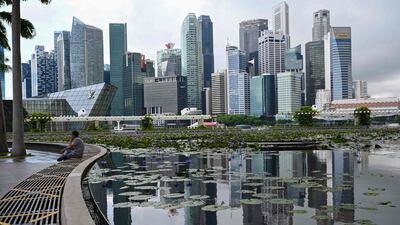
Singapore was among countries that recorded the sharpest increases in debt-to-GDP ratios since the onset of the pandemic. Photo: AFP

Global debt declines for first time in 10 quarters, IIF says


Deepthi Nair
  • English
  • Arabic

Global debt declined for the first time in 10 quarters by $1.7 trillion to $289tn in the first three months of 2021, according to the Institute of International Finance.

However, despite the dip in the first quarter, total global debt is still up $30tn or 12 per cent since the end of 2019, and now stands at more than $288tn as countries grappling with widening fiscal deficits and the impact of Covid-19 on their economies continue to borrow amid low interest rates, the IIF said in its latest Global Debt Monitor.

The drop in debt was entirely driven by mature markets, where total debt dropped $2.3tn to below $203tn. However, debt in emerging markets rose slightly by $0.6tn in Q1 to a record high of more than $86tn, the IIF said.

“While near-term sovereign debt vulnerabilities in major emerging market economies have eased back to pre-pandemic levels, government revenues remain under pressure due to continued lockdowns,” the IIF said.

“With vaccination still relatively slow in many emerging markets, sovereigns with high borrowing needs risk having persistently high interest expenses relative to revenues and gross domestic product.”

Governments and central banks globally have provided more than $12tn in monetary and fiscal support since the outbreak of the Covid-19 pandemic. Interest rates have been cut and liquidity injections and asset purchases by central banks have helped prevent a financial meltdown. However, governments are still looking at widening fiscal deficits amid an uneven global economic recovery.

The ratio of global debt-to-GDP increased only one percentage in Q1 2021, to just over 360 per cent of GDP compared with a surge of 35 percentage points to over 355 per cent in 2020 the IIF said.

“With global bond issuance now back below pre-Covid-19 levels, debt ratios should dip slightly this year given the projected recovery in global economic activity,” the IIF said.

Greece, Singapore and Spain recorded the sharpest increases in debt-to-GDP ratios since the onset of the pandemic, though the pace slowed in the first quarter of 2021, the report said. Denmark, Slovenia, Estonia, Finland, Lithuania and the US were the only mature markets that recorded a decline in debt ratios in Q1, the IIF added.

While near-term sovereign debt vulnerabilities in major emerging market economies have eased back to pre-pandemic levels, government revenues remain under pressure due to continued lockdowns

Emerging government debt-to-GDP ratio surged from 52 per cent in the fourth quarter of 2019 to about 60 per cent in Q1 2021. However, the increase in government debt ratios has been sharper in mature markets to near 135 per cent of GDP from 110 per cent over the same period.

The IIF report said that pandemic-related spending increases and revenue losses have made debt service a greater burden for many emerging markets, including Philippines, South Africa, India, Indonesia and Turkey.

“For many EMs, much-needed improvements in domestic tax regimes could help boost revenue capacity. However, heightened political and social tensions as the pandemic wears on could limit governments’ willingness to deliver structural tax reforms, leaving many sovereigns more reliant on domestic and international debt markets,” according to the Global Debt Monitor.

The financial sector accounted for nearly half of the decline in debt levels in mature markets in the first quarter this year, with household and non-financial corporate debt also declining slightly, according to the IIF. In contrast, mature market government debt continued to increase, but at its slowest pace since Q4 2018, the report added.

Meanwhile, the increase in debt in emerging markets was driven by the private sector. With EM government debt stable, the non-financial corporate and financial sectors have been the main drivers of the debt build-up, the IIF added.

Emerging markets are also under increasing pressure to accelerate the transition to a low-carbon economy.

“Failure to reduce reliance on carbon-intensive activities could add to upward pressure on EM government borrowing costs by reducing investor appetite for EM assets,” the IIF report said.

“On the flip side, improvements in climate change resilience should help EM sovereigns to tap international debt markets at more favourable rates.”


Islamophobia definition

A widely accepted definition was made by the All Party Parliamentary Group on British Muslims in 2019: “Islamophobia is rooted in racism and is a type of racism that targets expressions of Muslimness or perceived Muslimness.” It further defines it as “inciting hatred or violence against Muslims”.

THE BIO:

Favourite holiday destination: Thailand. I go every year and I’m obsessed with the fitness camps there.

Favourite book: Born to Run by Christopher McDougall. It’s an amazing story about barefoot running.

Favourite film: A League of their Own. I used to love watching it in my granny’s house when I was seven.

Personal motto: Believe it and you can achieve it.

Key facilities
  • Olympic-size swimming pool with a split bulkhead for multi-use configurations, including water polo and 50m/25m training lanes
  • Premier League-standard football pitch
  • 400m Olympic running track
  • NBA-spec basketball court with auditorium
  • 600-seat auditorium
  • Spaces for historical and cultural exploration
  • An elevated football field that doubles as a helipad
  • Specialist robotics and science laboratories
  • AR and VR-enabled learning centres
  • Disruption Lab and Research Centre for developing entrepreneurial skills
Multitasking pays off for money goals

Tackling money goals one at a time cost financial literacy expert Barbara O'Neill at least $1 million.

That's how much Ms O'Neill, a distinguished professor at Rutgers University in the US, figures she lost by starting saving for retirement only after she had created an emergency fund, bought a car with cash and purchased a home.

"I tell students that eventually, 30 years later, I hit the million-dollar mark, but I could've had $2 million," Ms O'Neill says.

Too often, financial experts say, people want to attack their money goals one at a time: "As soon as I pay off my credit card debt, then I'll start saving for a home," or, "As soon as I pay off my student loan debt, then I'll start saving for retirement"."

People do not realise how costly the words "as soon as" can be. Paying off debt is a worthy goal, but it should not come at the expense of other goals, particularly saving for retirement. The sooner money is contributed, the longer it can benefit from compounded returns. Compounded returns are when your investment gains earn their own gains, which can dramatically increase your balances over time.

"By putting off saving for the future, you are really inhibiting yourself from benefiting from that wonderful magic," says Kimberly Zimmerman Rand , an accredited financial counsellor and principal at Dragonfly Financial Solutions in Boston. "If you can start saving today ... you are going to have a lot more five years from now than if you decide to pay off debt for three years and start saving in year four."

T10 Cricket League
Sharjah Cricket Stadium
December 14- 17
6pm, Opening ceremony, followed by:
Bengal Tigers v Kerala Kings 
Maratha Arabians v Pakhtoons
Tickets available online at q-tickets.com/t10

360Vuz PROFILE

Date started: January 2017
Founder: Khaled Zaatarah 
Based: Dubai and Los Angeles
Sector: Technology 
Size: 21 employees
Funding: $7 million 
Investors: Shorooq Partners, KBW Ventures, Vision Ventures, Hala Ventures, 500Startups, Plug and Play, Magnus Olsson, Samih Toukan, Jonathan Labin

Blue%20Beetle
%3Cp%3E%3Cstrong%3EDirector%3A%3C%2Fstrong%3E%20Angel%20Manuel%20Soto%3Cbr%3E%3Cstrong%3EStars%3A%20%3C%2Fstrong%3EXolo%20Mariduena%2C%20Adriana%20Barraza%2C%20Damian%20Alcazar%2C%20Raoul%20Max%20Trujillo%2C%20Susan%20Sarandon%2C%20George%20Lopez%3Cbr%3E%3Cstrong%3ERating%3A%20%3C%2Fstrong%3E4%2F5%C2%A0%3C%2Fp%3E%0A

Mercer, the investment consulting arm of US services company Marsh & McLennan, expects its wealth division to at least double its assets under management (AUM) in the Middle East as wealth in the region continues to grow despite economic headwinds, a company official said.

Mercer Wealth, which globally has $160 billion in AUM, plans to boost its AUM in the region to $2-$3bn in the next 2-3 years from the present $1bn, said Yasir AbuShaban, a Dubai-based principal with Mercer Wealth.

Within the next two to three years, we are looking at reaching $2 to $3 billion as a conservative estimate and we do see an opportunity to do so,” said Mr AbuShaban.

Mercer does not directly make investments, but allocates clients’ money they have discretion to, to professional asset managers. They also provide advice to clients.

“We have buying power. We can negotiate on their (client’s) behalf with asset managers to provide them lower fees than they otherwise would have to get on their own,” he added.

Mercer Wealth’s clients include sovereign wealth funds, family offices, and insurance companies among others.

From its office in Dubai, Mercer also looks after Africa, India and Turkey, where they also see opportunity for growth.

Wealth creation in Middle East and Africa (MEA) grew 8.5 per cent to $8.1 trillion last year from $7.5tn in 2015, higher than last year’s global average of 6 per cent and the second-highest growth in a region after Asia-Pacific which grew 9.9 per cent, according to consultancy Boston Consulting Group (BCG). In the region, where wealth grew just 1.9 per cent in 2015 compared with 2014, a pickup in oil prices has helped in wealth generation.

BCG is forecasting MEA wealth will rise to $12tn by 2021, growing at an annual average of 8 per cent.

Drivers of wealth generation in the region will be split evenly between new wealth creation and growth of performance of existing assets, according to BCG.

Another general trend in the region is clients’ looking for a comprehensive approach to investing, according to Mr AbuShaban.

“Institutional investors or some of the families are seeing a slowdown in the available capital they have to invest and in that sense they are looking at optimizing the way they manage their portfolios and making sure they are not investing haphazardly and different parts of their investment are working together,” said Mr AbuShaban.

Some clients also have a higher appetite for risk, given the low interest-rate environment that does not provide enough yield for some institutional investors. These clients are keen to invest in illiquid assets, such as private equity and infrastructure.

“What we have seen is a desire for higher returns in what has been a low-return environment specifically in various fixed income or bonds,” he said.

“In this environment, we have seen a de facto increase in the risk that clients are taking in things like illiquid investments, private equity investments, infrastructure and private debt, those kind of investments were higher illiquidity results in incrementally higher returns.”

The Abu Dhabi Investment Authority, one of the largest sovereign wealth funds, said in its 2016 report that has gradually increased its exposure in direct private equity and private credit transactions, mainly in Asian markets and especially in China and India. The authority’s private equity department focused on structured equities owing to “their defensive characteristics.”

The Voice of Hind Rajab

Starring: Saja Kilani, Clara Khoury, Motaz Malhees

Director: Kaouther Ben Hania

Rating: 4/5

HIJRA

Starring: Lamar Faden, Khairiah Nathmy, Nawaf Al-Dhufairy

Director: Shahad Ameen

Rating: 3/5

Honeymoonish
%3Cp%3E%3Cstrong%3EDirector%3A%3C%2Fstrong%3E%20Elie%20El%20Samaan%3C%2Fp%3E%0A%3Cp%3E%3Cstrong%3EStarring%3A%20%3C%2Fstrong%3ENour%20Al%20Ghandour%2C%20Mahmoud%20Boushahri%3C%2Fp%3E%0A%3Cp%3E%3Cstrong%3ERating%3A%3C%2Fstrong%3E%203%2F5%3C%2Fp%3E%0A